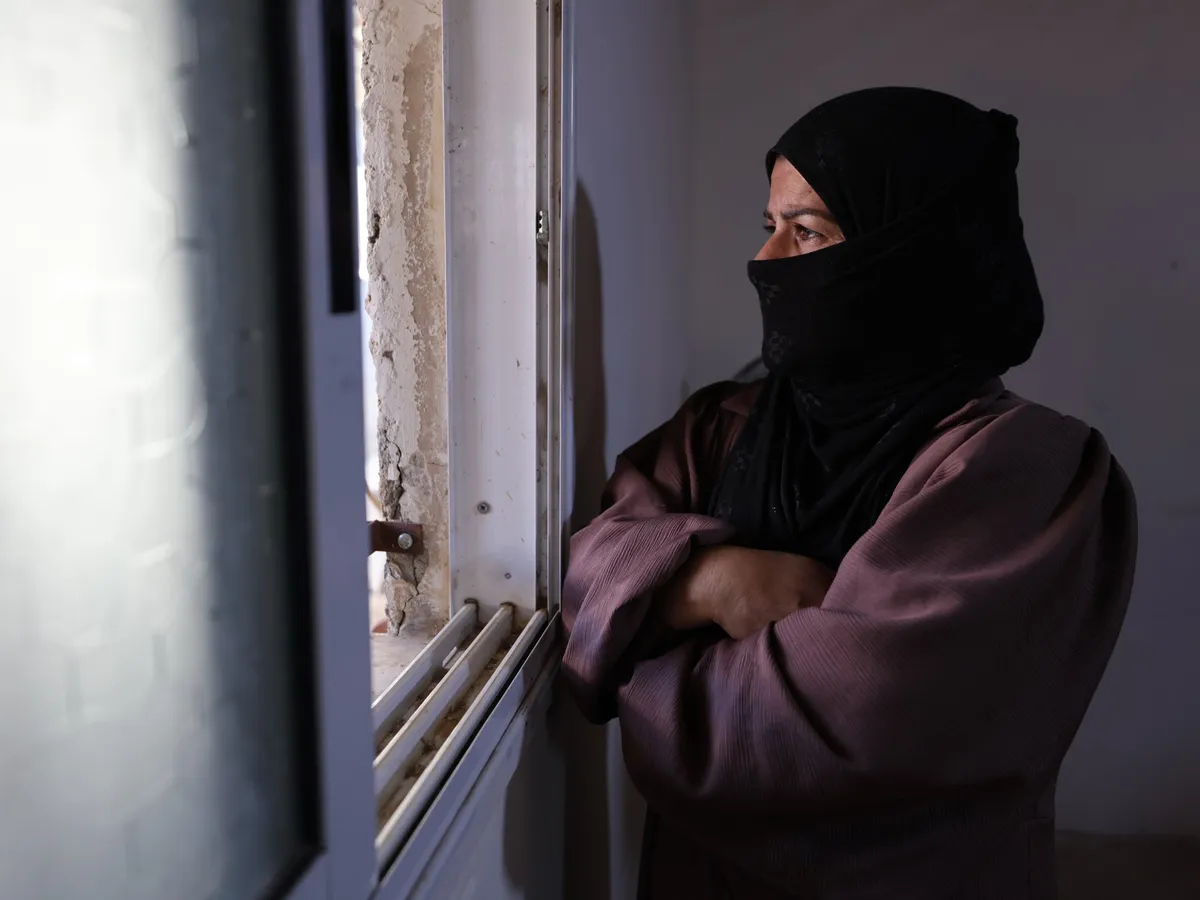
An illegal Israeli outpost set up next to Umm al-Khair in the West Bank, immediately separating villagers from their land.Ikhlas al-Hathaleen looks out of her window at the land she can't reach, thanks to the presence of Israeli settlers [Mosab Shawer/Al Jazeera]Published On 17 Jul 2026Umm al-Khair, occupied West Bank – The Palestinian villagers of Masafer Yatta, a collection of hamlets in the southern West Bank, feel Israel’s military and settlers closing in on them on a daily basis.In one of those villages, Umm al-Khair, the presence of a newly established illegal settlement outpost nearby is the latest evidence that they are being replaced in their own land.Recommended Stories list of 3 itemslist 1 of 3Church of England backs Palestinian Christians despite backlashlist 2 of 3Knesset dissolves: How will Israel vote in October’s general election?list 3 of 3How three Ivorian firms are competing with global brandsend of listSalem and Ikhlas al-Hathaleen live with their eight children in a modest home covered with sheet metal. The land around their home had been somewhere the family could use for agriculture and grazing. But the illegal outpost, an extension of the nearby settlement of Carmel established last September, was set up on that land, roughly 20 metres (66 feet) away from their house.Ikhlas explains that her old morning routine used to involve taking the family’s sheep out of their enclosure, providing them with food and water, milking them, and allowing them to graze.The tasks were simple – but that is no longer the case.Now, thanks to the new Israeli outpost, reaching the enclosure – which lies just behind the house – has become difficult, and at times, impossible.According to Ikhlas, the family was initially prevented for four consecutive days from reaching the livestock enclosure and then was only allowed to access it once, while accompanied by Israeli soldiers, in order to provide food and water for the animals. They were then prevented from accessing the enclosure for two days. This pattern of occasional visits interspersed with days of not being allowed to access the animals has continued, and Ikhlas says they have only been able to check on the animals three times in July.“I look every morning to see whether the sheep are still alive,” Ikhlas says. “I only wish I could reach them and take care of them like I used to.”Struggle for a bathroomIt is not just sheep enclosure that is a struggle to get to for the al-Hathaleen family.Even the family’s bathroom, which is a freestanding structure a few metres away from their home, has become difficult to reach.Ikhlas explains that settlers in early July placed obstacles near the bathroom, including barbed wire and children’s playground equipment, all in an effort to make access harder, particularly for children and the elderly.She adds that the situation has become more complicated since the Israeli army declared the area around the bathroom a closed military zone. As a result, the family – including the children, the youngest of whom is a year old – have been forced to use a neighbour’s toilet, despite the risks involved in reaching it.The route requires crossing a road used by settler vehicles, Ikhlas says, adding that her five-year-old daughter Swar was injured after being hit on the road last August.For Ikhlas, it is not just an issue of reaching a toilet or the family’s livestock, but about a family’s ability to live with dignity and have a normal life inside their own home.“We will not leave our land,” she says. “Even if we have to live in a tent or under a tree, we will stay here.”Settlers have attempted to block access to the al-Hathaleen’s outdoor bathroom [Mosab Shawer/Al Jazeera]Growing settlementsUmm al-Khair has faced an increasing tide of settler attacks since October 2023, when Israel’s genocidal war on Gaza began, as well as a simultaneous escalation in Israeli attacks in the occupied West Bank.Jewish settlers, seeking to capture more land from Palestinians in the West Bank, have become a particular menace, with little pushback from the Israeli state – and often encouragement, particularly in light of the presence of far-right settler leaders, such as Itamar Ben-Gvir and Bezalel Smotrich, in the highest ranks of government.Settlements continue to expand rapidly across the occupied West Bank and occupied East Jerusalem, making any hope for a Palestinian state on these lands increasingly remote.An Israeli court issued an order last October that the new illegal outpost next to Umm al-Khair be evacuated, but after the Israeli army did nothing to implement the order, it was cancelled.The local Palestinians have little ability to push back against the Israeli settlers – if they do, they are at risk of being attacked more forcefully by the settlers, who have weapons, or arrested by soldiers.Khalil al-Hathaleen, the head of Umm al-Khair’s village council, says that settlement expansion in the area has accelerated in recent years, including the establishment of the new illegal outpost, as well as the opening of roads for settlers, and expanding the areas under the control of existing settlements – all of which rely on expropriating Palestinian land.The extension of the illegal Israeli settlement of Carmel lies right next to Umm al-Khair [Mosab Shawer/Al Jazeera]Khalil explains that as a result, the number of livestock owned by Umm al-Khair’s residents has dropped from 3,000 to about 700, as a result of the difficult conditions facing herders and the growing challenges in accessing grazing areas.He adds that more than 1,000 olive trees have been cut in the area, 50,000 square metres (538,000sq feet) of agricultural land taken over, and demolition orders issued against 14 homes and structures.“For the people of Umm al-Khair, losing access to their land does not only mean losing property,” Khalil says. “It means losing an entire way of life that has existed for generations.”Hisham al-Sharbati, a researcher at the Jerusalem Legal Aid and Human Rights Center, says the organisation has been monitoring the situation in Umm al-Khair for years, and that challenges facing residents have intensified alongside settlement expansion in the area.“The humanitarian impact is visible in every detail of daily life – from difficulties accessing sources of income to restrictions affecting homes and basic facilities,” he says, adding that the actions of Israel and its settlers directly contravene international law.Khalil al-Hathaleen is the head of Umm al-Khair’s village council [Mosab Shawer/Al Jazeera]Children in fearAhmed al-Hathaleen, another resident of Umm al-Khair, works to track Israeli abuses in the village.“I have a special folder on my phone called ‘Umm al-Khair File’,” he says, adding that it contains about 1,500 video clips and 1,200 photographs that he has collected since April 2025.“Photography and video have become a way to tell our story and show people what is happening here,” he says.Ahmed, who is 31 years old, says that it is the children – and he has three of them – who are most affected by the situation, with some experiencing nightmares as a result of the surrounding environment.Sahm Khalil al-Hathaleen is one of those children. He says children in the community have lost much of their normal childhood, especially their right to education and safe spaces to play.The Palestinian children in Umm al-Khair say they’re fearful of the Israeli settlers [Mosab Shawer/Al Jazeera]The 12-year-old boy says that he just wants to go to school and play without fear, but that is impossible in the current situation they face.“The children here just want to live like other children,” he says.Sahm sees some of those other children living normal lives – the children from the nearby Israeli settlements. While they play, he describes being woken up in the middle of the night scared whenever he hears a sound outside.
SRCAl Jazeera
LANGEN
LEANCenter
WORDS1 275
ENT10
FRI · 2026-07-17 · 15:40 GMTBRIEF NSR-2026-0717-93841
NSR-2026-0717-93841News Report·EN·Human Rights
‘They took our toilet’: How a settlement has squeezed a Palestinian village
An illegal Israeli settlement outpost established near Umm al-Khair in the occupied West Bank has severely restricted Palestinian villagers' access to their land and essential facilities. The outpost, an extension of the Carmel settlement, was set up in September and is located just 20 meters from the al-Hathaleen family's home.
Mosab ShawerAl JazeeraFiled 2026-07-17 · 15:40 GMTLean · CenterRead · 6 min
Al JazeeraFIG 01
Reading time
6min
Word count
1 275words
Sources cited
1cited
Entities identified
10entities
Quality score
100%
§ 01
Briefing Summary
AI-generatedNEWSAR · AI
An illegal Israeli settlement outpost established near Umm al-Khair in the occupied West Bank has severely restricted Palestinian villagers' access to their land and essential facilities. The outpost, an extension of the Carmel settlement, was set up in September and is located just 20 meters from the al-Hathaleen family's home. This has prevented the family from reaching their livestock enclosure for days at a time and made their outdoor bathroom difficult to access due to settlers placing obstacles and the army declaring the area a closed military zone. Villagers are now forced to use a neighbor's toilet, risking injury on a road used by settler vehicles. The article states that settlement expansion has accelerated, with an Israeli court order to evacuate the outpost being canceled after the army failed to implement it.
Confidence 0.90Sources 1Claims 4Entities 10
§ 02
Article analysis
Model · rule-basedFraming
Human Rights
Social Justice
Tone
Mixed Tone
AI-assessed
CalmNeutralAlarmist
Factuality
0.60 / 1.00
Mixed
LowHigh
Sources cited
1
Limited
FewMany
§ 03
Key claims
4 extracted01
Settlers placed obstacles, including barbed wire and playground equipment, near the family's bathroom.
quoteIkhlas al-Hathaleen
Confidence
0.90
02
The al-Hathaleen family was prevented from accessing their livestock enclosure for extended periods.
quoteIkhlas al-Hathaleen
Confidence
0.90
03
An illegal Israeli outpost was set up next to Umm al-Khair, separating villagers from their land.
factual
Confidence
0.90
04
The area around the bathroom was declared a closed military zone by the Israeli army.
factual
Confidence
0.80
§ 04
Full report
6 min read · 1 275 words§ 05
Entities
10 identifiedKey playerOppositionContextPositiveNeutralNegative
Locations5
§ 06
Keywords & salience
10 termspalestinian village
1.00
israeli settlement outpost
1.00
occupied west bank
0.90
umm al-khair
0.80
masafer yatta
0.70
land access
0.70
settlers
0.60
agricultural land
0.50
livestock enclosure
0.50
illegal settlement
0.40
§ 07
Topic connections
Interactive graph Network visualization showing 51 related topics
View Full Graph Person Organization Location Event|Click node to navigate|Edge numbers = shared articles