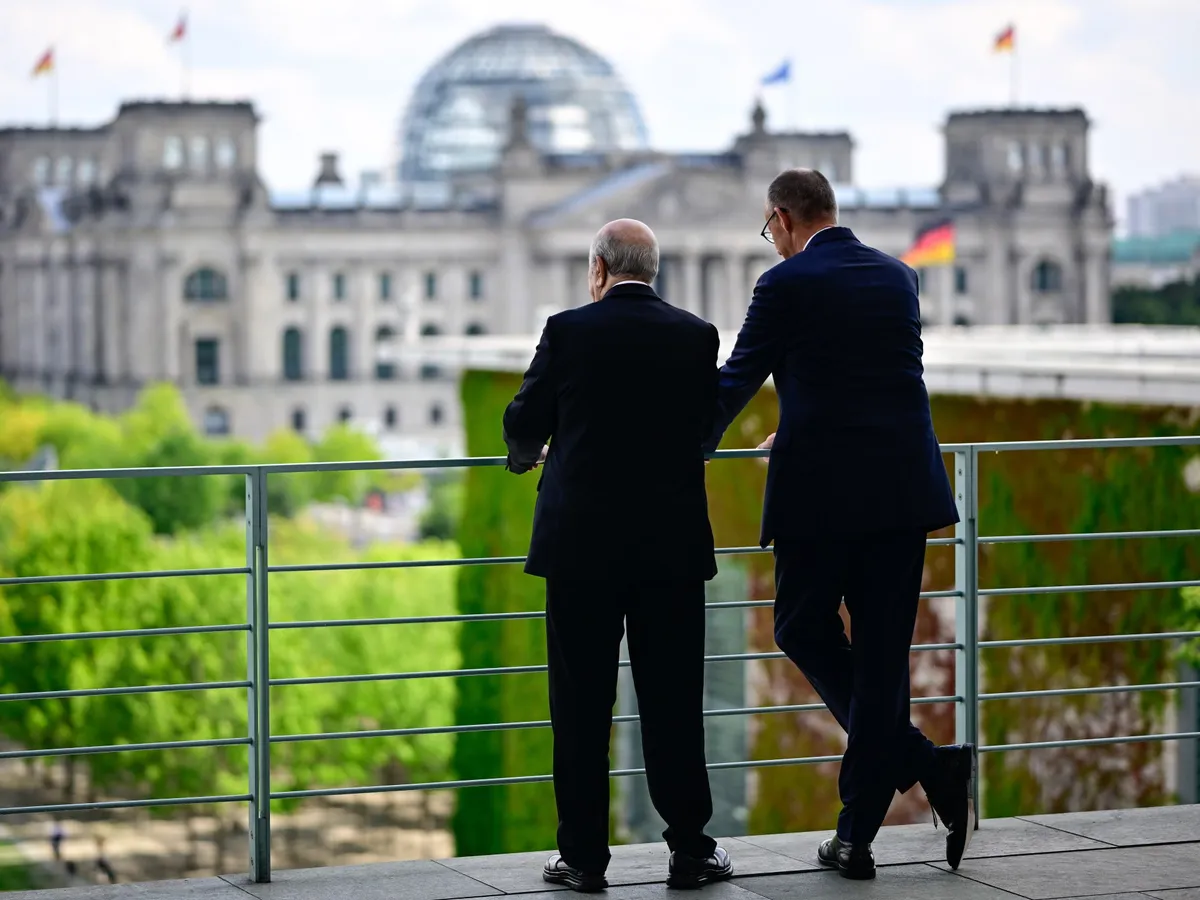
Germany, stripped of Russian pipeline gas, received Algeria’s president with military honours and talked about Hydrogen and Rare Earths as much as LNG.German Chancellor Friedrich Merz, right, and Algeria's President Abdelmadjid Tebboune talk on the terrace of the Chancellery, in Berlin, Thursday July 16, 2026 [Tobias Schwarz/Pool Photo via AP]Published On 17 Jul 2026Berlin, Germany – Algerian President Abdelmadjid Tebboune was welcomed with military honours at the historic Villa Borsig on Thursday, high above Lake Tegel, north of Berlin.Hours before the ceremony, he reminded a small group of guests, in French, just how far relations between the two countries had come.“Algeria and Germany were not in the same league,” he told the delegation about past Algerian-German relations, in remarks heard by Al Jazeera.The ceremony came two weeks before a tanker, the Tessala, landed at a floating terminal off Wilhelmshaven on Germany’s North Sea coast loaded with gas from the GL2Z liquefaction complex near Oran, Algeria.It was the first ever Liquefied Natural Gas export to Germany from Algeria’s state energy company, Sonatrach.President Frank-Walter Steinmeier’s invitation to Tebboune to visit Germany was part of a wider business and political outreach programme designed to bolster ties between the two countries.Thirty agreements were signed between German and Algerian companies at a bilateral economic forum in Berlin, including on hydrocarbons, renewables and energy transition, pharmaceuticals, manufacturing and advanced technology.Chancellor Friedrich Merz, who met Tebboune at the Chancellery on Thursday, said the visit had been marked by “a whole series of agreements” – including on legal, investment and transparency issues – between German and Algerian companies, and he wished to see further progress on this issue.On Wednesday, Tebboune addressed members of the Algerian community at the Hotel Adlon in Berlin, where he called Germany a great friend. He also revealed that the two countries had agreed to work together on green Hydrogen, gas, helium and car manufacturing industries.German Chancellor Friedrich Merz, left, and Algeria’s President Abdelmadjid Tebboune chat on the terrace of the Chancellery in Berlin on July 16, 2026, prior to bilateral talks [John MacDougall/AFP]Why Algeria, and why nowTebboune’s visit comes at a critical time for Europe, which has been desperately looking for new energy suppliers given the global tumult in recent years which has affected markets.Russia’s share of EU imports of pipeline gas has collapsed since the 2022 invasion of Ukraine, from about 40 percent in 2021 to approximately 6 percent last year.In January, the European Council adopted a regulation banning Russian LNG and pipeline gas outright from March 18, 2026, with transition periods for existing contracts.Algeria has helped make up some of this shortfall, with Norway now supplying 54.4 percent of the EU’s gaseous natural gas imports in 2025 and Algeria second at 18.5 percent. Algeria’s role appears to be increasing, with this share rising to 20 percent of EU pipeline imports in the first quarter of 2026.Merz has acknowledged this, saying that Algeria is playing “a very important contribution to Europe’s security of energy supply” and pointing out that the country also holds “significant raw-material deposits, among them natural gas, oil and Rare Earths”.Rare Earths are among the materials Europe has spent three years trying to source from outside China and Russia.Standing beside Merz on Thursday at a joint news conference at the Chancellery in Berlin, Tebboune offered words Germany must have wanted to hear.“We are careful to be a reliable supplier — we always meet our contractual delivery obligations,” he said, and promised that Algerian supplies would not only be destined for Germany, but all of Europe.This pledge comes at a critical time for Europe, with Qatari LNG exports disrupted by the US-Israel war on Iran, after Iranian attacks on shipping in the Strait of Hormuz.The Institute for Energy Economics and Financial Analysis (IEEFA) now forecasts that the United States will overtake Norway as the EU’s main gas supplier in 2026.Amid these difficulties, it is convenient that Algerian gas is able to directly reach Europe via a sub-Mediterranean pipeline.“Algeria is strategically central for Europe, above all for Germany, if it is to get its industry back on its feet in the next three to five years,” Michael Ayari, Algeria analyst at the International Crisis Group, told the Frankfurter Rundschau. “It could ramp up its gas deliveries and thereby compensate for the loss of Russian gas.”Algerian President Abdelmadjid Tebboune speaks during a joint news conference with German Chancellor Friedrich Merz, at the Chancellery in Berlin, Germany, July 16, 2026 [Nadja Wohlleben/Reuters]Behind that sits the Trans-Saharan pipeline, a line stretching approximately 4,000km (2,500 miles) and intended to carry up to 30 billion cubic metres (1.06 trillion cubic feet) of Nigerian gas a year across Niger and Algeria to Europe.Sonatrach began welding its own 1,210km (752 miles) section of this pipeline in June, which will feed into the national grid and Hassi R’Mel, northern Algeria, Africa’s largest gasfield.The Hydrogen corridorHydrogen, considered a cleaner energy source than LNG, became a prominent part of the news conference. Both Tebboune and Merz returned to the issue of the Southern Hydrogen Corridor, a 3,300km (2050 miles) dedicated Hydrogen pipeline linking North Africa to Italy, Austria and Germany. It is recognised as a Project of Common Interest under the EU’s TEN-E regulation, which should speed up the approval of permits and access to money from the Connecting Europe Facility. Design capacity, according to the project’s promoters, is 4 million tonnes of green Hydrogen a year.Tebboune called it a pioneering project and thanked Germany for backing it, while Merz said Berlin would drive the corridor forward together with Italy.On January 21, 2025, Algeria, Tunisia, Italy, Austria and Germany signed a Joint Declaration of Political Intent in Rome, at a ministerial attended by European Commission representatives and the EU body now lists the corridor as a “Team Europe initiative” under its Global Gateway strategy.Transmission operators have begun feasibility studies. The pipeline would carry Hydrogen produced in Algeria, the corridor’s main production hub, through neighbouring Tunisia and across the Mediterranean to Italy, Austria and Germany, with initial work under way on the Algerian and Tunisian sections.The corridor has political backing at the highest level, underlined by Merz’s support on Thursday, and strong interest from industrial customers along the route. What it still needs are binding offtake agreements, the long-term purchase contracts that would allow investment decisions to move forward.“On the Algerian side, the expectation is that Germany now sends clear signals that green Hydrogen produced in Algeria will actually be bought,” Oliver Blank, managing director of the German-Algerian Chamber of Industry and Commerce in Algiers, told ARD. No German company has yet signed an offtake agreement for Algerian Hydrogen.The question he would not answerOne name went unmentioned in the opening statements. Christophe Gleizes, the French freelance sport journalist and contributor to the magazines So Foot and Society. He was arrested in Tizi Ouzou in May 2024 while reporting on the football club JS Kabylie and convicted of glorifying “terrorism” over alleged contacts with the Movement for the Self-Determination of Kabylie.He was sentenced to seven years in June 2025, and an appeals court upheld the sentence on December 3. Reporters Without Borders, a press freedom NGO, describes him as the only French journalist currently imprisoned anywhere in the world.When a German reporter asked Tebboune about appeals for clemency from Gleizes’s supporters, asking the president to pardon the journalist, he gave a firm but not dismissive response.“Out of respect for the Algerian judicial system, I will not answer this question except on Algerian soil,” he replied. “I am now in Germany, not in Algeria.”Cases of this kind have moved between Algiers and Berlin before, including the issue of detained Franco-Algerian novelist Boualem Sansal. He was pardoned on humanitarian grounds in November 2025 following a German request and flown to Berlin for treatment.Merz closed the news conference with condolences for the children killed in an orphanage fire in Dar El Beida, outside Algiers, on the eve of the visit.
SRCAl Jazeera
LANGEN
LEANCenter
WORDS1 314
ENT12
FRI · 2026-07-17 · 18:28 GMTBRIEF NSR-2026-0717-93856
NSR-2026-0717-93856News Report·EN·Diplomatic
Beyond LNG: Berlin’s red-carpet diplomacy signals a bigger bet on Algeria
Algerian President Abdelmadjid Tebboune visited Berlin, Germany, on July 16, 2026, receiving military honors and engaging in high-level discussions with Chancellor Friedrich Merz. This visit signifies Germany's intensified diplomatic and economic outreach to Algeria, particularly in the wake of reduced Russian gas supplies.
Al JazeeraFiled 2026-07-17 · 18:28 GMTLean · CenterRead · 6 min
Al JazeeraFIG 01
Reading time
6min
Word count
1 314words
Sources cited
3cited
Entities identified
12entities
Quality score
100%
§ 01
Briefing Summary
AI-generatedNEWSAR · AI
Algerian President Abdelmadjid Tebboune visited Berlin, Germany, on July 16, 2026, receiving military honors and engaging in high-level discussions with Chancellor Friedrich Merz. This visit signifies Germany's intensified diplomatic and economic outreach to Algeria, particularly in the wake of reduced Russian gas supplies. Thirty agreements were signed between German and Algerian companies across various sectors, including hydrocarbons, renewables, and advanced technology. Algeria is increasingly becoming a crucial energy supplier for Europe, with its liquefied natural gas (LNG) now reaching Germany. Beyond energy, the two nations agreed to collaborate on green hydrogen, helium, and car manufacturing. The strategic importance of Algeria for Europe's energy security and industrial recovery was highlighted, with discussions also touching upon rare earth minerals.
Confidence 0.90Sources 3Claims 5Entities 12
§ 02
Article analysis
Model · rule-basedFraming
Diplomatic
Economic Impact
Tone
Measured
AI-assessed
CalmNeutralAlarmist
Factuality
0.80 / 1.00
Factual
LowHigh
Sources cited
3
Well sourced
FewMany
§ 03
Key claims
5 extracted01
Germany and Algeria agreed to work together on green hydrogen, gas, helium, and car manufacturing industries.
quotePresident Abdelmadjid Tebboune
Confidence
1.00
02
Germany is seeking new energy suppliers due to the collapse of Russian pipeline gas imports to the EU.
factual
Confidence
1.00
03
Thirty agreements were signed between German and Algerian companies at a bilateral economic forum in Berlin.
factual
Confidence
1.00
04
The first ever liquefied natural gas export from Algeria's Sonatrach to Germany arrived on the tanker Tessala.
factual
Confidence
1.00
05
Algeria's President Abdelmadjid Tebboune was welcomed with military honours at the Villa Borsig in Berlin.
factual
Confidence
1.00
§ 04
Full report
6 min read · 1 314 words§ 05
Entities
12 identifiedKey playerOppositionContextPositiveNeutralNegative
People3
Locations6
§ 06
Keywords & salience
8 termsalgeria-germany relations
1.00
energy security
0.90
liquefied natural gas (lng)
0.80
green hydrogen
0.70
rare earths
0.60
energy transition
0.50
economic cooperation
0.50
diplomacy
0.40
§ 07
Topic connections
Interactive graph Network visualization showing 51 related topics
View Full Graph Person Organization Location Event|Click node to navigate|Edge numbers = shared articles