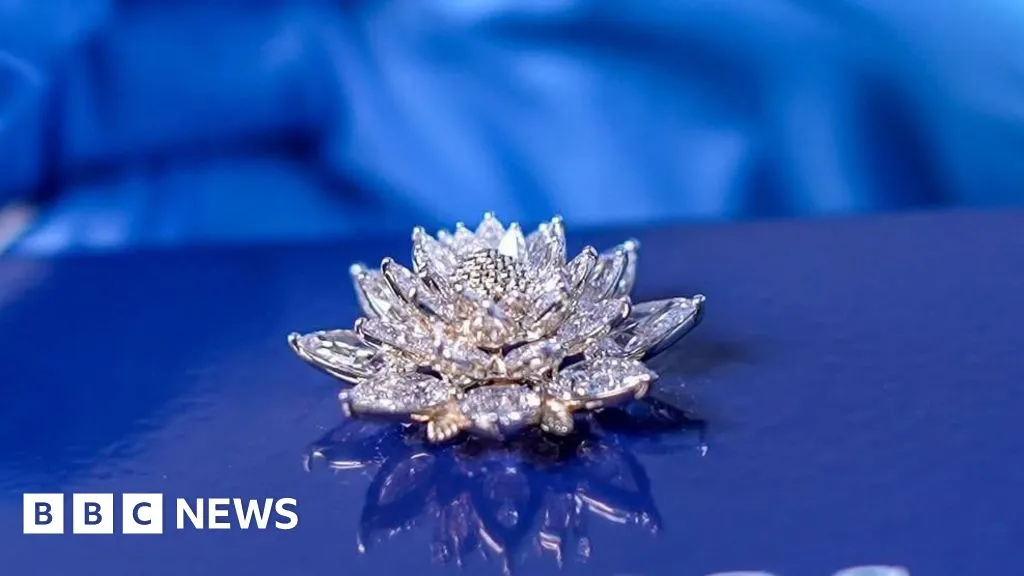
Diamonds and 'cab to orbit': The rocket aiming to transform India's space ambitionsSkyroot AerospaceVikram-1 is set to take off from the Indian Space Research Organisation's launch facility in Sriharikota on SaturdayWhat if launching a satellite was as easy as calling a cab? That's the vision behind an Indian private rocket company that will attempt its first orbital launch on Saturday.Skyroot Aerospace, which recently became India's first space tech unicorn after reaching $1.1bn valuation, is all set to launch Vikram-1 from the Indian Space Research Organisation's (Isro) launch facility in Sriharikota in southern India.The seven-storey rocket, set for lift-off at 11:30 India time [06:00 GMT], will be headed for the Low Earth Orbit which is 280 miles (450km) away.If the 16-minute flight succeeds, Skyroot will become the first Indian private company to launch a rocket into orbit, making India only the third country, after the US and China, with a private company capable of orbital launches.A successful Vikram-1 launch will take Skyroot closer to its goal of offering what it calls a "cab service to space", where companies can hire a rocket "to ride to a unique location in the orbit to place a satellite or visit a space station".Skyroot AerospaceA diamond lotus is among Vikram-1's payloadsThe rocket - named after Vikram Sarabhai, who is called the father of India's space programme - is small and has the capacity to carry payloads of up to 350kg, Skyroot co-founder and CEO Pawan Kumar Chandana told the BBC.Chandana says today, access to space remains "a major bottleneck, with satellite operators often waiting for months or even years for a launch opportunity" and that their venture expects to change that.He says Skyroot aims to cut long waits for satellite launches by offering dedicated missions for small payloads. Instead of sharing space on large rockets that fly on fixed schedules, customers can book a launch tailored to their satellite and its required orbit - much like taking a taxi instead of waiting for a train."If you want to just go to a friend's house, you don't need a train, you book a cab, an Uber. What we are offering is a cab service to space, which can be used to ride to a unique location in the orbit to place a satellite or visit a station."If successful, Skyroot's model would appear similar to that of Rocket Lab in the US, which provides small-lift launch vehicles. If all goes to plan, the Indian test launch mission called Aagman - Sanskrit for arrival - will place into orbit six payloads. They include scientific instruments such as a robotic arm for removing space debris, an Earth observation camera and satellites, including one from a German company. But they also include two symbolic payloads which have generated a buzz in India. One is a lotus made of lab-grown diamonds and a tiny gold rocket with micro-sculptures of three of India's best-known scientists.Each smaller than a grain of rice, the sculptures pays tribute to Nobel Prize-winning physicist CV Raman and aerospace engineer and former Indian president APJ Abdul Kalam, besides Sarabhai. "We exist because of the Indian space programme, we stand on the shoulders of our early visionaries and this is our way of paying tribute to three great scientists who shaped India's space programme," Chandana explained.He said the diamond lotus - called Cosmic Bloom and developed by Cosmos Diamonds - is an artist's tribute to space and celebrates India's creativity. It is expected to remind us all of the line "like a diamond in the sky" - from the popular nursery rhyme Twinkle, Twinkle.Skyroot AerospaceThe payloads include scientific instruments such as a robotic arm for removing space debrisSaturday's launch is the first of two test flights Skyroot plan to do this year before they launch commercially next year."We have the capacity to build one rocket every month at our factory in the southern city of Hyderabad," Chandana said. "This will be a historic flight for the private space sector in India. It'll be a major milestone," he added.It's fingers crossed for him at the moment though - SpaceX succeeded in its fourth attempt, he says.Skyroot came into being in 2018 when Chandana and Naga Bharath Daka - who were colleagues at Isro - quit their jobs and co-founded the space-tech start-up to build rocket components for satellites.In 2020, India opened the space sector to private firms, allowing them to build rockets and satellites and use Isro's launch facilities with the aim of increasing the country's share in the global business market from 2% at present to 10% by 2030. Since then, the Indian government says more than 400 space start-ups have been set up in India, but Skyroot remains the most successful of them - and the only unicorn in the sector. The company first made headlines in November 2022 when it launched India's first privately developed suborbital rocket.All eyes are now on Saturday's launch, which comes at a time when India's space programme has been in focus following Isro's historic Moon, Mars and solar missions in recent years. India plans to send astronauts into space next year, an orbiter to Venus by 2028 and build its own space station by 2035. And Skyroot's cab service could also cater to Isro's space programmes, but Chandana says that "70-80% of our market would be the global economy"."These would include satellites supporting services that millions rely on every day, from agriculture and fisheries to disaster management, communications, connectivity, navigation and national security. So, the economic opportunity is huge."
SRCBBC News - World
LANGEN
LEANCenter
WORDS917
ENT11
SAT · 2026-07-18 · 07:05 GMTBRIEF NSR-2026-0718-93954
NSR-2026-0718-93954News Report·EN·Technology
Space start-up launches India’s first commercial rocket designed for orbit
Skyroot Aerospace, India's first space-tech unicorn, launched its Vikram-1 rocket on Saturday from ISRO's facility in Sriharikota. This marks India's first commercial orbital rocket launch by a private company, aiming to provide a "cab service to space" for satellite deployment.
7 hours agoShareSaveAdd as preferred on GoogleGeeta PandeyBBC Correspondent, DelhiBBC News - WorldFiled 2026-07-18 · 07:05 GMTLean · CenterRead · 4 min
BBC News - WorldFIG 01
Reading time
4min
Word count
917words
Sources cited
2cited
Entities identified
11entities
Quality score
100%
§ 01
Briefing Summary
AI-generatedNEWSAR · AI
Skyroot Aerospace, India's first space-tech unicorn, launched its Vikram-1 rocket on Saturday from ISRO's facility in Sriharikota. This marks India's first commercial orbital rocket launch by a private company, aiming to provide a "cab service to space" for satellite deployment. The seven-story rocket, named after India's space program pioneer Vikram Sarabhai, is designed to carry payloads up to 350kg to Low Earth Orbit. If successful, Skyroot will join the US and China as countries with private companies capable of orbital launches. The mission, named Aagman, carries six payloads including scientific instruments and symbolic items like a diamond lotus. This launch is a significant step towards Skyroot's goal of reducing wait times for satellite launches and increasing India's share in the global space market.
Confidence 0.90Sources 2Claims 5Entities 11
§ 02
Article analysis
Model · rule-basedFraming
Technology
Human Interest
Tone
Mixed Tone
AI-assessed
CalmNeutralAlarmist
Factuality
0.70 / 1.00
Factual
LowHigh
Sources cited
2
Limited
FewMany
§ 03
Key claims
5 extracted01
The Vikram-1 rocket has a capacity to carry payloads of up to 350kg.
quotePawan Kumar Chandana
Confidence
1.00
02
Skyroot aims to offer a 'cab service to space' for companies to hire rockets for satellite launches.
quoteSkyroot Aerospace
Confidence
1.00
03
The Vikram-1 rocket is set to launch from ISRO's facility in Sriharikota.
factual
Confidence
1.00
04
Skyroot Aerospace is launching India's first commercial rocket designed for orbit, Vikram-1.
factual
Confidence
1.00
05
If successful, Skyroot will be the first Indian private company to launch a rocket into orbit.
prediction
Confidence
0.90
§ 04
Full report
4 min read · 917 words§ 05
Entities
11 identifiedKey playerOppositionContextPositiveNeutralNegative
Organizations3
Locations4
§ 06
Keywords & salience
10 termscommercial rocket launch
1.00
orbital launch
0.90
skyroot aerospace
0.90
india's space ambitions
0.80
vikram-1
0.70
private space company
0.60
space tech unicorn
0.60
satellite launches
0.50
low earth orbit
0.50
cab service to space
0.40
§ 07
Topic connections
Interactive graph No topic relationship data available yet. This graph will appear once topic relationships have been computed.