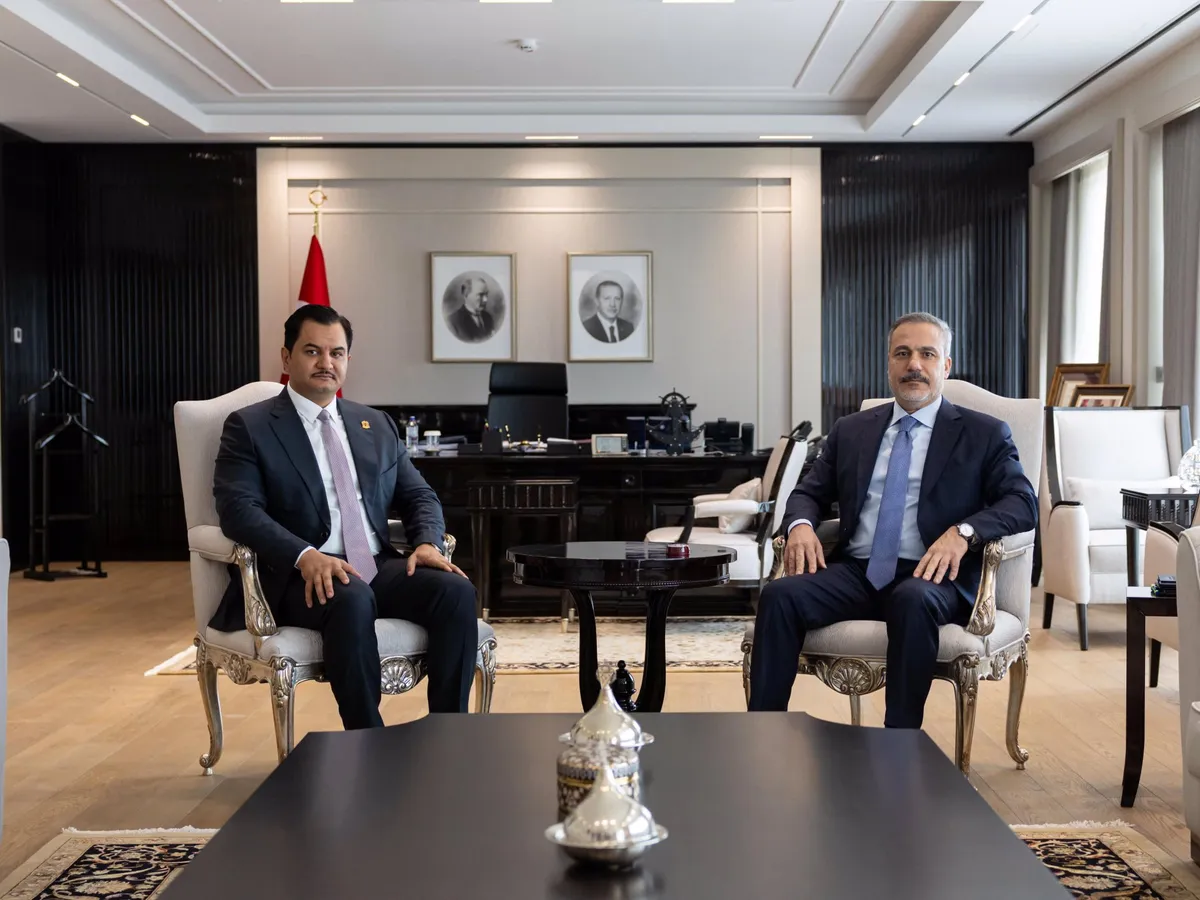
Turkiye is expanding its military cooperation with eastern Libyan forces, raising questions about Egypt’s strategic red lines and regional security.Turkiye's Minister of Foreign Affairs Hakan Fidan, right, meets with Libyan National Army Deputy Commander General Saddam Haftar in Ankara [Handout/Turkish Ministry of Foreign Affairs]Published On 20 Jul 2026After years of being the primary backer of the internationally recognised government in Tripoli, Turkiye is now rapidly expanding its military footprint to a rival authority in eastern Libya.This strategic shift has seen Ankara move from dialogue with the eastern-based General Command of renegade military commander Khalifa Haftar to tangible technical and military cooperation with his self-styled Libyan National Army (LNA).The LNA, long believed to have been supported by Egypt and other regional powers, has since the start of the Libyan civil war in 2014 been in conflict with forces loyal to the Tripoli-based Libyan government.This has led some to question whether Turkiye’s outreach to the eastern Libyan authorities could provoke anxiety in neighbouring Egypt, Haftar’s longtime backer.A Turkish military presence close to Libya’s eastern border, which Egypt has historically viewed as its geopolitical backyard, would habitually trigger alarm bells in Cairo.Exclusive information obtained by Al Jazeera, however, indicates that the current dynamic is now driven by a new era of unprecedented coordination between former regional rivals where Libya was a key point of contention.According to private sources, the rapprochement between Ankara and the General Command includes understandings on how to develop military facilities and advanced surveillance systems. The agreements also feature training programmes inside Turkiye for eastern Libyan officers, with specialised Turkish defence companies participating in these projects.A security source told Al Jazeera that Saddam Haftar, the deputy commander of the eastern forces, is spearheading this through regular meetings with Turkiye’s defence minister and chief of staff.While official statements vaguely refer to enhancing joint military cooperation and exchanging expertise, without explicitly mentioning the establishment of military bases or the deployment of drones, the reality reflects a deeper technical alignment between the two parties.Why Cairo is not sounding the alarmDespite the expanding Turkish presence in Egypt’s traditional sphere of influence, Cairo is unexpectedly not expressing concern with the situation.An Egyptian source familiar with the bilateral relations told Al Jazeera that Ankara does not take a single step in Libya without prior coordination with Egypt, effectively neutralising any potential friction on this issue.Brigadier General Samir Ragheb, director of the Arab Foundation for Development Strategic Studies, told Al Jazeera that Egypt and Turkiye have reached their highest level of coordination across multiple fields, including military.In Sudan’s civil war, where Egypt and Turkiye back the army against the renegade Rapid Support Forces (RSF), the two countries are both aligned.Ragheb argues that Turkiye’s cooperation with Haftar’s camp might actually serve Cairo’s broader strategic goals to limit the LNA’s support for the RSF.Furthermore, Ragheb explains that Ankara’s engagement in the east fills a vacuum that might otherwise be exploited by other regional actors who threaten Cairo’s policies for the strategically significant Horn of Africa region.He also noted that potential Turkish bases in southern Libya – far from the Egyptian border – do not threaten Cairo and could even facilitate joint coordination to manage security threats in the volatile Sahel and Sahara regions.Egyptian Foreign Minister Badr Abdelatty, right, welcomes Turkish Foreign Minister Hakan Fidan, left, before a quadrilateral meeting at Tahrir Palace in Cairo, Egypt, June 21, 2026 [Mohamed Hossam/EPA]This eastern pivot is a move designed to secure Turkiye’s long-term geopolitical and economic interests, preserving its influence in Libya regardless of future political settlements between the government and eastern authorities.Sources suggest that a primary driver behind Turkiye’s outreach is its desire to secure eastern Libyan authorities’ acceptance of the 2019 maritime border agreement signed with the former Government of National Accord. Notably, Egypt has refrained from objecting to a maritime demarcation based on a Benghazi-Turkiye line, indicating a tacit understanding on the issue.However, there are still boundaries. Faisal Bualraiga, a Libyan national security expert, noted that while the current cooperation allows Haftar to diversify his alliances beyond Russia and the United Arab Emirates, it lacks a declared defensive agreement and has not yet evolved into a full strategic pact. He cautioned that any permanent Turkish military presence near the Egyptian or Algerian borders would likely cross a red line, inevitably increasing regional sensitivities.Ultimately, experts suggest the Libyan file is transitioning from an era of rigid polarisation to one of flexible partnerships, where Turkiye and Egypt are choosing pragmatism over proxy conflicts.
SRCAl Jazeera
LANGEN
LEANCenter
WORDS742
ENT12
MON · 2026-07-20 · 09:48 GMTBRIEF NSR-2026-0720-94368
NSR-2026-0720-94368Analysis·EN·Diplomatic
Turkiye and Libya’s Haftar are boosting military ties. Is Egypt worried?
Turkiye is expanding its military cooperation with eastern Libyan forces, specifically the Libyan National Army (LNA) led by General Saddam Haftar. This includes technical assistance, training programs, and development of military facilities and surveillance systems.
Al Jazeera StaffAl JazeeraFiled 2026-07-20 · 09:48 GMTLean · CenterRead · 3 min
Al JazeeraFIG 01
Reading time
3min
Word count
742words
Sources cited
3cited
Entities identified
12entities
Quality score
100%
§ 01
Briefing Summary
AI-generatedNEWSAR · AI
Turkiye is expanding its military cooperation with eastern Libyan forces, specifically the Libyan National Army (LNA) led by General Saddam Haftar. This includes technical assistance, training programs, and development of military facilities and surveillance systems. Despite this move into Egypt's traditional sphere of influence, Cairo is not expressing concern. Sources indicate this is due to prior coordination between Turkiye and Egypt, with both countries aligned on issues like the civil war in Sudan. Egypt may also see this cooperation as a way to counter other regional actors and fill a security vacuum. The expansion aims to secure Turkiye's long-term interests, including acceptance of its 2019 maritime border agreement with Libya. However, a permanent Turkish military presence near Egypt's border would likely be a red line.
Confidence 0.90Sources 3Claims 4Entities 12
§ 02
Article analysis
Model · rule-basedFraming
Diplomatic
National Security
Tone
Mixed Tone
AI-assessed
CalmNeutralAlarmist
Factuality
0.60 / 1.00
Mixed
LowHigh
Sources cited
3
Well sourced
FewMany
§ 03
Key claims
4 extracted01
Egypt and Turkiye have reached their highest level of coordination across multiple fields, including military.
factualBrigadier General Samir Ragheb
Confidence
0.90
02
Egypt is not expressing concern about the expanding Turkish presence in Libya due to prior coordination with Ankara.
factualEgyptian source familiar with bilateral relations
Confidence
0.90
03
Turkiye is expanding its military cooperation with eastern Libyan forces, including technical and military cooperation with the Libyan National Army (LNA).
factualAl Jazeera
Confidence
0.90
04
Agreements between Ankara and the General Command include developing military facilities, advanced surveillance systems, and training programs for Libyan officers.
factualprivate sources
Confidence
0.80
§ 04
Full report
3 min read · 742 words§ 05
Entities
12 identifiedKey playerOppositionContextPositiveNeutralNegative
People3
Locations6
§ 06
Keywords & salience
9 termsmilitary cooperation
1.00
libyan national army
0.90
egypt
0.80
turkiye
0.80
regional security
0.70
strategic shift
0.60
military footprint
0.50
surveillance systems
0.40
defence minister
0.40
§ 07
Topic connections
Interactive graph Network visualization showing 51 related topics
View Full Graph Person Organization Location Event|Click node to navigate|Edge numbers = shared articles