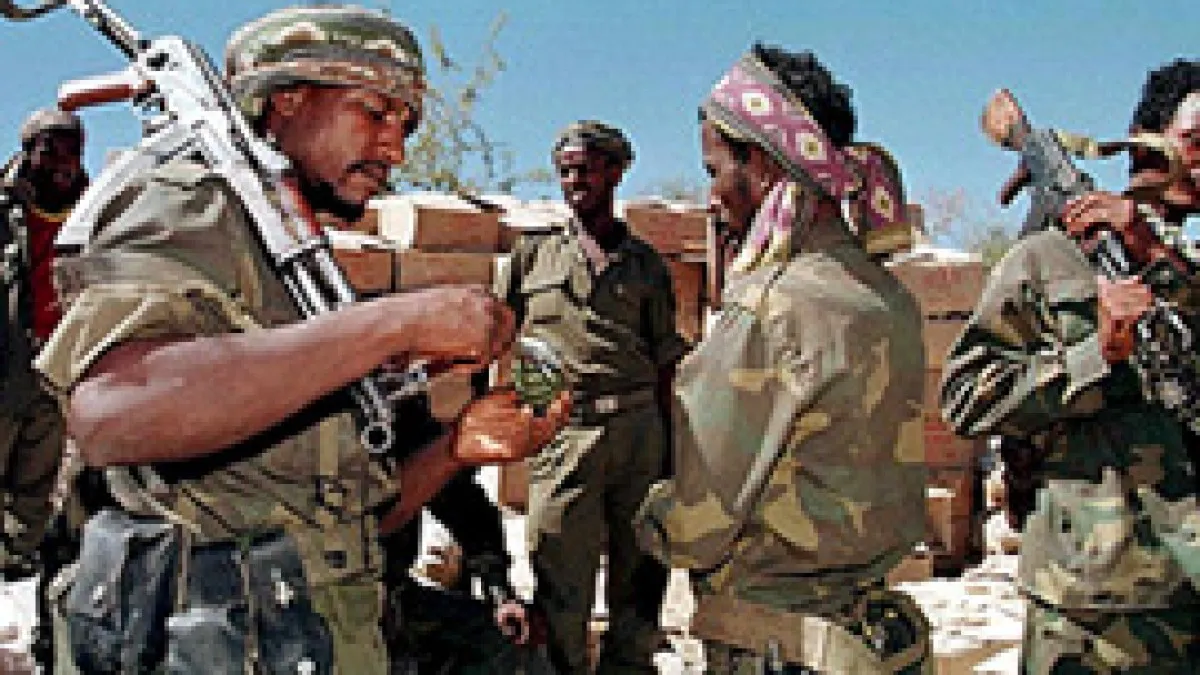
A series of diplomatic consultations in Cairo underscores the Horn of Africa’s growing strategic importance.Eritrean soldiers patrol near the country's border. Eritrea remains a key player in the Horn of Africa's evolving security landscape [POOL/ALEXANDER JOE/AFP]Published On 21 Jul 2026Cairo, Egypt – A series of diplomatic consultations in Cairo involving Egypt, Somalia, Eritrea and a senior US envoy reflects growing efforts to coordinate approaches to security challenges in the Horn of Africa and the Red Sea.The discussions come as Ethiopia’s maritime ambitions reshape regional politics, Red Sea shipping remains under pressure, and countries reassess old alliances and security partnerships.Few public details have emerged from the discussions. According to official statements, security in the Horn of Africa and the Red Sea region was at the centre of the agenda.That broad description reflects how issues once viewed separately, Ethiopia’s expanding regional role, maritime security and competition for influence, are becoming increasingly interconnected.The significance of the Cairo discussions lies less in what was said publicly than in the effort to coordinate diplomacy among Egypt, the United States and key Horn of Africa actors at a time of growing regional uncertainty.While the discussions appear to have included separate consultations rather than a single joint session, they nevertheless signalled a shared interest in coordinating approaches to regional security, Red Sea stability and broader geopolitical competition.For Egypt, however, much of that conversation still begins with Ethiopia.Egypt’s focus is moving beyond the NileThe Grand Ethiopian Renaissance Dam dispute has dominated Cairo’s relationship with Addis Ababa for years. But Egypt’s concerns now extend beyond water security.Ethiopia’s pursuit of maritime access, efforts to strengthen regional partnerships and its growing role in the Horn of Africa have become part of Cairo’s broader regional calculations.Cairo has long viewed developments involving Ethiopia through a national security lens. The Horn of Africa adds another dimension to that concern, particularly as competition over ports, coastlines and regional influence intensifies.For Egypt, the Red Sea is no longer only a shipping lane. It has become an extension of its broader security environment, where trade, maritime access and regional politics increasingly overlap.Developments there matter not only because of geography, but because of the importance of global maritime routes and the strategic role of the Suez Canal.Why Somalia is central to the conversationSomalia’s importance in this equation goes beyond its domestic challenges.Its location gives it a strategic position near the Bab el-Mandeb Strait and along major maritime routes. But its role in the current regional debate is also shaped by its dispute with Ethiopia over sovereignty and access to the sea.Ethiopia’s pursuit of maritime access has become one of the region’s most sensitive issues. Addis Ababa views greater access to the sea as an economic and strategic necessity, while Mogadishu has opposed moves it sees as undermining Somalia’s territorial integrity.The dispute has reshaped diplomatic engagement across the region. Somalia’s concerns have drawn it closer to Egypt and other regional actors closely watching Ethiopia’s expanding role.For Cairo, ties with Mogadishu provide an opportunity to strengthen its presence in a region where security partnerships are being reassessed.Eritrea’s strategic positionEritrea adds another layer of complexity to the regional equation.With a coastline on the Red Sea and a long, complicated relationship with Ethiopia, Eritrea remains an important actor in any discussion about regional security.Its interests do not always fully align with Egypt or Somalia, but its geography gives it strategic weight.For Cairo, maintaining ties with Eritrea and Somalia forms part of a broader effort to preserve influence in a region where access, security and political alignments are increasingly contested.Why Washington’s role mattersThe participation of a US envoy across the Cairo consultations added an international dimension to the discussions and underscored Washington’s continued interest in the Horn of Africa and Red Sea region.Following separate meetings in Cairo with Somali and Eritrean officials, US President’s Senior Adviser for Africa Massad Boulos said on X that he had discussed with Somalia’s foreign minister “important issues of security and stability in the Horn of Africa”, including ways to promote regional stability and Somalia’s domestic political dialogue.Following his meeting with Eritrean Foreign Minister Osman Saleh, Boulos said the two sides had explored opportunities to strengthen cooperation on trade, regional economic development and security, while underscoring the need to “work together constructively to address regional conflicts and advance lasting peace, stability, and prosperity in the Red Sea and the Horn of Africa.”For Washington, the Horn of Africa remains tied to familiar priorities: regional stability, counterterrorism and the security of one of the world’s busiest maritime routes. The Red Sea has become harder to ignore as disruptions to shipping and wider geopolitical tensions have drawn renewed international attention.Speaking to Al Jazeera, Mubarak Aliyu, a political and security risk analyst specialising in West Africa and the Sahel, said Egypt’s coordination with Washington reflects a recognition that regional crises can no longer be addressed separately.“Egypt’s coordination with the United States is an acknowledgment that crises in the Horn of Africa have become interconnected, demanding diplomacy that balances deterrence, regional partnerships and long-term stability.”Aliyu said the timing of the Cairo discussions suggests that Egypt is seeking to shape the evolving security order in the Horn of Africa rather than simply reacting to developments around it.Whether Washington is trying to build a broader diplomatic framework or simply prevent another regional crisis remains one of the key questions emerging from the Cairo consultations.The dam dispute remains unresolved, but no longer stands aloneDespite its importance to Egypt’s foreign policy, there is no indication that the Grand Ethiopian Renaissance Dam dispute produced new developments during the Cairo discussions.That does not make the issue any less important. Instead, it shows that Cairo’s concerns with Ethiopia are no longer confined to the Nile. The dam dispute now sits alongside broader questions about Ethiopia’s regional role, maritime ambitions and relationships with neighbouring countries.Sudan and the wider regional balanceAlthough Sudan was not publicly involved in the Cairo consultations, developments there remain central to Egypt’s broader regional security calculations.The conflict in Sudan continues to shape the strategic environment along the Red Sea and Egypt’s southern frontier, while its geographic position makes it an important factor in the wider balance of power in the Horn of Africa and Northeast Africa.There is no indication that Sudan featured directly in the Cairo discussions. Its significance lies in the broader regional context rather than the immediate diplomatic framework of the consultations.Cairo’s broader calculationThe Cairo discussions do not appear to mark the formation of a new regional bloc. Rather than signalling a formal alliance, they are better understood as a consultation framework among states whose interests increasingly intersect across the Horn of Africa and the Red Sea.Their significance lies in what they reveal about a changing regional environment. The Horn of Africa and the Red Sea are increasingly being viewed as a single strategic arena, where maritime access, political influence and security competition are becoming harder to separate.Speaking to Al Jazeera, Tegha King, secretary-general of the Universal Peace Federation (UPF) Ghana, acknowledged “Cairo’s diplomatic efforts to bring the United States and other international partners into dialogue on the Horn of Africa.”He argued, however, that durable peace would ultimately require “inclusive, AU-led cooperative frameworks that uphold the sovereign rights, security, and developmental aspirations of all Nile and Red Sea states.”For Aliyu, the Cairo discussions reflect Egypt’s determination not only to respond to regional developments but also to shape the emerging security order around the Horn of Africa and the Red Sea.But, he added, the success of that approach will ultimately depend on whether regional and international engagement strengthens cooperation rather than fuelling new rivalries.“The challenge is ensuring that external coordination reinforces African-led stability instead of deepening regional rivalries.”
SRCAl Jazeera
LANGEN
LEANCenter
WORDS1 271
ENT12
TUE · 2026-07-21 · 02:52 GMTBRIEF NSR-2026-0721-94562
NSR-2026-0721-94562Analysis·EN·Diplomatic
Who is driving diplomacy in the Horn of Africa and the Red Sea, and why?
Recent diplomatic consultations in Cairo involving Egypt, Somalia, Eritrea, and a senior US envoy highlight the growing strategic importance of the Horn of Africa and the Red Sea. These discussions underscore efforts to coordinate approaches to regional security challenges, driven by Ethiopia's maritime ambitions, ongoing Red Sea shipping pressures, and shifting alliances.
By Al Jazeera staffAl JazeeraFiled 2026-07-21 · 02:52 GMTLean · CenterRead · 6 min
Al JazeeraFIG 01
Reading time
6min
Word count
1 271words
Sources cited
0cited
Entities identified
12entities
Quality score
100%
§ 01
Briefing Summary
AI-generatedNEWSAR · AI
Recent diplomatic consultations in Cairo involving Egypt, Somalia, Eritrea, and a senior US envoy highlight the growing strategic importance of the Horn of Africa and the Red Sea. These discussions underscore efforts to coordinate approaches to regional security challenges, driven by Ethiopia's maritime ambitions, ongoing Red Sea shipping pressures, and shifting alliances. Egypt's concerns extend beyond the Nile to Ethiopia's regional role and maritime access, viewing the Red Sea as an extension of its security environment. Somalia's strategic location and its dispute with Ethiopia over maritime access make it central to these conversations, drawing it closer to Egypt. Eritrea's Red Sea coastline and relationship with Ethiopia also make it a key player. The US envoy's participation signals Washington's continued interest in regional stability and cooperation.
Confidence 0.90Claims 5Entities 12
§ 02
Article analysis
Model · rule-basedFraming
Diplomatic
National Security
Tone
Measured
AI-assessed
CalmNeutralAlarmist
Factuality
0.60 / 1.00
Mixed
LowHigh
Sources cited
0
No named sources
FewMany
§ 03
Key claims
5 extracted01
The Red Sea has become an extension of Egypt's broader security environment, where trade, maritime access, and regional politics overlap.
factual
Confidence
0.90
02
Somalia's strategic location near the Bab el-Mandeb Strait and along major maritime routes makes it central to regional security discussions.
factual
Confidence
0.90
03
Egypt's concerns extend beyond water security to Ethiopia's pursuit of maritime access and its growing regional role, viewed through a national security lens.
factual
Confidence
0.90
04
Diplomatic consultations in Cairo involving Egypt, Somalia, Eritrea, and a US envoy reflect efforts to coordinate approaches to security challenges in the Horn of Africa and the Red Sea.
factual
Confidence
0.90
05
Ethiopia’s maritime ambitions are reshaping regional politics, Red Sea shipping remains under pressure, and countries are reassessing alliances.
factual
Confidence
0.80
§ 04
Full report
6 min read · 1 271 words§ 05
Entities
12 identifiedKey playerOppositionContextPositiveNeutralNegative
Locations8
§ 06
Keywords & salience
10 termsred sea
1.00
horn of africa
1.00
diplomacy
0.90
security challenges
0.80
ethiopia
0.70
egypt
0.70
maritime ambitions
0.60
regional politics
0.50
geopolitical competition
0.50
united states
0.40
§ 07
Topic connections
Interactive graph No topic relationship data available yet. This graph will appear once topic relationships have been computed.