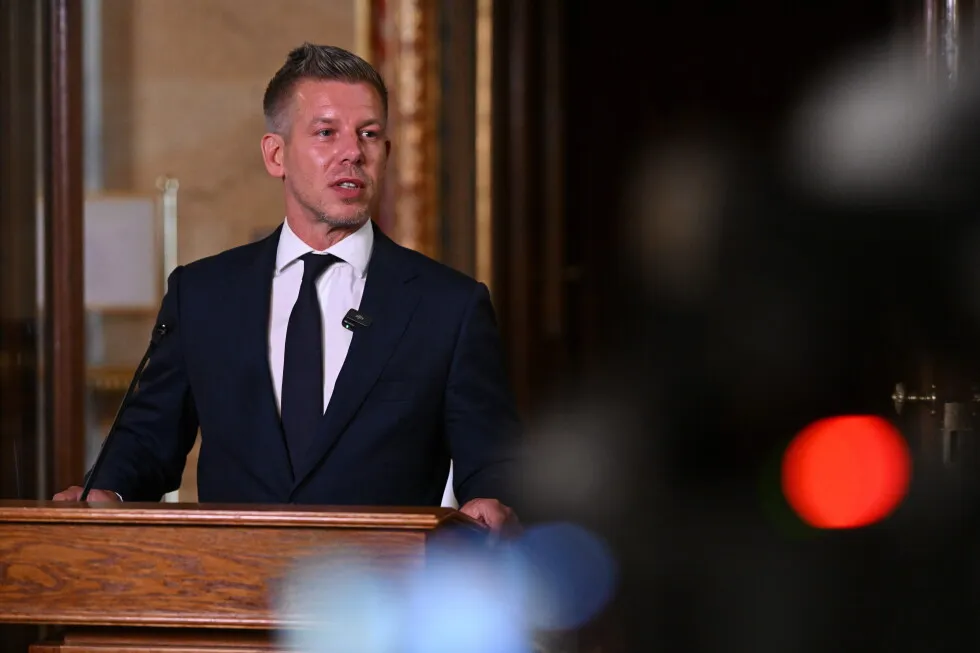
Hungary investigates deal with China’s BYD carmaker after ex-foreign minister takes job there 1 of 2 | Hungarian Prime Minister Peter Magyar holds an extraordinary press briefing following a voting on the 17th amendment to the Fundamental Law in the parliament building in Budapest, Hungary, Monday, July 13, 2026. (Tamas Purger/MTI via AP) 2 of 2 | The then-Hungarian Minister of Foreign Affairs and Trade Peter Szijjarto holds a press conference following a cabinet meeting in Budapest, Hungary, Wednesday, Feb. 18, 2026. (Boglarka Bodnar/MTI via AP, File) By JUSTIN SPIKE Updated 2:41 AM MESZ, July 21, 2026 Leer en español Add AP News on Google Add AP News as your preferred source to see more of our stories on Google. Share Share Facebook Copy Link copied Print Email X LinkedIn Bluesky Flipboard Pinterest Reddit Budapest, Hungary (AP) — Hungary’s government announced an investigation Monday into a large foreign investment by Chinese automaker BYD negotiated by a former foreign minister who last week resigned from Parliament to take an executive position at the company. Péter Szijjártó’s announcement last Wednesday that he would take the job at the world’s top electric carmaker prompted accusations of a conflict of interest and criticism over his role in facilitating substantial government subsidies to the company while in office. Prime Minister Péter Magyar told lawmakers on Monday that Szijjártó, a close ally of former Prime Minister Viktor Orbán, had helped BYD while he was in office “with hundreds of billions (of forints) in public money, diplomatic support and state infrastructure.” “We will examine all the decisions, negotiations and state commitments made by Péter Szijjártó that were related to the BYD Hungary investment,” Magyar said Monday. He added the investigation would look into all subsidies, tax breaks, permits, environmental exemptions and publicly-funded investments given to large multinational firms during Orbán’s tenure. “We will investigate who made these decisions, who prepared them, what professional warnings were ignored, and how much burden they left on Hungarian taxpayers, workers, local communities and the environment,” Magyar said. Hungary’s former foreign minister quits parliament for Chinese automaker BYD, sparking backlash 2 MIN READ 30 Tens of thousands march in the first Budapest Pride since Viktor Orbán was voted out 3 MIN READ Leaders of four Central European countries meet in Hungary to reboot regional group 3 MIN READ Neither Szijjártó nor BYD have responded to Magyar’s allegations of conflict of interest while Szijjártó was in office. The former foreign minister has posed his new job as a “prestigious” opportunity to work for one the “greatest success stories” in the automotive industry. While serving in government, Szijjártó was instrumental in securing foreign investments in Hungary from Chinese companies, including his now-employer BYD, which received considerable state subsidies during his tenure. In 2023, Szijjártó announced that BYD would open its first European factory in Hungary — allowing the conglomerate to skirt European Union import tariffs on Chinese electric vehicles imposed to protect the continent’s domestic auto manufacturing sector. In 2025, Szijjártó also announced BYD would locate its European headquarters and a research and development center in Budapest and receive 20 billion forints ($63.7 million) in government assistance. The investments were part of the Orbán government’s push to make Hungary a global hub of lithium-ion battery manufacturing, largely through attracting Chinese battery manufacturers who opened a series of plants across the country. The moves led local residents, environmentalists and opposition politicians to protest over fears the new industry would exacerbate existing environmental problems, hit the country’s precious water supplies and further undermine its economy to China. While foreign minister, Szijjártó also maintained close relations with Russia despite its full-scale invasion of Ukraine on Feb. 24, 2022. Breaking with nearly all of his EU counterparts, he frequently traveled to Moscow to negotiate agreements on purchasing Russian oil and gas and to meet with Russian Foreign Minister Sergey Lavrov, whom he referred to as his “friend.” He was embroiled in controversy during Hungary’s 2026 election campaign when the Washington Post reported that he made regular phone calls to Lavrov during high-level EU meetings with “live reports on what’s been discussed.” Szijjártó has dismissed the report while acknowledging that he conferred with Lavrov before and after EU foreign minister meetings about their agenda and decisions. During a government news conference last week, Magyar said that “as far as I know,” an investigation had been launched concerning Szijjártó’s connections to the Russian government. JUSTIN SPIKE Spike is an Associated Press reporter based in Budapest, Hungary. twitter mailto
SRCAssociated Press (AP)
LANGEN
LEANCenter
WORDS748
ENT10
TUE · 2026-07-21 · 10:53 GMTBRIEF NSR-2026-0721-94651
NSR-2026-0721-94651News Report·EN·Political Strategy
Hungary investigates deal with China’s BYD carmaker after ex-foreign minister takes job there
Hungary's government has launched an investigation into a significant investment deal with Chinese automaker BYD. This investigation follows the former Foreign Minister Péter Szijjártó's resignation from Parliament to accept an executive position at BYD.
Associated Press (AP)Filed 2026-07-21 · 10:53 GMTLean · CenterRead · 3 min
Associated Press (AP)FIG 01
Reading time
3min
Word count
748words
Sources cited
1cited
Entities identified
10entities
Quality score
100%
§ 01
Briefing Summary
AI-generatedNEWSAR · AI
Hungary's government has launched an investigation into a significant investment deal with Chinese automaker BYD. This investigation follows the former Foreign Minister Péter Szijjártó's resignation from Parliament to accept an executive position at BYD. Prime Minister Péter Magyar announced the probe, stating it will examine all decisions, negotiations, and state commitments made by Szijjártó concerning BYD's investment in Hungary, including subsidies and infrastructure support. The investigation aims to scrutinize decisions made during former Prime Minister Viktor Orbán's tenure regarding large multinational firms. Szijjártó was instrumental in securing investments from Chinese companies like BYD while in office, which included substantial government subsidies for BYD's European factory and headquarters in Hungary.
Confidence 0.90Sources 1Claims 5Entities 10
§ 02
Article analysis
Model · rule-basedFraming
Political Strategy
Economic Impact
Tone
Measured
AI-assessed
CalmNeutralAlarmist
Factuality
0.70 / 1.00
Factual
LowHigh
Sources cited
1
Limited
FewMany
§ 03
Key claims
5 extracted01
The investigation will examine all decisions, negotiations, and state commitments related to the BYD Hungary investment made by Szijjártó.
factualPéter Magyar
Confidence
1.00
02
Prime Minister Péter Magyar stated Szijjártó helped BYD with 'hundreds of billions (of forints) in public money, diplomatic support and state infrastructure' while in office.
quotePéter Magyar
Confidence
1.00
03
Former foreign minister Péter Szijjártó resigned from Parliament to take an executive position at BYD.
factualPéter Szijjártó
Confidence
1.00
04
Hungary's government announced an investigation into a large foreign investment by Chinese automaker BYD.
factualHungary's government
Confidence
1.00
05
Szijjártó's move prompted accusations of a conflict of interest and criticism over his role in facilitating government subsidies to BYD.
factualnull
Confidence
0.90
§ 04
Full report
3 min read · 748 words§ 05
Entities
10 identifiedKey playerOppositionContextPositiveNeutralNegative
People3
§ 06
Keywords & salience
10 termsforeign investment
0.90
government subsidies
0.80
conflict of interest
0.80
byd
0.70
electric carmaker
0.70
hungary
0.60
péter szijjártó
0.60
china
0.50
taxpayers
0.40
public money
0.40
§ 07
Topic connections
Interactive graph Network visualization showing 51 related topics
View Full Graph Person Organization Location Event|Click node to navigate|Edge numbers = shared articles