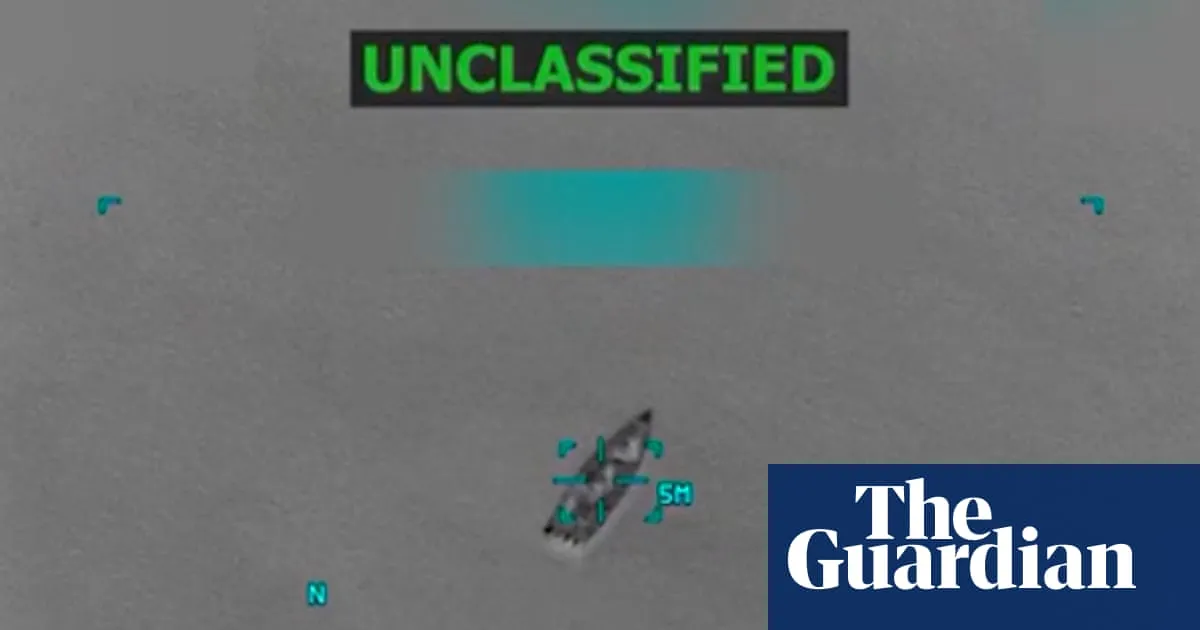
Graphic depictions of two survivors being killed by a second US military strike on an alleged Venezuelan drug ferrying boat have provoked outrage where previously there was none – or at least relatively little.A firestorm of controversy has greeted a recent Washington Post report which suggested that a deadly attack on a vessel carrying 11 people in the Caribbean was followed with a second assault after the initial strike failed to kill everybody onboard.Since September, the Trump administration has relentlessly targeted vessels in the Caribbean and Pacific suspected of being used by “narco-terrorists” to export illicit narcotics to the US – killing at least 81 people in more than 20 strikes.The administration has insisted the strikes are legal under the rules of war, arguing that the US is engaged in armed conflict with traffickers, whom it accuses of being in league with Venezuela’s autocratic president, Nicolás Maduro, to flood the US with illicit narcotics.The rationale has been widely rejected by most legal experts, who have pointed out that the US is not in conflict with an armed group involved in attacking its territory or its assets abroad.But only after the Washington Post reported that the first strike on 2 September was followed by a so-called “second tap” – allegedly to comply with an order from Pete Hegseth, the defence secretary, to “kill everybody” onboard – has the issue assumed wider resonance. The follow-up strike reportedly killed two survivors clinging to the side of the vessel.Amid speculation that a war crime or even murder may have been committed, the Republican-led armed service committees in the Senate and House of Representatives – until now, acquiescent to the demands of Donald Trump – have vowed to investigate.Fuelling the urgency, say legal analysts, are suspicions that the strikes violate long-established laws of warfare, even if the White House’s highly contentious claims that it is at war are accepted.Greater piquancy is added by the allegation that the strike occurred in compliance with an order from Hegseth. Days before the Post’s report, the defence secretary threatened to recall Mark Kelly, a Democratic senator, to active military duty to face court martial for his role in a video, created with fellow Democrats, advising service personnel that they have a right to disobey illegal orders.“Even if we buy into their framing that the individuals on these vessels are combatants, it would still be unlawful to kill them if they are hors de combat, which means they’re incapacitated,” said Rebecca Ingber, a professor at Cardozo law school and a former legal adviser to the state department.“It is manifestly unlawful to kill someone who’s been shipwrecked. This is such a longstanding textbook principle of the law of armed conflict.”The prohibition is made explicit in the Pentagon’s own Law of War manual.“Members of the armed forces and other persons … who are wounded, sick, or shipwrecked, shall be respected and protected in all circumstances,” it says. “Such persons are among the categories of persons placed hors de combat; making them the object of attack is strictly prohibited.”Significantly – given the allegation that the second strike was conducted in accordance with Hegseth’s order to kill everyone onboard – the manual also addresses the question of illegal orders.“The requirement to refuse to comply with orders to commit law of war violations applies to orders to perform conduct that is clearly illegal or orders that the subordinate knows, in fact, are illegal,” it states, citing as an example orders to “fire upon the shipwrecked”.The statutory compulsion to resist clearly illegal orders are bolstered by the 1950 Nuremberg principles – adopted after the allied tribunals that tried Nazi war criminals after the second world war. The principle lays down that an individual carrying out illegal instructions on behalf of a superior is not absolved of responsibility under international law.US law also rejects the principle of superior orders as a defence under a precedent established in the prosecution of the former army lieutenant William Calley, who was convicted for his role in the notorious My Lai massacre during the Vietnam war.The rules are enshrined under the Uniform Code of Military Justice, the legal system governing the US armed forces.The administration has offered a mix of caveats. While Trump has distanced himself from the second strike – telling journalists he would not have wanted it to be carried out – Hegseth has denied ordering the killing of survivors.Administration officials have gone further by suggesting that Adm Frank Bradley, the commander in charge of the operation, had not been trying to kill survivors but was instead targeting the disabled vessel and the drugs it presumably carried.Such an explanation could complicate matters, analysts say, but still rebound on the administration by intensifying scrutiny over the legality of the boat strikes.Geoffrey Corn, director of the Center for Military Law at Texas Tech University and a former senior adviser to the US army on warfare law, said it also raised questions over why the survivors could not be rescued first before sinking the vessel – as reportedly happened after at least one subsequent strike.“I think the first question for the admiral is: what was your target on the second strike? Was it the boat, or was it the crew members?” said Corn.“If it’s the crew, you have a real problem, because that’s simply improper. If the boat was your alleged military necessity for the second strike, why did you have to do it while they were clinging to the side? Why couldn’t you have intervened to save them?” he said.Corn compared the action of sinking the boat to two naval vessels doing battle, saying the analogy illustrated why the actions against the alleged trafficking vessels did not qualify as an armed conflict, as the administration insists.“If one of them is struck multiple times, which means, inevitably, there are wounded and sick or wounded enemy sailors on that ship and it continues to fight, you don’t stop fighting back because of the potential harm to the wounded sailors,” he said.“This is the crux of the problem. You’re treating a criminal menace as a wartime menace, and the rule doesn’t fit in that situation. With an enemy warship, there are ways to know that it’s done – it stops firing, or it strikes its colors. But how does that apply to a drug boat?”A possible answer to that question emerged on Thursday as Bradley prepared to go to Capitol Hill along with Dan Caine, the chairman of the joint chiefs of staff, to address senators in a behind-closed-doors session. The New York Times reported that Bradley ordered the second strike after one of the two survivors was seen radioing suspected cartel members for help.The paper reported that Hegseth had approved a contingency plan for what to do if the first strike left survivors. If they were shipwrecked and “out of the fight”, US forces would help them. But if they took potentially hostile action such as communicating with fellow smugglers, attempts would be made to kill them.The explanation seemed to raise the possibility of any investigation getting bogged down in complex detail.Brian Finucane, senior adviser of the International Crisis Group and a former state department legal adviser, said the focus on the second strike risked obscuring the flimsy legal case for the boat strikes.“There’s a risk here of losing sight of the forest for the tree, because the broader campaign is really problematic,” he said.“The strike, and the attack itself, is likely unlawful regardless of the precise details, because there is no armed conflict. Without an armed conflict, you don’t have a law of war apply with either its permission structure to conduct lethal attacks, or its relevant prohibitions and criminal penalties. My concern is if there is [congressional] oversight, it may be myopic and narrowly focused on the details of this specific strike, which would be a mistake.”Corn urged the Senate to direct a series of specific questions at Bradley.“They need to ask him: What was the order you received? What exactly did Hegseth tell you to do? Did he make that statement about ‘kill them all’? Did he make it before the first strike or before the second strike? What was the target you were attacking? What was the weapons package you used? Why did it have to be attacked at that moment? Why were you indifferent to the plight of the shipwrecked crew members?” he said.“If we saw an enemy do this to a couple of our sailors, I think we would be outraged.”
SRCThe Guardian - World News
LANGEN
LEANCenter-Left
WORDS1 414
ENT3
THU · 2025-12-04 · 12:00 GMTBRIEF NSR-2025-1204-947
NSR-2025-1204-947News Report·EN·Legal & Judicial
Killing of survivors sparks outrage – but entire US ‘drug boat’ war is legally shaky
A recent report alleging a second US military strike that killed survivors of an initial attack on a Venezuelan drug-ferrying boat in the Caribbean has sparked outrage and investigations. Since September, the Trump administration has conducted over 20 strikes against vessels suspected of narcotics trafficking, resulting in at least 81 deaths.
Robert Tait in WashingtonThe Guardian - World NewsFiled 2025-12-04 · 12:00 GMTLean · Center-LeftRead · 6 min
The Guardian - World NewsFIG 01
Reading time
6min
Word count
1 414words
Sources cited
2cited
Entities identified
3entities
Quality score
100%
§ 01
Briefing Summary
AI-generatedNEWSAR · AI
A recent report alleging a second US military strike that killed survivors of an initial attack on a Venezuelan drug-ferrying boat in the Caribbean has sparked outrage and investigations. Since September, the Trump administration has conducted over 20 strikes against vessels suspected of narcotics trafficking, resulting in at least 81 deaths. The administration claims these actions are legal under the rules of war, arguing the US is in armed conflict with traffickers linked to Venezuelan President Maduro. However, legal experts widely reject this rationale. The controversy intensified after reports indicated a follow-up strike occurred, allegedly under orders to eliminate all onboard, raising concerns about potential war crimes and prompting investigations by Republican-led armed service committees. The legality of the strikes is now under scrutiny, even if the administration's claim of being at war is accepted.
Confidence 0.90Sources 2Claims 5Entities 3
§ 02
Article analysis
Model · rule-basedFraming
Legal & Judicial
Human Rights
Tone
Mixed Tone
AI-assessed
CalmNeutralAlarmist
Factuality
0.70 / 1.00
Factual
LowHigh
Sources cited
2
Limited
FewMany
§ 03
Key claims
5 extracted01
It is manifestly unlawful to kill someone who’s been shipwrecked.
quoteRebecca Ingber, professor at Cardozo law school
Confidence
1.00
02
The administration insists the strikes are legal under the rules of war.
quoteTrump administration
Confidence
1.00
03
Since September, the Trump administration has targeted vessels suspected of being used by “narco-terrorists”.
factualnull
Confidence
1.00
04
A second US military strike killed two survivors on an alleged Venezuelan drug ferrying boat.
factualWashington Post report
Confidence
0.90
05
The rationale has been widely rejected by most legal experts.
factualnull
Confidence
0.80
§ 04
Full report
6 min read · 1 414 words§ 05
Entities
3 identifiedKey playerOppositionContextPositiveNeutralNegative
Locations1
§ 06
Keywords & salience
9 termsdrug boat war
0.90
military strike
0.80
rules of war
0.70
war crime
0.70
laws of warfare
0.60
illicit narcotics
0.60
pete hegseth
0.50
armed conflict
0.50
venezuela
0.50
§ 07
Topic connections
Interactive graph Network visualization showing 51 related topics
View Full Graph Person Organization Location Event|Click node to navigate|Edge numbers = shared articles