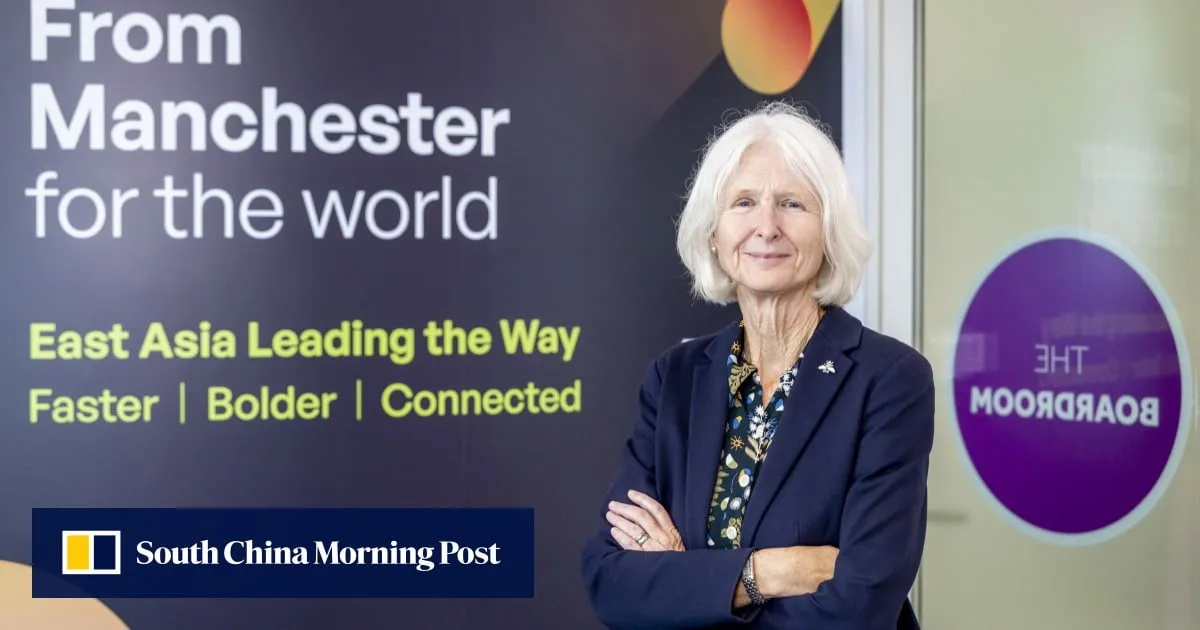
[The content of this article has been produced by our advertising partner.]When Professor Fiona Devine returned to Hong Kong this year, it was her first visit since 2019. Since then, both the city and the global higher education landscape have changed significantly.Now Vice-President and Dean of the Faculty of Humanities at the University of Manchester, and formerly head of Alliance Manchester Business School for a decade, Professor Devine arrived in a region shaped by post-pandemic recovery, regional integration and the rise of Artificial Intelligence. Her message to Hong Kong’s executives and educators is clear: the future belongs to holistic leaders who can bridge business acumen, human understanding and technological fluency.“Universities want to keep the world open,” she said.Since Devine’s last trip, Hong Kong has reasserted itself within the fast-developing Greater Bay Area. Visits to Shenzhen and neighbouring cities underscored for her the scale and youth of the region, with an average age in the early 30s and a population in the tens of millions.“Every time I come back… it always looks amazing,” she said.While she acknowledged that post-Covid recovery has been uneven globally, she contrasted the UK’s sluggish growth with the continued dynamism of mainland China and Hong Kong. She also noted the intensifying competition for global talent, which universities and cities alike must now navigate.From Global MBA to Borderless HubsManchester’s Hong Kong centre was originally built around one flagship offering: the Global MBA. Today, it forms part of a digitally connected international network spanning Hong Kong, Singapore, Shanghai and Dubai. In Hong Kong, this flagship programme is delivered on a part-time basis, specifically designed to fit the schedules of busy working professionals.“Once upon a time the international centers were very much focused on really one programme,” Professor Devine said. “Now we do more in transnational education.”Hybrid delivery, blended learning and cross-border collaboration are now structural necessities. In Professor Devine’s vision, future students may be physically based in Manchester while enrolled in programmes delivered partly through Hong Kong, and vice versa.“In 10 years’ time, those boundaries will have disappeared,” she said.Breaking SilosProfessor Devine’s own career mirrors the institutional shift she describes. After 10 years leading AMBS, she stepped into the role of Dean of Humanities, a move that might seem unconventional in a world that often separates business from the arts and social sciences.“My background is as a professor of sociology,” she explained. “Humanities brings that human-centered, people-focused perspective.”For her, the transition was not a departure from business but an expansion of its lens. She argues that modern corporate leadership must grapple with geopolitics, social change, cultural complexity and environmental pressures.In Hong Kong, where executives operate amid global supply chains, ESG expectations and technological disruption, that interdisciplinary awareness is increasingly critical.“We talk about our students being socially responsible leaders,” she said.Manchester 2035These themes are embedded in the University’s new institutional roadmap, “Manchester 2035,” launched under President Duncan Ivison.“This is the first time the university has had a 10-year strategy,” Professor Devine said.Universities face mounting pressures: financial constraints, demographic shifts, global competition and digital disruption. Academic excellence alone is no longer enough.“Academic success is the baseline,” she observed.Those “other things” include employability, partner-enabled learning, academic advising and student support. They also include alignment with student values, particularly around sustainability and social responsibility.“The younger generation are very preoccupied with environmental sustainability and climate change,” she noted.Central to the 2035 strategy is “Becoming One University,” aimed at breaking down internal silos and creating a more integrated, digitally enhanced institution capable of supporting lifelong learners across geographies.Professor Devine sees the first degree not as a culmination but as an entry point. As careers evolve, professionals will return for short courses, executive programmes and new credentials.AI Through a Human LensNo conversation about the future of education can ignore Artificial Intelligence. Manchester has already partnered with Microsoft to provide AI tools, including Co-pilot, to staff and students. But Professor Devine cautions against technological determinism.“There’s huge amounts of excitement… but also fear and trepidation,” she acknowledged.Rather than policing AI use, the university has focused on guidelines and responsible integration. The real emphasis, she argues, must remain on critical thinking.“You don’t just take the information it gives you at face value.”From the Faculty of Humanities’ recent conference on AI in higher education to panel discussions in Hong Kong, the recurring theme has been the distinction between learning and leading. AI can process data and generate insights, but leadership involves values, judgment and lived experience.“Leadership is about setting the tone and expectations,” she said.Questions around digital twins, AI agents and consent, she added, are not merely technical. They are ethical and social, precisely the domain of humanities scholarship.Beyond the Ivory TowerUltimately, Devine returns to a simple principle: usefulness.“In terms of impact, there is nothing wrong with being useful,” she said. “We’re not an ivory tower.”For Hong Kong’s executives navigating regional integration, technological disruption and rising societal expectations, Manchester’s proposition is not simply a degree. It is a philosophy: tomorrow’s leaders must combine business expertise with human insight and technological literacy.In a world of algorithms and accelerating change, Devine’s argument is that wisdom, grounded in values and social understanding, remains the ultimate competitive advantage.Registration No. 250144. It is a matter of discretion of individual employers to recognise any qualification to which this course may lead.
SRCSouth China Morning Post
LANGEN
LEANCenter-Right
WORDS875
ENT12
TUE · 2026-07-21 · 16:00 GMTBRIEF NSR-2026-0721-94756
NSR-2026-0721-94756Analysis·EN·Economic Impact
Rethinking Leadership for a Changing World
Professor Fiona Devine, Vice-President and Dean of the Faculty of Humanities at the University of Manchester, recently returned to Hong Kong after a significant period of change in both the city and global higher education. She advocates for a new model of leadership that integrates business acumen, human understanding, and technological fluency, particularly relevant in Hong Kong's post-pandemic recovery and the rise of AI.
Advertising partnerSouth China Morning PostFiled 2026-07-21 · 16:00 GMTLean · Center-RightRead · 4 min
South China Morning PostFIG 01
Reading time
4min
Word count
875words
Sources cited
1cited
Entities identified
12entities
Quality score
100%
§ 01
Briefing Summary
AI-generatedNEWSAR · AI
Professor Fiona Devine, Vice-President and Dean of the Faculty of Humanities at the University of Manchester, recently returned to Hong Kong after a significant period of change in both the city and global higher education. She advocates for a new model of leadership that integrates business acumen, human understanding, and technological fluency, particularly relevant in Hong Kong's post-pandemic recovery and the rise of AI. Devine highlights the University of Manchester's shift towards transnational education and breaking down institutional silos, exemplified by its "Manchester 2035" roadmap. This strategy emphasizes employability, student support, and alignment with values like sustainability, while also focusing on the responsible integration of AI through critical thinking.
Confidence 0.90Sources 1Claims 5Entities 12
§ 02
Article analysis
Model · rule-basedFraming
Economic Impact
Technology
Tone
Measured
AI-assessed
CalmNeutralAlarmist
Factuality
0.60 / 1.00
Mixed
LowHigh
Sources cited
1
Limited
FewMany
§ 03
Key claims
5 extracted01
Universities want to keep the world open.
quoteProfessor Fiona Devine
Confidence
1.00
02
Modern corporate leadership must grapple with geopolitics, social change, cultural complexity, and environmental pressures.
quoteProfessor Fiona Devine
Confidence
1.00
03
The future belongs to holistic leaders who can bridge business acumen, human understanding, and technological fluency.
quoteProfessor Fiona Devine
Confidence
1.00
04
Hybrid delivery, blended learning, and cross-border collaboration are now structural necessities for transnational education.
factual
Confidence
0.90
05
Hong Kong has reasserted itself within the fast-developing Greater Bay Area.
factual
Confidence
0.90
§ 04
Full report
4 min read · 875 words§ 05
Entities
12 identifiedKey playerOppositionContextPositiveNeutralNegative
Organizations2
Locations6
§ 06
Keywords & salience
10 termsholistic leadership
1.00
higher education
0.90
artificial intelligence
0.80
changing world
0.70
global talent
0.70
transnational education
0.60
post-pandemic recovery
0.50
greater bay area
0.50
hybrid delivery
0.40
business acumen
0.40
§ 07
Topic connections
Interactive graph No topic relationship data available yet. This graph will appear once topic relationships have been computed.