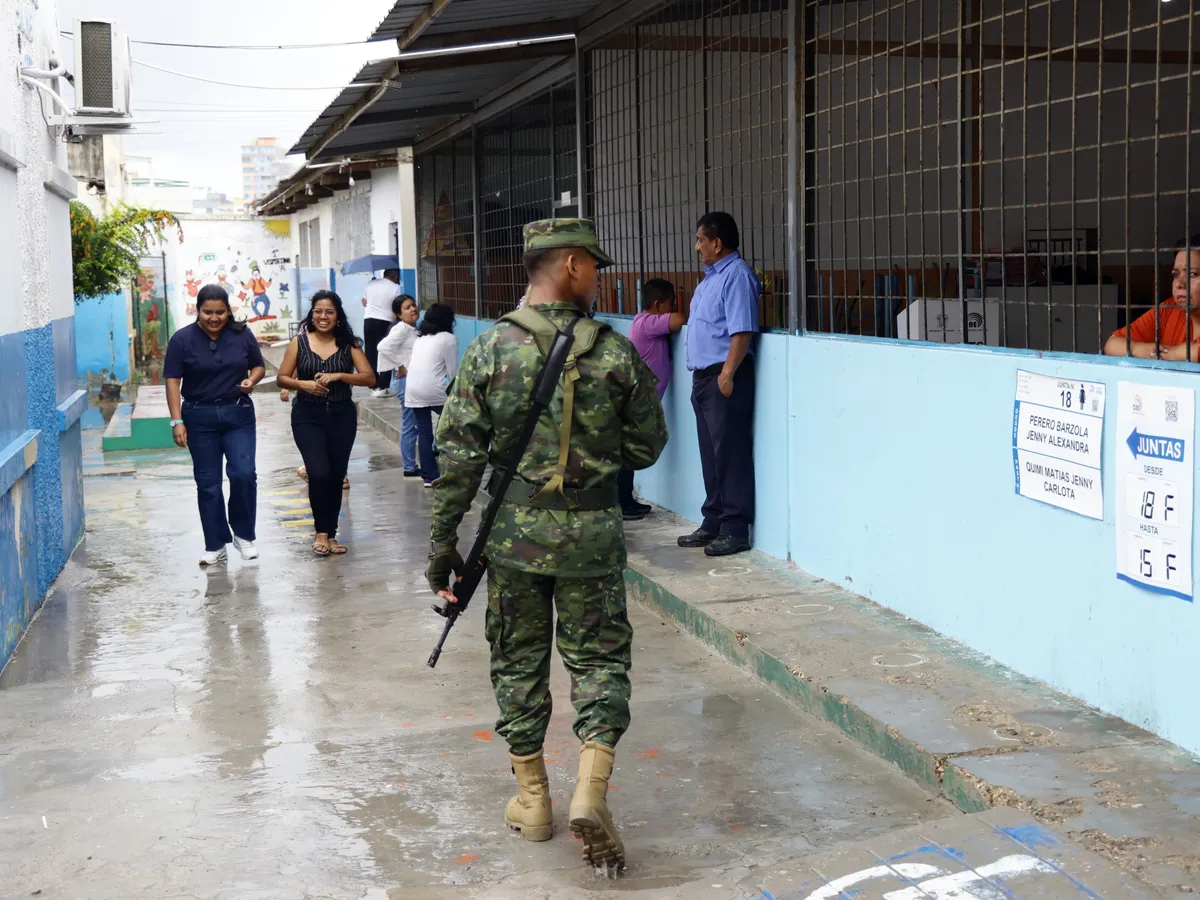
Report presents evidence that civilian farmers and fisherman were caught up in anti-drug crime operations from January to March.A member of Ecuador's military is seen patrolling a polling station during the February presidential election in Salinas, Ecuador [Franklin Jacome/Getty]Published On 21 Jul 2026Civilians in Ecuador faced attacks and abuses as part of a joint Ecuador-military-campaign" class="entity-link entity-event" data-entity-id="168887" data-entity-type="event">US-Ecuador military campaign meant to target organised crime in the country, according to a new report from Human Rights Watch (HRW).The rights group on Tuesday called on the US Congress to assert greater oversight over the administration of US President Donald Trump’s militaristic approach to crime in Latin America, and particularly its “perilous” partnership with Ecuador, which has seen Washington provide “equipment, training, intelligence, and most recently, direct military support”.Recommended Stories list of 3 itemslist 1 of 3Ecuador claims 28% drop in homicides amid concerns over anti-crime campaignlist 2 of 3CIA agents reported killed in Mexico were not authorised to operate: Gov’tlist 3 of 3What’s behind the forced disappearances in Ecuador?end of list“US-Ecuador cooperation on security has been too opaque and too dangerous for Ecuadorians,” the organisation’s Americas director, Juanita Goebertus, said in a statement. “Before more harm is done, the US Congress should demand real answers and effective safeguards.”The report focused on joint US-Ecuador attacks on both land and sea and was based on 62 interviews, with researchers analysing more than “100 photographs and videos provided by lawyers and interviewees or published online on social media, along with satellite imagery, vessel monitoring data, fire detection data, medical records, and judicial documents”.In joint US-Ecuador military operations between March 1 and 6, in a border settlement near Colombia, HRW said that Ecuadorian soldiers “arbitrarily detained and tortured” four dairy farm workers as they burned three properties. They later dropped munitions on two of those locations.One of the detained men said the soldiers “tortured me with electricity, with a taser”.“They poured water on me and then shocked me, and I passed out. I lost consciousness at least twice,” he told HRW investigators.The four detained men were not charged, as soldiers “failed to provide any evidence against them”, the report said.US and Ecuadorian authorities have said the attackers were targeting facilities of an armed group that operates on both sides of the Ecuador-Colombia border, known as the Comandos de la Frontera. But HRW said that, after reviewing “photographs, videos, satellite imagery, property records, and commercial receipts”, it found no evidence that the targeted properties were camps for Comandos de la Frontera, as Ecuador’s government had claimed.It said evidence indicated two of the locations had been abandoned for years, while the third, where the men were detained, was an operating dairy farm.The full extent of US involvement in the specific attacks was known, although the administration of US President Donald Trump has said its forces were “present” in operations in the region, known as San Martin, the report stated.Attacks at seaRights investigators have also found evidence that the US was involved in attacks on Ecuadorian fishermen operating in the Eastern Pacific.While the Trump administration has denied involvement in the attacks, it comes amid a campaign of US strikes on alleged drug smuggling boats in the Caribbean and Eastern Pacific. Rights observers have charged that such attacks amount to extrajudicial killings.Between January and March of 2026, two Ecuadorian fishing vessels were attacked near the Galapagos Islands, and one vessel disappeared with its eight crew members.On March 17, the crew of La Negra Francisca Duarte II said it came under attack by armed drones. The crew of the Don Maca said it came under attack nine days later, on March 26.Both crews reported boarding a nearby blue and white vessel where “US nationals wearing military-style uniforms bearing US flag insignias detained them and later transferred them to the Salvadoran Coast Guard”.“I was in the hold, icing fish, when I felt the first explosion,” a crew member of the Don Maca told HRW investigators.Meanwhile, eight crew members of the Fiorella, and the ship itself, have not been seen since January 20. The surviving crew, who had been fishing away from the main vessel when it disappeared, reported seeing a patrol vessel carrying a US flag in the days before it disappeared.The report said that, despite multiple requests for further information from Washington and Quito, many questions have gone unanswered.“First and foremost, it is unclear what happened to the Fiorella and its crew,” it said.The Ecuador operations have come amid a wider pivot towards a more militaristic approach towards Latin America from the Trump administration.That has included designating several criminal groups as “foreign terrorist organisations”, and framing the wider US strategy as a “war” against “narco-terrorists” who aim to use the drug trade to destabilise the US.While several countries have ruled out directly working with US forces on their sovereign territory, a handful of right-wing leaders, including Ecuador’s President Daniel Noboa, have embraced cooperation with the US military.The embrace has accompanied a dramatic rise in drug-related crime in Ecuador, long considered a bastion of stability in the region. Rights groups have said at least 51 people have been disappeared since early 2024, amid a government crackdown.Noboa has repeatedly declared a state of emergency, most recently designating a 60-day period beginning on June 16 across several provinces.The decree, among other measures, allows police and Ecuador’s armed forces to enter private residences without a warrant.
SRCAl Jazeera
LANGEN
LEANCenter
WORDS889
ENT12
TUE · 2026-07-21 · 16:53 GMTBRIEF NSR-2026-0721-94775
NSR-2026-0721-94775News Report·EN·Human Rights
Civilians faced attacks, abuse in joint US-Ecuador operations, HRW says
A Human Rights Watch report details alleged civilian abuses during joint US-Ecuador anti-drug operations between January and March. The report claims Ecuadorian soldiers arbitrarily detained and tortured four dairy farm workers in March, burning their properties despite no evidence linking them to the targeted armed group.
Joseph StepanskyAl JazeeraFiled 2026-07-21 · 16:53 GMTLean · CenterRead · 4 min
Al JazeeraFIG 01
Reading time
4min
Word count
889words
Sources cited
2cited
Entities identified
12entities
Quality score
100%
§ 01
Briefing Summary
AI-generatedNEWSAR · AI
A Human Rights Watch report details alleged civilian abuses during joint US-Ecuador anti-drug operations between January and March. The report claims Ecuadorian soldiers arbitrarily detained and tortured four dairy farm workers in March, burning their properties despite no evidence linking them to the targeted armed group. Additionally, HRW presents evidence of US involvement in attacks on Ecuadorian fishing vessels in the Eastern Pacific, with crews reporting detention by individuals in US military-style uniforms. One fishing vessel and its eight crew members disappeared in January. HRW calls for increased US Congressional oversight of these operations due to their opacity and danger to Ecuadorians.
Confidence 0.90Sources 2Claims 5Entities 12
§ 02
Article analysis
Model · rule-basedFraming
Human Rights
Conflict
Tone
Mixed Tone
AI-assessed
CalmNeutralAlarmist
Factuality
0.70 / 1.00
Factual
LowHigh
Sources cited
2
Limited
FewMany
§ 03
Key claims
5 extracted01
US-Ecuador cooperation on security has been too opaque and too dangerous for Ecuadorians.
quoteJuanita Goebertus (Human Rights Watch)
Confidence
1.00
02
The US Congress should demand real answers and effective safeguards before more harm is done.
factualHuman Rights Watch
Confidence
0.90
03
Ecuadorian soldiers arbitrarily detained and tortured four dairy farm workers and dropped munitions on their properties.
factualHuman Rights Watch
Confidence
0.90
04
Civilians in Ecuador faced attacks and abuses during joint US-Ecuador military anti-drug operations.
factualHuman Rights Watch
Confidence
0.90
05
HRW found no evidence that the targeted properties were camps for the Comandos de la Frontera, contradicting Ecuador's government claims.
factualHuman Rights Watch
Confidence
0.85
§ 04
Full report
4 min read · 889 words§ 05
Entities
12 identifiedKey playerOppositionContextPositiveNeutralNegative
§ 06
Keywords & salience
10 termsus-ecuador operations
1.00
civilian abuse
1.00
anti-drug operations
0.90
human rights watch
0.80
military campaign
0.70
organized crime
0.70
torture
0.60
arbitrary detention
0.60
us congress oversight
0.50
security cooperation
0.40
§ 07
Topic connections
Interactive graph No topic relationship data available yet. This graph will appear once topic relationships have been computed.