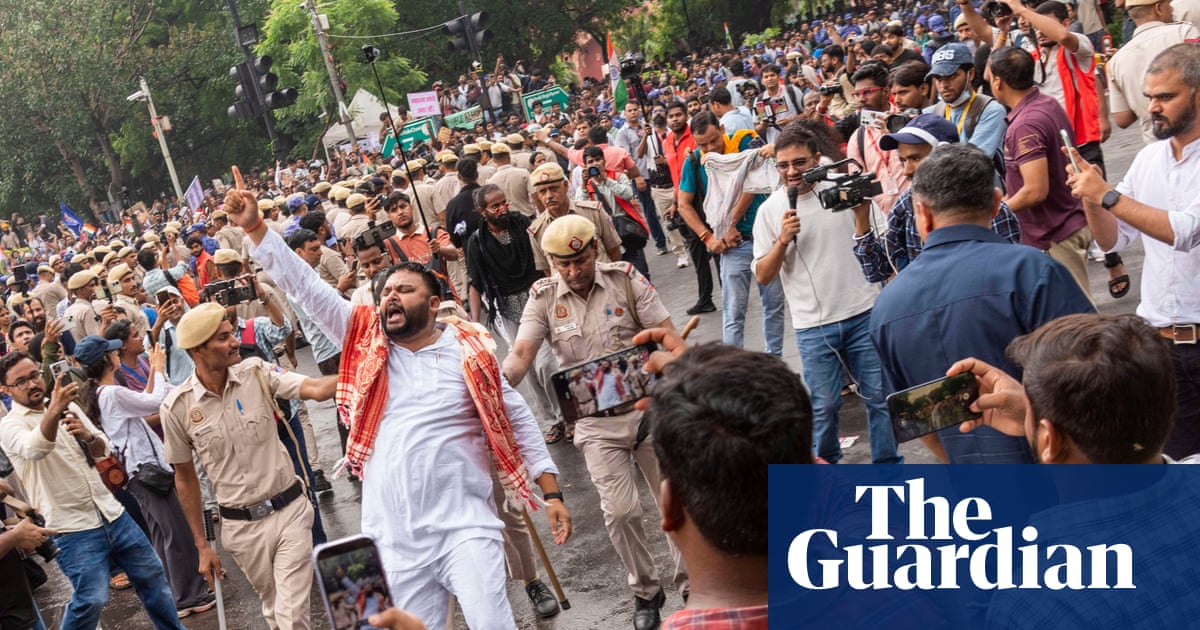
Taru had come to the protest prepared this time. In one hand was an anti-government poster and in the other was a bicycle helmet. “We need to have protection in case Delhi-police" class="entity-link entity-organization" data-entity-id="168045" data-entity-type="organization">Delhi police beat us up again,” said the 25-year-old, who stood among her friends. “We are not scared of them and we won’t run away, no matter what they do. We’ll stay here till they listen.”On Tuesday, central Delhi still thronged with thousands of protesters, as an unprecedented expression of dissent against the powerful ruling Narendra Modi government showed no sign of abating.Just 24 hours earlier, more than 50,000 people took to the streets in protest, swathes of them in their late teens and early 20s, mobilised by a new youth-led political movement that calls itself the Cockroach Janta party (CJP). Their rallying call was the resignation of the education minister and for reform of a corrupt and broken education system.But what began peacefully on Monday – people fanning each other in the gruelling humidity, sharing snacks and chanting slogans – turned into scenes of brutality by the afternoon. Delhi-police" class="entity-link entity-organization" data-entity-id="168045" data-entity-type="organization">Delhi police denied the protesters the right to march on parliament and kettled the expanding crowd into a restricted area. The internet was shut down and barricades were erected across the capital. The came the police batons and the teargas.Police said they were responding to agitation but organisers and witnesses claimed the police carried out unprovoked attacks, including against women and children in the crowd. About 60 suffered injuries and at least one protester is on a ventilator in hospital intensive care.Abhijeet Dipke, founder of the Cockroach Janta party, next to a portrait of hunger-striking activist Sonam Wangchuk during a protest in Delhi on Tuesday. Photograph: Shekhar Yadav/APAbhijeet Dipke at a march organised by the CJP on Monday demanding the resignation of Dharmendra Pradhan. Photograph: Kabir Jhangiani/NurPhoto/Shutterstock“The day was so wholesome to start with, there was so much love,” said Taru. “But after 3pm the police started attacking us. They were bashing us like anything. I saw them come up and hit people on the head as they were sitting down on the pavement doing nothing. And then as we were running, they opened up teargas on us.”Taru described the response by Delhi-police" class="entity-link entity-organization" data-entity-id="168045" data-entity-type="organization">Delhi police – which are under central government control – as a “big mistake. Now we are more agitated than ever.”On Tuesday, the heavy hand of the Delhi-police" class="entity-link entity-organization" data-entity-id="168045" data-entity-type="organization">Delhi police did little to keep supporters away from the historical site of Jantar Mantar in Delhi, which has become the focal point of the CJP protests over the past month. The crowds were thick and lively as they shouted slogans against the Modi government with abandon, calling for both the education minister and the prime minister to resign.Some had travelled hundreds of miles to be there and said they intended to camp out until the government responded to the demands of the country’s millions of young people. “The government needs to understand: we are not going anywhere,” said Ranjit Verma, 23.India’s main opposition Congress party had also seized upon the mood, calling for Modi to resign “for destroying the future of India’s youth” as it held its own protest in Delhi on Tuesday.Members of the Rapid Action Force deployed at the protest site near Jantar Mantar in New Delhi on Monday. Photograph: Jai Thakur/Zuma Press Wire/ShutterstockThe protest site near Jantar Mantar in New Delhi on Sunday. Photograph: Jai Thakur/Zuma Press Wire/ShutterstockWhile the CJP movement has primarily focused on accountability for devastating leaks of exam papers and calling for the resignation of the education minister, Dharmendra Pradhan, the overriding feeling in the aftermath of Monday’s protest was that this was now so much bigger than one issue. For some, this was the moment India’s youth – totalling more than 600 million – had found its political voice.“The solidarity on the streets yesterday filled my heart,” said Kuhoo Kaushik, 26, a content creator from Delhi. “How the government responded was really sad, police beating up 14-year-olds is horrible. But personally, I feel like it’s really awoken something in me.“That’s why I’ve come back today: we won’t be moved until the government listens to us. It’s become about so much more than education – but one step at a time”’Speaking at a press conference on Tuesday, CJP founder Abhijeet Dipke vowed that the protests would continue, though did not state what the next steps for the movement would be to capitalise on their momentum.Standing by the stage at the protest site, Ratna Singh, a CJP spokesperson, said the movement was very aware of ways in which the Modi government had successfully cracked down on previous movements and figures of dissent during its 12 years in power.“Anyone who has tried to speak up against this government has faced terrorism charges or tax raids or jail and there is so much fear,” she said. “But I am very proud at how many people have showed up and come out on the streets. The police showed us no mercy – but no matter what barbaric treatment they give us, we will not be silenced.”While a senior government minister met two CJP spokespeople on Monday to discuss their demands, Singh said the government had not responded to them on Tuesday and the “prime minister has remained silent about what happened”.It was not only young people who returned to the protest site on Tuesday. Shobha Varma, 80, was attending with her granddaughter. “Our education system has been failing young people for years,” she said. “But when I look out at everyone here, I really feel hope.”
SRCThe Guardian - World News
LANGEN
LEANCenter-Left
WORDS928
ENT10
TUE · 2026-07-21 · 16:13 GMTBRIEF NSR-2026-0721-94781
NSR-2026-0721-94781News Report·EN·Social Justice
India’s Cockroach movement protesters show no sign of backing down
Thousands of protesters, primarily young people, continued demonstrations in Delhi on Tuesday demanding education reforms and the resignation of the education minister. The protests, organized by the youth-led Cockroach Janta party (CJP), escalated on Monday when Delhi police reportedly used batons and teargas against the crowd, resulting in injuries.
Hannah Ellis-Petersen in DelhiThe Guardian - World NewsFiled 2026-07-21 · 16:13 GMTLean · Center-LeftRead · 4 min
The Guardian - World NewsFIG 01
Reading time
4min
Word count
928words
Sources cited
3cited
Entities identified
10entities
Quality score
100%
§ 01
Briefing Summary
AI-generatedNEWSAR · AI
Thousands of protesters, primarily young people, continued demonstrations in Delhi on Tuesday demanding education reforms and the resignation of the education minister. The protests, organized by the youth-led Cockroach Janta party (CJP), escalated on Monday when Delhi police reportedly used batons and teargas against the crowd, resulting in injuries. Protesters, some wearing protective gear, expressed determination to continue their dissent despite the police action. The movement, initially focused on exam paper leaks, has broadened into a larger expression of discontent against the ruling government, with some participants seeing it as a moment for India's youth to find their political voice. The CJP vows to persist until the government addresses their demands.
Confidence 0.90Sources 3Claims 5Entities 10
§ 02
Article analysis
Model · rule-basedFraming
Social Justice
Human Interest
Tone
Mixed Tone
AI-assessed
CalmNeutralAlarmist
Factuality
0.60 / 1.00
Mixed
LowHigh
Sources cited
3
Well sourced
FewMany
§ 03
Key claims
5 extracted01
The youth-led Cockroach Janta party (CJP) is demanding the resignation of the education minister and reform of the education system.
factual
Confidence
0.90
02
Thousands of protesters are demonstrating against the ruling Narendra Modi government.
factual
Confidence
0.90
03
About 60 protesters suffered injuries, and at least one is on a ventilator.
factual
Confidence
0.85
04
Protesters intend to camp out until the government responds to their demands.
quoteprotesters
Confidence
0.80
05
Protesters claim police carried out unprovoked attacks, including against women and children.
quoteorganizers and witnesses
Confidence
0.80
§ 04
Full report
4 min read · 928 words§ 05
Entities
10 identifiedKey playerOppositionContextPositiveNeutralNegative
People4
Organizations3
§ 06
Keywords & salience
10 termsprotest
1.00
police brutality
0.90
youth-led movement
0.90
government dissent
0.80
education reform
0.70
cockroach janta party
0.60
delhi police
0.60
internet shutdown
0.50
tear gas
0.50
narendra modi government
0.40
§ 07
Topic connections
Interactive graph Network visualization showing 22 related topics
View Full Graph Person Organization Location Event|Click node to navigate|Edge numbers = shared articles