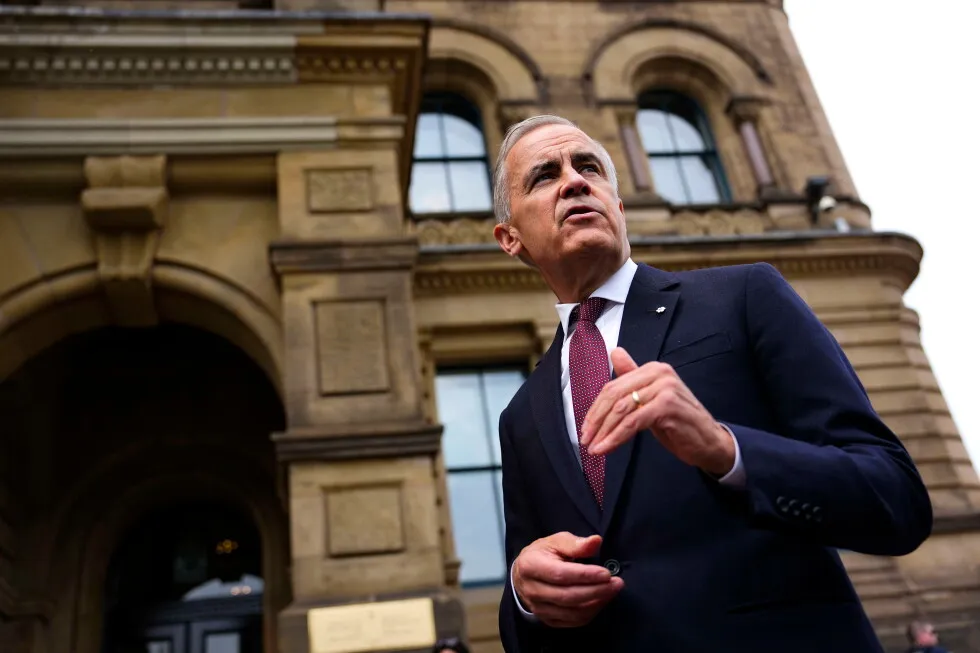
What to know about the 50% tariffs Trump is imposing on Canada 0 seconds of 1 minute, 24 secondsVolume 0% Press shift question mark to access a list of keyboard shortcuts Keyboard ShortcutsEnabledDisabled Shortcuts Open/Close/ or ? Play/PauseSPACE Increase Volume↑ Decrease Volume↓ Seek Forward→ Seek Backward← Captions On/Offc Fullscreen/Exit Fullscreenf Mute/Unmutem Decrease Caption Size- Increase Caption Size+ or = Seek %0-9 Next Up Wildfire smoke blankets Toronto, raising air quality concerns 00:15 00:00 01:24 01:24 More Videos 00:15 Wildfire smoke blankets Toronto, raising air quality concerns 00:59 Train crew in Canada surrounded by intense flames 00:57 Trump flies over stadium in Marine One before attending the World Cup final 01:47 Lebanon's president meets with Trump at White House 01:24 Trump's teleprompter operator on unpaid leave for alleged prediction market bets on Trump speeches 01:15 Trump celebrates World Cup success, comments on action against Iran 01:29 Democrats grill Trump's pick for Director of National Intelligence on his role in elections 00:55 ICE should keep making traffic stops despite recent shootings, Trump says Close 1 of 2 | President Donald Trump said Tuesday he is considering more tariffs on Canada over the wildfire smoke drifting into the United States, accusing Canada of mismanaging its forests. The threat comes a day after Trump imposed 50% tariffs on most Canadian goods. 2 of 2 | Canada Prime Minister Mark Carney makes a statement outside the Office of the Prime Minister and Privy Council in Ottawa, on Tuesday, July 21, 2026.(Justin Tang/The Canadian Press via AP) By PAUL WISEMAN and MAE ANDERSON Updated 9:09 PM MESZ, July 21, 2026 Add AP News on Google Add AP News as your preferred source to see more of our stories on Google. Share Share Facebook Copy Link copied Print Email X LinkedIn Bluesky Flipboard Pinterest Reddit WASHINGTON (AP) — President Donald Trump has reached back to the Great Depression for an obscure trade weapon he can use to wallop Canada again. Trump on Monday announced 50% tariffs on some Canadian products, ratcheting up tensions with one of the closest U.S. allies. The move threatens to push prices higher at a time when Americans are already frustrated with the high cost of living ahead of the Nov. 3 midterm elections. It’s also unclear whether Trump’s latest tariffs would survive a legal challenge. tariffs are taxes on foreign products. They’re paid by importers in the United States who often pass the costs along to consumers in the form of higher prices. Trump invoked Section 338 of the Tariff Act of 1930 to impose 50% tariffs on Canadian products ranging from hockey sticks to beer. In proclamations issued Monday, Trump claimed that Canada discriminates against American exports of autos, alcohol and cheese. He is angry over Canada’s retaliation against his own tariffs last year, which were imposed under the pretext that Canada should do more to stop fentanyl smuggling. The president has repeatedly sparred with his northern neighbor, declaring that Canada should be the 51st U.S. state and threatening tariffs over wildfires that have sent heavy smoke wafting over to the United States. His taunts, threats and trade sanctions have enraged Canadians and led to boycotts of American goods. Most Canadian provinces, for instance, have banned the sale of alcoholic beverages from the United States. The U.S. is renegotiating a trade pact — the US-Mexico-Canada Agreement. And the threat of Section 338 tariffs, set to take effect Aug. 19, gives the United States leverage to seek concessions from Ottawa. Trump imposes 50% tariffs on Canadian goods, citing disputes over autos, alcohol and cheese 4 MIN READ Trump administration races the clock to rebuild US tariff wall knocked down by Supreme Court 5 MIN READ 1452 The US, Canada and Mexico begin bumpy negotiations to renew North American trade pact 5 MIN READ 1452 Section 338 is ‘completely untested’ Nearly a century ago, with the U.S. and world economies in collapse, Congress passed the Tariff Act of 1930, imposing hefty taxes on imports. Known as the Smoot-Hawley tariffs, they are notorious among economists and historians for limiting world commerce and making the Great Depression worse. They made a memorable cameo in the 1986 movie “Ferris Bueller’s Day Off.” Section 338 of the law authorizes the president to impose tariffs of up to 50% on imports from countries that have discriminated against U.S. businesses. No investigation is required. Nor is there any limit on how long the tariffs can stay in place. Section 338 tariffs have never been imposed. U.S. trade negotiators traditionally have favored another tool, Section 301 of the Trade Act of 1974 — though the United States used the threat of Section 338 levies as a bargaining chip in trade talks in the 1930s. “It’s completely untested,” said trade lawyer Ryan Majerus, a partner at King & Spalding and a former U.S. trade official. “It’s kind of hard to believe it’s been on the books for 100 years.’’ Canada is America’s second-biggest trading partner behind Mexico. The United States last year imported $389 billion worth of goods from Canada — led by crude oil and autos — behind only the $541 billion in took in from Mexico. Canada depends heavily on the U.S. market: Nearly 72% of Canadian goods exports went to the United States last year, down from almost 76% in 2024, according to the Canadian government. Still, Stephen Brown, chief North America economist at Capital Economics, calculates that the Section 338 tariffs will hit only $20 billion worth of Canadian imports. As a result, they “will not have any major implications for U.S. (economic) growth or inflation … The consequences for Canada will be greater, but manageable.’’ Brown reckons that the 338 levies would raise the U.S. tariff rate on Canadian imports to 5.6% from 3.1%. Some of the top imports are not included in the 50% tariffs; energy products are excluded, as are motor vehicles, which are already subject to other tariffs. But a wide range of goods, ranging from building products like cement and wood, to agricultural products like dairy and honey, will be subject to the tax. In the past, Trump has often exempted from his tariffs goods that qualify for duty-free status under the USMCA, which he negotiated in his first term. But Monday’s announcement did not spare USMCA-compliant products. “Anything that got exempted before is basically going to be covered now,” said Barry Appleton, a law professor and co-director New York Law School’s Center for International Law. “So where American consumers were shielded from the costs earlier because of the USMCA exemption, this tariff is going to remove it.” And that will add to the burden already of U.S. consumers wallets, experts say. In 2025, the tariffs levied by Trump cost U.S. households an average of $1,000, according to the nonprofit Tax Foundation. “Even with the significant carve-outs, you’re still going to be hitting a fair amount of of goods, and those costs are going to be passed onto U.S. consumers at a time when the U.S. consumer is telling people pretty consistently that they feel tapped out by inflation,” said Greg Husisian, partner and chair of law firm Foley & Lardner’s international trade and national security practice Monday’s announcement comes at a time when the president’s trade policies, built around the aggressive use of tariffs, are in flux. Trump last year imposed double-digit taxes on imports from almost every country on Earth. He justified the tariffs by invoking the 1977 International Emergency Economic Powers Act (IEEPA) and declaring America’s longstanding trade deficit a national emergency. But the Supreme Court in February struck down the tariffs, ruling that the president had exceeded his authority in declaring them. As a result of that decision, the Trump administration has been forced to refund the IEEPA tariffs that importers had paid. In an attempt to rebuild his tariff wall around the U.S. economy, Trump turned to Section 122 of the Trade Act of 1974, which allows the president to impose global tariffs of up to 15% for up to 150 days. The Trump administration promptly announced 10% worldwide tariffs — but they expire on Friday. Trump is expected to replace the stopgap Section 122 tariffs with new Section 301 tariffs – but hasn’t done it yet. Trade lawyers have some doubts whether Trump’s latest tariffs will survive. Posting on social media, Peter Harrell, visiting scholar at Georgetown University’s law school, spotted some legal weaknesses in Section 338 tariffs. It’s not clear, for example, whether the U.S. International Trade Commission is supposed to conduct an investigation before the president can impose the taxes. And it’s also possible that Section 338 has been rendered obsolete by more recent statutes, including Section 301. “The legal case for 338 is weaker than IEEPA,’’ Majerus said. “There’s at least a fair probability it will get overturned.’’ MAE ANDERSON Anderson reports for The Associated Press on a wide range of issues that small businesses face. She is based in New York. twitter mailto
SRCAssociated Press (AP)
LANGEN
LEANCenter
WORDS1 491
ENT11
TUE · 2026-07-21 · 19:23 GMTBRIEF NSR-2026-0721-94797
NSR-2026-0721-94797News Report·EN·Economic Impact
What to know about the 50% tariffs Trump is imposing on Canada
President Donald Trump has announced 50% tariffs on certain Canadian products, invoking Section 338 of the Tariff Act of 1930. Trump claims Canada discriminates against U.S.
Associated Press (AP)Filed 2026-07-21 · 19:23 GMTLean · CenterRead · 6 min
Associated Press (AP)FIG 01
Reading time
6min
Word count
1 491words
Sources cited
1cited
Entities identified
11entities
Quality score
100%
§ 01
Briefing Summary
AI-generatedNEWSAR · AI
President Donald Trump has announced 50% tariffs on certain Canadian products, invoking Section 338 of the Tariff Act of 1930. Trump claims Canada discriminates against U.S. exports of autos, alcohol, and cheese, and is retaliating against Canada's own tariffs imposed last year. These new tariffs, set to take effect August 19, are intended to pressure Canada during renegotiations of the USMCA trade pact. This obscure trade weapon, never before used, could lead to higher prices for American consumers, though economists suggest the impact on U.S. growth will be manageable while Canada may face greater consequences. Legal challenges to the tariffs are anticipated, as their validity under current trade law is uncertain.
Confidence 0.90Sources 1Claims 5Entities 11
§ 02
Article analysis
Model · rule-basedFraming
Economic Impact
Political Strategy
Tone
Mixed Tone
AI-assessed
CalmNeutralAlarmist
Factuality
0.70 / 1.00
Factual
LowHigh
Sources cited
1
Limited
FewMany
§ 03
Key claims
5 extracted01
The tariffs are taxes on foreign products paid by importers who often pass costs to consumers.
factual
Confidence
1.00
02
Trump claimed Canada discriminates against American exports of autos, alcohol and cheese.
factualDonald Trump
Confidence
1.00
03
Trump invoked Section 338 of the Tariff Act of 1930 to impose tariffs.
factual
Confidence
1.00
04
President Donald Trump announced 50% tariffs on some Canadian products.
factualDonald Trump
Confidence
1.00
05
The move threatens to push prices higher at a time when Americans are already frustrated with the high cost of living.
factual
Confidence
0.80
§ 04
Full report
6 min read · 1 491 words§ 05
Entities
11 identifiedKey playerOppositionContextPositiveNeutralNegative
Organizations3
Topics1
§ 06
Keywords & salience
9 termsdonald trump
1.00
canada
1.00
tariffs
1.00
trade
0.90
economy
0.70
cost of living
0.60
midterm elections
0.50
great depression
0.40
wildfire smoke
0.40
§ 07
Topic connections
Interactive graph Network visualization showing 51 related topics
View Full Graph Person Organization Location Event|Click node to navigate|Edge numbers = shared articles