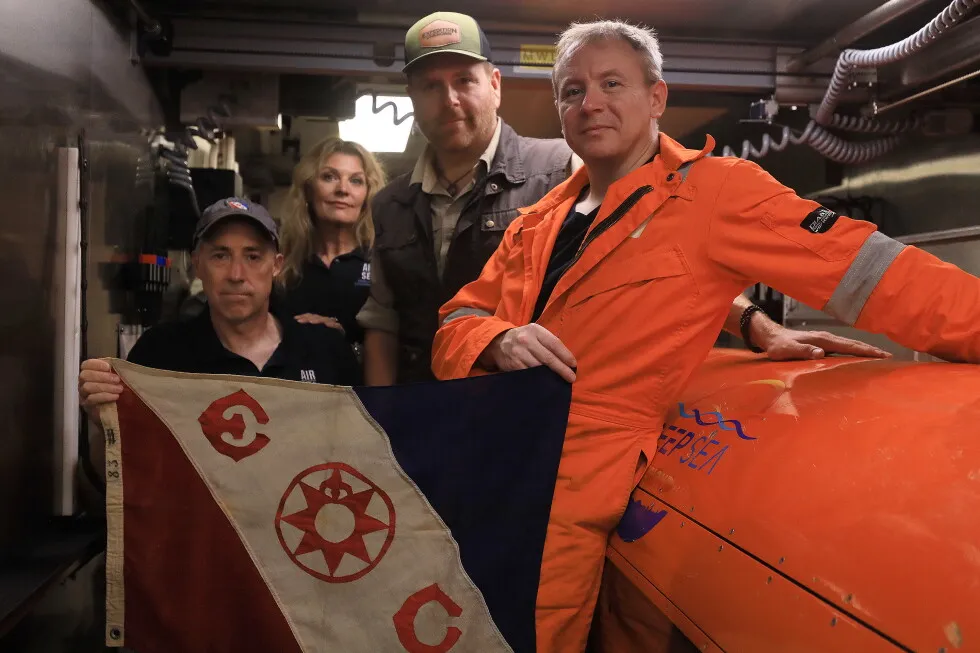
This undated photo provided by the Discovery Channel Tuesday, July 21, 2026, shows, from left, Air/Sea Heritage Foundation (ASHF) President Russ Matthews, ASHF Director Idee Matthews-Montijo, Expedition Unknown’s Josh Gates and Deep Sea Visoin President of Operations Craig Wallace inside an AUV hangar with an Explorers Club flag. (Discovery Channel via AP) By JOSH FUNK Updated 11:50 PM MESZ, July 21, 2026 Add AP News on Google Add AP News as your preferred source to see more of our stories on Google. Share Share Facebook Copy Link copied Print Email X LinkedIn Bluesky Flipboard Pinterest Reddit The wreckage from a Pan Am plane crash in the ocean 74 years ago that helped lead to requirements for the passenger safety briefings on every flight today has been found off the coast of Puerto Rico. The talks flight attendants deliver about how to inflate a life vest or find the exits on a plane that are routine today were developed after 52 people perished aboard Pan Am’s Clipper Endeavor because they didn’t get off the plane before it sank. Explorers used an autonomous sonar drone to find the fuselage and tail of the DC-4 last month under 2,000 feet of water. The 12 passengers and five crew members who survived the crash on Good Friday in 1952 told investigators that everyone survived the plane’s hard landing on the water, but then panic set in and many passengers were reluctant to venture out into the waves as they struggled to find life vests and the crew had a hard time pulling the rafts out. The plane sank within minutes. “This one became a catalyst, and it helped drive safety steps forward of better flotation equipment and the preflight briefings,” said aviation safety expert John Cox. “So this is one steppingstone along the path to what we today enjoy as aviation safety. It was a rallying cry at the time.” And now the discovery of this wreck could offer new hope for families who lost loved ones in other ocean crashes like Malaysia Airlines Flight 370 that disappeared 12 years ago with 269 people aboard. This crash first caught the attention of Russ Matthews in 2019 when he saw a blurb about a luggage tag from the flight washing ashore in Florida. He said the historical significance of the Clipper Endeavor prompted him to dig deeper. That led to years of digging through the Pan Am Airlines and Coast Guard archives looking for clues about the location of the plane’s watery grave. Reports from the Civil Aeronautics Board, which was the predecessor to the Federal Aviation Administration, also helped. He was fired by the White House right after being sworn in. Now a top federal prosecutor is suing 3 MIN READ The new commander-in-chief of Ukraine’s armed forces forged his reputation fighting Russia in 2014 3 MIN READ Mexican man killed after ICE encounter in Florida was on vacation, officials say 3 MIN READ But the key to finding the wreckage was found in records in Puerto Rico from a hearing that was held on the crash, and a map estimating the location of the crash that was done by Air Force pilots who witnessed the crash because they just happened to be in the area on a training flight. Bad weather disrupted a previous attempt to locate the wreck in 2024 with a towed sonar array that was also documented by the Discovery Channel’s “Expedition Unknown” show. But Matthews said he and the volunteers who work with his Air/Sea Heritage Foundation dreamed of making a second attempt to find it before next year’s 75th anniversary of the crash with one of these newer advanced drones that were originally developed for military uses like finding undersea mines. Tony Romeo, who is CEO of the undersea exploration firm Deep Sea Vision, had been talking with Matthews for a while about the possibility of helping try to find this plane if one of his ships was ever in the area, and then in April one just happened to be passing right by Puerto Rico between two other jobs while carrying an advanced underwater drone with the right sensors to be able to find it. “There we were, and everything kind of came together at the moment: good weather, the right team, and the right equipment and ship. So we took a shot at it,” Romeo said. Deep Sea Vision previously led an unsuccessful six-month search to find Amelia Earhart’s plane, but Romeo had a special interest in this case because his father was a mechanic and pilot for Pan Am airlines. In fact, the drone they used in the search already had a Pan Am sticker on the side. All the research Matthews’ group had done, combined with weather data from the time of the crash, was synthesized to create a map of the most likely location and a search area of 10 square nautical miles. The drone actually found the wreckage on its first pass over that area, although the explorers didn’t know that until it returned to the surface with its images. The Discovery Channel’s Josh Gates and his crew were again along for this latest search to capture the moment the plane showed up on images from the drone after they were downloaded. The search will be featured in a special episode of the show this fall, but a few highlights released Tuesday show the moment everyone in the control room realized what they had found. Shouts of “Oh God!” and “That’s a plane!” erupted when the image loaded on screen. “To have a front-row seat to an expedition like this as it’s unfolding is tremendous, and so I feel really lucky that we were able to be a part of it,” Gates said. JOSH FUNK Funk covers transportation including aviation safety, trucking and airlines along with the major freight railroads. Funk also covers Warren Buffett’s Berkshire Hathaway, drones, the effort to break China’s stranglehold on rare earth elements and agriculture. twitter mailto
SRCAssociated Press (AP)
LANGEN
LEANCenter
WORDS1 000
ENT12
TUE · 2026-07-21 · 21:53 GMTBRIEF NSR-2026-0721-94846
NSR-2026-0721-94846News Report·EN·Human Interest
Wreckage found of Pan Am plane crash that helped lead to today’s safety briefings on every flight
The wreckage of a Pan Am DC-4 airplane, known as the Clipper Endeavor, which crashed 74 years ago off the coast of Puerto Rico, has been discovered. The crash, which resulted in 52 fatalities, was a catalyst for the development of mandatory passenger safety briefings on flights.
Associated Press (AP)Filed 2026-07-21 · 21:53 GMTLean · CenterRead · 4 min
Associated Press (AP)FIG 01
Reading time
4min
Word count
1 000words
Sources cited
3cited
Entities identified
12entities
Quality score
100%
§ 01
Briefing Summary
AI-generatedNEWSAR · AI
The wreckage of a Pan Am DC-4 airplane, known as the Clipper Endeavor, which crashed 74 years ago off the coast of Puerto Rico, has been discovered. The crash, which resulted in 52 fatalities, was a catalyst for the development of mandatory passenger safety briefings on flights. Survivors reported that panic and a lack of readily available life vests and rafts contributed to the high death toll after the plane's hard landing on the water. Explorers used an autonomous sonar drone to locate the fuselage and tail of the aircraft at a depth of 2,000 feet. The discovery, made possible by years of archival research and advanced technology, offers potential hope for families of victims from other ocean plane crashes. The search and discovery will be featured in an upcoming episode of the Discovery Channel's "Expedition Unknown."
Confidence 0.90Sources 3Claims 5Entities 12
§ 02
Article analysis
Model · rule-basedFraming
Human Interest
Technology
Tone
Measured
AI-assessed
CalmNeutralAlarmist
Factuality
0.80 / 1.00
Factual
LowHigh
Sources cited
3
Well sourced
FewMany
§ 03
Key claims
5 extracted01
This crash became a catalyst and helped drive safety steps forward of better flotation equipment and preflight briefings.
quoteJohn Cox
Confidence
1.00
02
Explorers used an autonomous sonar drone to find the fuselage and tail of the DC-4 under 2,000 feet of water.
factual
Confidence
1.00
03
The crash of Pan Am’s Clipper Endeavor, which killed 52 people, helped lead to requirements for passenger safety briefings on every flight.
factual
Confidence
1.00
04
Wreckage of a Pan Am plane crash that occurred 74 years ago has been found off the coast of Puerto Rico.
factual
Confidence
1.00
05
The discovery of this wreck could offer new hope for families who lost loved ones in other ocean crashes like Malaysia Airlines Flight 370.
factual
Confidence
0.90
§ 04
Full report
4 min read · 1 000 words§ 05
Entities
12 identifiedKey playerOppositionContextPositiveNeutralNegative
Organizations7
Locations1
§ 06
Keywords & salience
10 termssafety briefings
1.00
aviation safety
1.00
pan am plane crash
0.90
wreckage discovery
0.80
autonomous sonar drone
0.70
ocean crashes
0.60
life vests
0.50
flight attendants
0.50
historical significance
0.40
archives
0.40
§ 07
Topic connections
Interactive graph No topic relationship data available yet. This graph will appear once topic relationships have been computed.