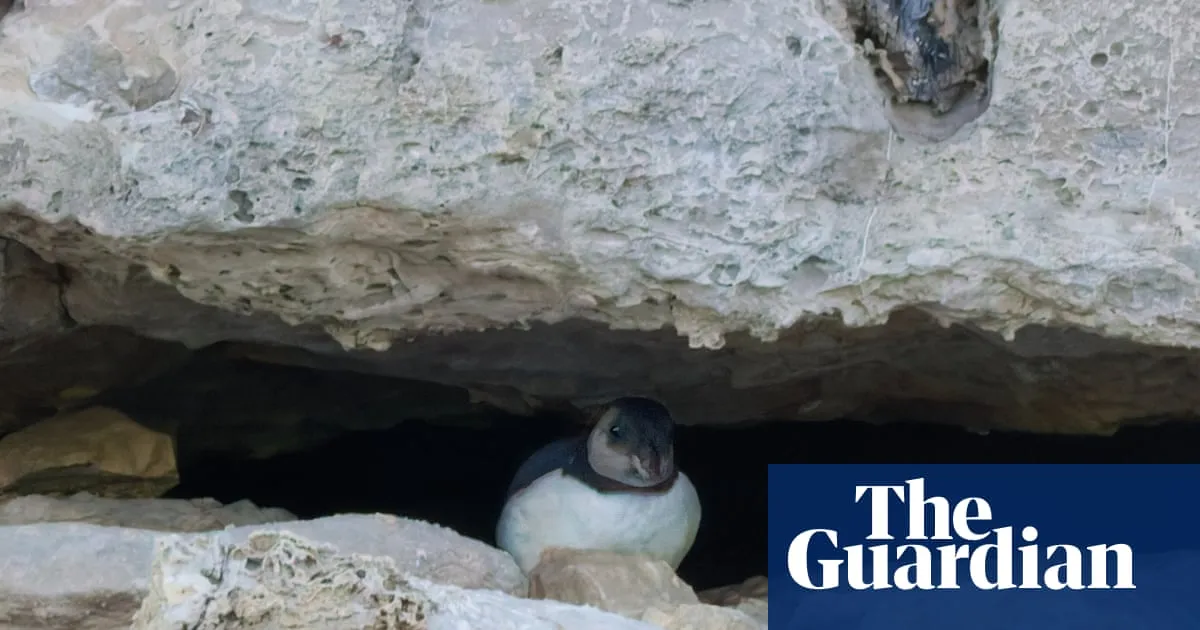
For years, volunteers have craned their necks and tested their patience to peer into the crevices of the cliffs hoping for a glimpse of fluffy joy.Finally it all paid off as a puffling – baby Puffin – poked its way into the sunshine, becoming the first to be spotted on the coast of Dorset in southern England for three decades.“Seeing the puffling was a great thrill,” said the marine ornithologist Richard Caldow. “Every chick matters. One puffling alone won’t save this colony but one is a whole lot better news than none.”This stretch of coast – the Purbeck coast near Swanage – is the last known regular nesting site for puffins on the mainland of southern England.In the 1950s, there were about 80 birds nesting there but the number of pairs dropped to three and there had been no definitive sightings of fledglings for 30 years. The fear was that the colony was heading to extinction.A Puffin in the sea off the Purbeck coast. Photograph: Picasa/Pete ChristieOver the summer, 13 volunteers have been monitoring the ledges for 15 weeks, no easy task as the vantage point is hard to access and precarious.In April, six adult puffins were recorded at the colony. Within a few weeks, volunteers were observing puffins carrying fish into at least two separate nesting locations, indicating that more than one pair may have been attempting to raise chicks.Most of the deliveries ended after 12 June, suggesting that not all the chicks had made it but the fish drops continued to one spot and eventually the puffling was spotted and photographed.Caldrow, who is supported by volunteers from the Purbeck Natural History Forum, said they timed the taking of the photo perfectly. “We knew its parents had been feeding it since about 29 May until 5 July so by then it was 38 days old.“By then it was likely to come into the open occasionally, usually if a parent was there too. That was most likely in evening so we chartered a boat on 7 July to anchor in the right spot from 4 till 8pm. It took three hours but just after 7pm it popped out behind its parent. Great to see.”A camera being installed on the cliff. Photograph: Pete ChristieHe believes the puffling may have left that night. “Where it is now we have no idea. It will be well out at sea somewhere on its own. The parents don’t look after it once it fledges. It won’t come back for at least two years and won’t breed till 2030 at the soonest. It may come back here but it could go somewhere different.”Caldow, who has nearly 40 years’ experience researching and conserving coastal bird populations, said he was delighted at the sight of the puffling. “It tells us that Purbeck puffins can still lay fertile eggs, hatch them and, at least in some years, find enough food to rear a chick and escape the attention of predators.”skip past newsletter promotionafter newsletter promotionOver the last few years, the National Trust has been working to understand why the Puffin colony has been failing to produce chicks. Theories have ranged from rats to peregrine falcons to the climate emergency.Dancing Ledge, which contains the fissure where the puffins nest. Photograph: Will WilkinsonMotion-sensor cameras, powered by solar panels, have been installed by high-rope experts, positioned to take images of movement within the deep fissure – the puffins nest about 2 metres back from the entrance.The cameras will be recovered after the seabird breeding season, and volunteers will then review the thousands of images taken.Ben Cooke, the rivers and coast project officer for the National Trust in Purbeck, said: “The images should hopefully reveal more of the nesting, feeding and fledging activity of the puffins. Understanding what is happening inside the nesting crevice is the missing piece of the puzzle.“If we can identify the reasons why chicks and eggs are being lost, we can begin to explore what conservation measures might help. Puffins are such an iconic bird, we want to do everything in our power to help them survive in Purbeck.” The National Trust is offering live Puffin and clifftop webcams on the Farne Islands in north-east England. Streaming daily from dawn until dusk between May and the end of July, the cameras form part of the trust’s Window to the Wild project, giving viewers an up-close view of the seabirds that breed on the islands.
SRCThe Guardian - World News
LANGEN
LEANCenter-Left
WORDS735
ENT8
WED · 2026-07-22 · 04:00 GMTBRIEF NSR-2026-0722-94934
NSR-2026-0722-94934News Report·EN·Human Interest
‘A great thrill’: baby puffin is first one seen on Dorset coast in three decades
A puffling, a baby puffin, has been spotted on the Purbeck coast in Dorset, marking the first sighting in three decades at the last known regular nesting site for puffins on mainland southern England. Volunteers have been monitoring the site for years, and their efforts paid off when the puffling emerged, indicating that the colony, which had dwindled significantly, can still produce chicks.
Steven MorrisThe Guardian - World NewsFiled 2026-07-22 · 04:00 GMTLean · Center-LeftRead · 3 min
The Guardian - World NewsFIG 01
Reading time
3min
Word count
735words
Sources cited
1cited
Entities identified
8entities
Quality score
100%
§ 01
Briefing Summary
AI-generatedNEWSAR · AI
A puffling, a baby puffin, has been spotted on the Purbeck coast in Dorset, marking the first sighting in three decades at the last known regular nesting site for puffins on mainland southern England. Volunteers have been monitoring the site for years, and their efforts paid off when the puffling emerged, indicating that the colony, which had dwindled significantly, can still produce chicks. Marine ornithologist Richard Caldow expressed excitement, stating that while one puffling won't save the colony, it's positive news. The National Trust is installing cameras to understand why chicks and eggs are lost, hoping to implement conservation measures to help the iconic puffin population survive.
Confidence 0.90Sources 1Claims 5Entities 8
§ 02
Article analysis
Model · rule-basedFraming
Human Interest
Environmental
Tone
Measured
AI-assessed
CalmNeutralAlarmist
Factuality
0.70 / 1.00
Factual
LowHigh
Sources cited
1
Limited
FewMany
§ 03
Key claims
5 extracted01
Marine ornithologist Richard Caldow stated that seeing the puffling was 'a great thrill' and 'every chick matters'.
quoteRichard Caldow
Confidence
1.00
02
In the 1950s, there were about 80 puffin pairs nesting on the Purbeck coast; numbers dropped to three pairs.
statistic
Confidence
1.00
03
The Purbeck coast is the last known regular nesting site for puffins on the mainland of southern England.
factual
Confidence
1.00
04
A baby puffin (puffling) was spotted on the Dorset coast, the first in three decades.
factual
Confidence
1.00
05
The puffling was likely to come into the open occasionally, usually if a parent was there too, most likely in the evening.
factualRichard Caldow
Confidence
0.90
§ 04
Full report
3 min read · 735 words§ 05
Entities
8 identifiedKey playerOppositionContextPositiveNeutralNegative
Organizations1
Locations4
Topics1
§ 06
Keywords & salience
10 termsbaby puffin
1.00
dorset coast
0.90
puffling
0.90
wildlife monitoring
0.80
seabird colony
0.70
conservation
0.70
ornithologist
0.60
nesting site
0.50
extinction threat
0.50
purbeck coast
0.40
§ 07
Topic connections
Interactive graph No topic relationship data available yet. This graph will appear once topic relationships have been computed.