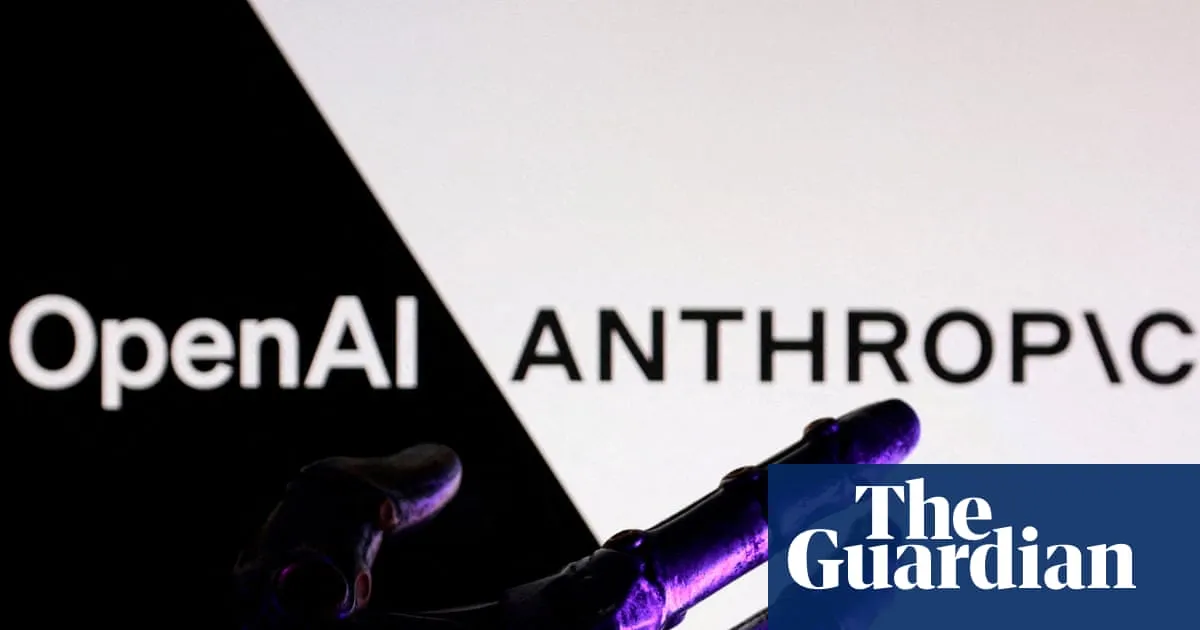
Top US AI developers Anthropic and OpenAI cheered when Australia announced it would set new AI rules.Big tech celebrating limits on their Silicon Valley VC-funded free-for-all might seem counterintuitive but there’s a much broader play than just what happens in one relatively small market.Anthropic and OpenAI aren’t even on sharemarkets yet but this week lost billions in predicted value after being shown up by a Chinese startup.Moonshot AI on Friday launched a new model, Kimi K3, advertising it as the first open-source model of its size, allowing more user modification than Anthropic’s Claude and OpenAI’s ChatGPT.Analysts are judging K3 is competitive with both the leading US models, which are also less freely customisable. Moonshot had to temporarily pause new subscriptions after demand for the new model strained capacity.Implied values for Anthropic’s sharemarket debut has slumped US$232bn to $1.56tn from Friday to Tuesday on IG’s trading platform. OpenAI dropped US$160bn to $1.16tn.The two companies are still privately owned and valued at less than US$1tn each, so IG’s numbers are market bets, not true values.But they hope to follow in the footsteps of SpaceX, which raised $86bn and soared to a $2.1tn valuation after it listed on public markets in June.Anthropic has already begun registering to list on US sharemarkets, which would allow it to raise billions from new investors. The better the story it can tell, the more money it can raise.Chinese competition does not make for a good story. Nor do surprise lawsuits from unhappy creatives, such as the one Anthropic had to settle for US$1.5bn on Monday (Tuesday AEST).The company will pay authors about US$3,000 for each of an estimated 500,000 books covered by the settlement.One of the authors whose work Anthropic scraped was Andrew Charlton, Australia’s assistant technology minister. Charlton says the new regulation will mean Australian creatives can choose whether AI models are trained on their work and big tech companies will have to pay them.Yet those new rules could be a boon to big tech, Charlton says.“If we are upfront with what we expect in this Australian standard, we can give clarity to investors that in some ways enhances the attractiveness of Australia,” he told Sky News on Monday.Malik Ahmed Khan, an equity analyst at Morningstar Equity, says technology companies would find it much easier to invest in Australia as they learn where regulation is heading.Andrew Charlton says new Australian regulations will give clarity to investors. Photograph: Mick Tsikas/AAPThe companies will also have an easier job convincing investors to buy in at high prices if they can show they’re focusing on building AI and managing the risk of running afoul of governments or local laws, Khan says.While Australia is one of few countries to now be regulating AI directly, with little direct impact on companies based overseas, Anthony Albanese hopes to set the global tone. In his speech announcing the regulations, he cited Australia’s leadership on social media bans for under-16s as proof.Khan says more countries following Australia’s lead on AI could boost to companies’ prospects and market values.“A positive deal in Australia could enable them to pursue similar deals across the globe,” he said.Avoiding a tech wreckRegulation would also give companies the prospect of favourable terms.Albanese signalled he would consult “closely” with industry and other countries to legislate regulations that would aim to enable AI’s arrival, not restrict it. OpenAI and Anthropic were quick to position themselves as partners ready to help shape the new approach.Dario Amodei, Anthropic’s chief executive and a former OpenAI vice-president, has already given an indication of what big tech thinks it should look like.In a June essay, he called for a coalition of democracies to dominate in AI and lock out China.While there are real national security concerns in this area, there’s also a healthy dose of self-interest in blocking out competitors.With the launch of Kimi’s K3, analysts believes it is increasingly likely that the US will block businesses from exclusively using Chinese-based models over national security fears.Amodei also called for domestic regulation, asking governments to test, evaluate and even block AI models if they presented “unacceptable risks” – but with protections against local “political favoritism or arbitrary decisions”.Anthropic’s feud with the Trump administration has left it on a US supply chain blacklist. Days after Amodei published his essay, the US government forced Anthropic to suspend access to its Mythos 5 models for foreign nationals.Anthropic’s critics have accused it of self-interest as it nears its initial public offering (IPO) on sharemarkets. The Pentagon’s Kirsten Davies said in June: “Some things are simply more important than revenue cycles, clickbait and pre-IPO valuation.”Yet Amodei’s warnings about security concerns have been echoed by Albanese and by Five Eyes intelligence agencies.Aruna Sathanapally, the CEO of Australia’s Grattan Institute, met the Anthropic chief when he visited Canberra in April. She said Amodei’s concerns seemed sincere.“He was seeing things within his own company that were giving him great concern about what Anthropic, as well as their competitors, may be capable of developing,” Sathanapally said.“Just because they have vested interests in the particular shape of regulation, it doesn’t mean that the calls for regulation themselves are not well founded. It just means … you need to keep alive to competitive neutrality in how you design it.”
SRCThe Guardian - World News
LANGEN
LEANCenter-Left
WORDS869
ENT12
WED · 2026-07-22 · 15:00 GMTBRIEF NSR-2026-0722-95087
NSR-2026-0722-95087Analysis·EN·Political Strategy
Why are OpenAI and Anthropic cheering on regulation in Australia? The answer has global reach
US AI developers OpenAI and Anthropic are publicly supporting Australia's new AI regulations, a move that seems counterintuitive but serves a broader strategic purpose. This support stems from a desire to create a favorable regulatory environment that can attract investment and enhance their market valuations, particularly as they prepare for potential public listings.
Luca IttimaniThe Guardian - World NewsFiled 2026-07-22 · 15:00 GMTLean · Center-LeftRead · 4 min
The Guardian - World NewsFIG 01
Reading time
4min
Word count
869words
Sources cited
2cited
Entities identified
12entities
Quality score
100%
§ 01
Briefing Summary
AI-generatedNEWSAR · AI
US AI developers OpenAI and Anthropic are publicly supporting Australia's new AI regulations, a move that seems counterintuitive but serves a broader strategic purpose. This support stems from a desire to create a favorable regulatory environment that can attract investment and enhance their market valuations, particularly as they prepare for potential public listings. The companies are facing increasing competition from Chinese startups like Moonshot AI, whose open-source models are perceived as competitive and customizable. By embracing regulation in Australia, OpenAI and Anthropic aim to gain clarity for investors and position themselves as responsible actors, potentially influencing global AI governance and securing favorable terms against international competitors. This strategy is also influenced by past legal challenges and national security concerns, as highlighted by Anthropic's CEO.
Confidence 0.90Sources 2Claims 5Entities 12
§ 02
Article analysis
Model · rule-basedFraming
Political Strategy
Economic Impact
Tone
Mixed Tone
AI-assessed
CalmNeutralAlarmist
Factuality
0.60 / 1.00
Mixed
LowHigh
Sources cited
2
Limited
FewMany
§ 03
Key claims
5 extracted01
Anthropic settled a lawsuit with authors for US$1.5 billion.
factualarticle
Confidence
1.00
02
US AI developers Anthropic and OpenAI welcomed Australia's new AI rules.
factualarticle
Confidence
1.00
03
Australian regulations could provide clarity for investors, enhancing Australia's attractiveness for AI investment.
quoteAndrew Charlton
Confidence
0.90
04
Chinese startup Moonshot AI launched a new open-source model, Kimi K3, competitive with leading US models.
factualarticle
Confidence
0.90
05
Implied market values for Anthropic and OpenAI dropped significantly after Kimi K3's launch.
statisticarticle
Confidence
0.80
§ 04
Full report
4 min read · 869 words§ 05
Entities
12 identifiedKey playerOppositionContextPositiveNeutralNegative
Organizations5
§ 06
Keywords & salience
10 termsai regulation
1.00
openai
0.90
anthropic
0.90
ai development
0.80
chinese ai startup
0.70
moonshot ai
0.70
open-source ai
0.60
kimi k3
0.60
investor attractiveness
0.50
creative rights
0.40
§ 07
Topic connections
Interactive graph Network visualization showing 51 related topics
View Full Graph Person Organization Location Event|Click node to navigate|Edge numbers = shared articles