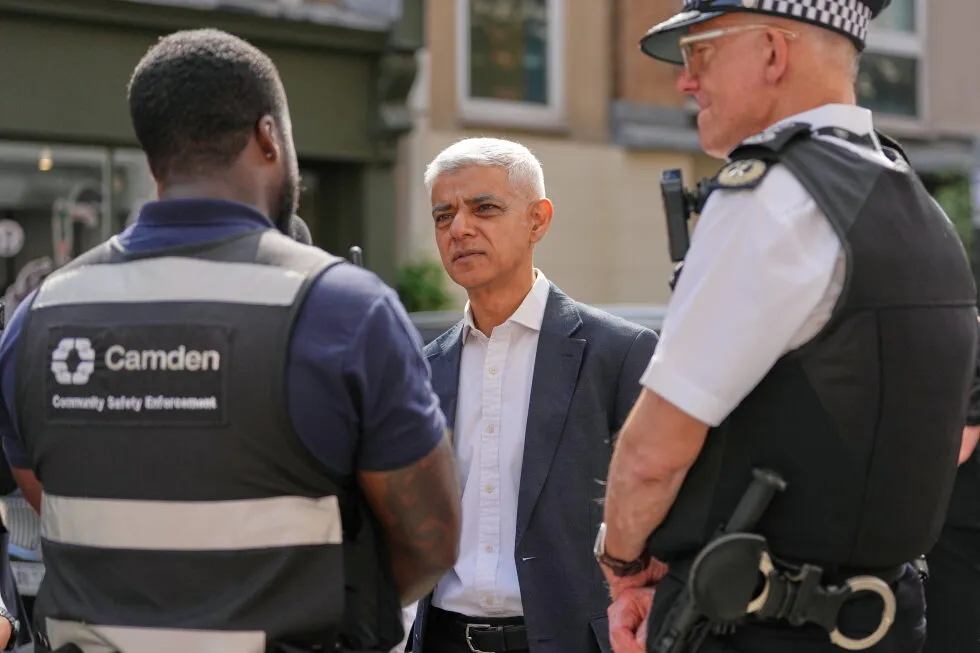
London’s mayor says falling crime shows the city is safe despite alarming online claims 1 of 5 | London Mayor Sadiq Khan, centre, and Mark Rowley, Commissioner of Police of the Metropolis, right, speak to staff, during a walkabout through the borough of Camden in London, Thursday, July 23, 2026. (AP Photo/Kirsty Wigglesworth) 2 of 5 | London Mayor Sadiq Khan, is interviewed after a walkabout through the borough of Camden in London, Thursday, July 23, 2026. (AP Photo/Kirsty Wigglesworth) 3 of 5 | London Mayor Sadiq Khan, right, with Police Constable Opara speak, during a walkabout through the borough of Camden in London, Thursday, July 23, 2026. (AP Photo/Kirsty Wigglesworth) 4 of 5 | Mark Rowley, Commissioner of Police of the Metropolis, is interviewed after a walkabout through the borough of Camden in London, Thursday, July 23, 2026. (AP Photo/Kirsty Wigglesworth) 5 of 5 | London Mayor Sadiq Khan, is interviewed after a walkabout through the borough of Camden in London, Thursday, July 23, 2026. (AP Photo/Kirsty Wigglesworth) By JILL LAWLESS Updated 3:50 PM MESZ, July 23, 2026 Add AP News on Google Add AP News as your preferred source to see more of our stories on Google. Share Share Facebook Copy Link copied Print Email X LinkedIn Bluesky Flipboard Pinterest Reddit London (AP) — London’s mayor and police chief on Thursday used a drop in recorded street crime to reassure tourists the city is safe and counter an online narrative depicting Britain’s capital as a lawless dystopia. The city’s Metropolitan Police force said “neighborhood crime,” a category that includes phone theft, pickpocketing, residential burglary and vehicle crime, fell 14% in the year to June. In Westminster borough – home to tourist magnets including Parliament, Soho and Leicester Square – those crimes fell by more than a third, and they were down by a quarter in neighboring Camden, another tourist hotspot. Yet Mayor Sadiq Khan said that in the past two years “we’ve seen a 200% increase in stories on social media about London being in quote unquote ‘decline’ or London being dangerous.” Those claims have mushroomed on social media and have been echoed by right-leaning politicians, often tied to anti-immigrant and anti-Muslim views. Khan blames an online “outrage economy” that monetizes negativity. A big chunk of that online ire is aimed at London’s first Muslim mayor. Khan, who has led London since 2016, has been the target of insults from X owner Elon Musk and U.S. President Donald Trump, who has called him a “stone-cold loser” and a “terrible, terrible mayor.” “We know there are bot farms making money from negative stories about London,” Khan told The Associated Press. “We know that there are state actors in Russia and China and MAGA-backed influencers in the USA who want to do London down. Why? Because we’re liberal, we’re progressive, we are multicultural and we’re incredibly successful. What to know about Nigel Farage’s dramatic resignation and political gambit 3 MIN READ Shooting in northern Germany leaves 6 people dead. Suspected shooter arrested 3 MIN READ 72 Suspects arrested in the Philippines over killing of US marine biologist 3 MIN READ 72 “If the social media companies don’t sort themselves out, I think there’s got to be regulation,” he said. Violent crime has been falling in London, as in other big cities in Europe and North America. Police recorded 97 homicides in the city in 2025, the fewest since 2014 and a lower rate per population than Paris, Berlin or New York. That is only part of London’s crime story, though. Khan said he is concerned by a rise in hate crimes targeting Muslims and Jews, spurred in part by conflicts in the Middle East. “We’ve got to make sure we give these communities the confidence to report these crimes,” he said. “We’ve also got to be sure we support them to make their places of worship safer, so nobody’s scared to practice their faith.” Then there is the everyday crime that degrades urban quality of life. Many Londoners have firsthand experience of phone-snatching or have witnessed a surge in shoplifting and subway fare-dodging. Police said Thursday’s figures show they are curbing those offenses through a combination of high visibility patrols in crime hotspots, intelligence-led operations targeting prolific offenders and technology. Metropolitan Police chief Mark Rowley highlighted the force’s “innovative and creative” – though also contentious – use of facial recognition technology. “There’s classic police work, officers on the streets, supported by the best of 21st century technology that’s making a difference,” he said. Rowley was appointed Metropolitan Police commissioner in 2022, and has led the force as it tries to regain public confidence following a series of scandals and an independent review that found it mired in sexism, homophobia and institutional racism. It also faces counter-claims from the right of a “two-tier” policing approach that is biased against white people. Rowley said that “the entire community can have faith in the Met.” “We’re routinely invited to join either side of the culture wars. We’re politely declining those invites,” he said. “We operate under the law without fear or favor. We’re here to protect every citizen and we do that with equal vigor.” Julianne Sweeten, a 21-year-old university student from Chesapeake, Virginia studying abroad in London, said the city “feels a lot safer than the U.S.” “There’s very little threat of gun violence,” she said, and her worries about phone-snatching have proved unfounded so far. Artist Vicky Hawkins, 78, has lived in London all her life and thinks crime is “about the same” as it ever was. “I know people feel more unsafe, I think, these days. But I don’t,” she said. “But I know not to push my luck.” JILL LAWLESS Lawless is based in London, covering British politics, diplomacy and culture and top stories from the UK and beyond. She has reported for the AP from two dozen countries on four continents. twitter mailto
SRCAssociated Press (AP)
LANGEN
LEANCenter
WORDS985
ENT12
THU · 2026-07-23 · 13:53 GMTBRIEF NSR-2026-0723-95325
NSR-2026-0723-95325News Report·EN·Political Strategy
London’s mayor says falling crime shows the city is safe despite alarming online claims
London's Mayor Sadiq Khan and Police Commissioner Mark Rowley are using a reported 14% decrease in "neighborhood crime" to counter a negative online narrative about the city's safety. This category includes offenses like phone theft and burglary, which saw significant drops in tourist areas like Westminster and Camden.
Associated Press (AP)Filed 2026-07-23 · 13:53 GMTLean · CenterRead · 4 min
Associated Press (AP)FIG 01
Reading time
4min
Word count
985words
Sources cited
3cited
Entities identified
12entities
Quality score
100%
§ 01
Briefing Summary
AI-generatedNEWSAR · AI
London's Mayor Sadiq Khan and Police Commissioner Mark Rowley are using a reported 14% decrease in "neighborhood crime" to counter a negative online narrative about the city's safety. This category includes offenses like phone theft and burglary, which saw significant drops in tourist areas like Westminster and Camden. Khan attributes the rise in negative online stories to an "outrage economy" and potential foreign interference, calling for social media regulation. While violent crime is also falling, Khan expressed concern about rising hate crimes. Police attribute crime reduction to visible patrols, targeted operations, and technology, including facial recognition.
Confidence 0.90Sources 3Claims 5Entities 12
§ 02
Article analysis
Model · rule-basedFraming
Political Strategy
Social Justice
Tone
Measured
AI-assessed
CalmNeutralAlarmist
Factuality
0.70 / 1.00
Factual
LowHigh
Sources cited
3
Well sourced
FewMany
§ 03
Key claims
5 extracted01
In Westminster, street crimes fell by more than a third.
statisticMetropolitan Police
Confidence
1.00
02
London's recorded street crime fell 14% in the year to June.
statisticMetropolitan Police
Confidence
1.00
03
Elon Musk and Donald Trump have insulted London Mayor Sadiq Khan.
quoteSadiq Khan
Confidence
0.90
04
There has been a 200% increase in social media stories about London being in decline or dangerous in the past two years.
statisticSadiq Khan
Confidence
0.90
05
Bot farms, Russian and Chinese state actors, and MAGA-backed influencers aim to negatively portray London.
quoteSadiq Khan
Confidence
0.80
§ 04
Full report
4 min read · 985 words§ 05
Entities
12 identifiedKey playerOppositionContextPositiveNeutralNegative
People4
Locations5
Topics1
§ 06
Keywords & salience
8 termslondon crime
1.00
sadiq khan
0.90
online claims
0.80
city safety
0.70
neighborhood crime
0.60
outrage economy
0.50
social media
0.50
mark rowley
0.40
§ 07
Topic connections
Interactive graph Network visualization showing 51 related topics
View Full Graph Person Organization Location Event|Click node to navigate|Edge numbers = shared articles