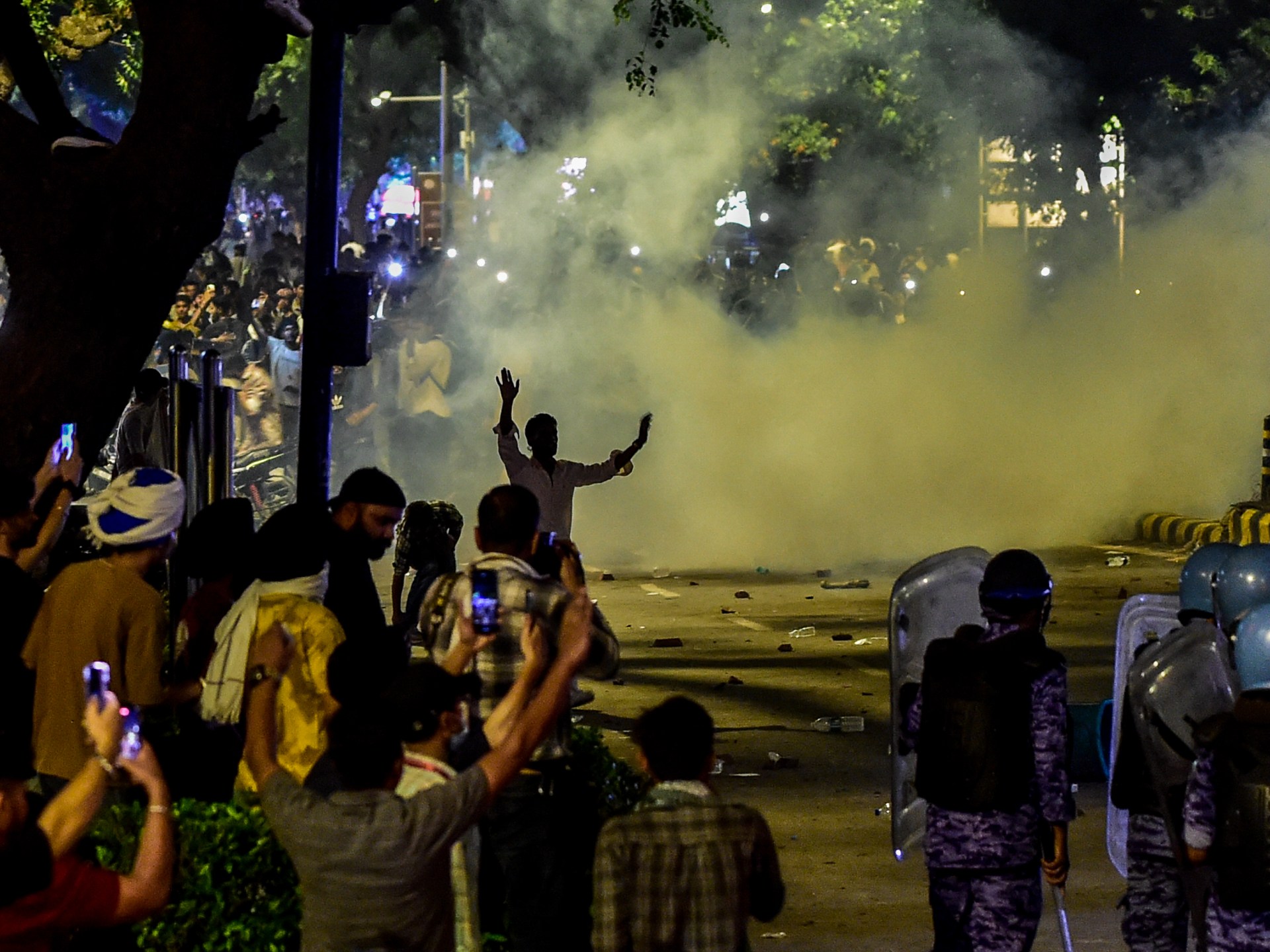
By refusing to be intimidated, India’s students have turned a protest over education into a crisis for Narendra Modi.Investigative journalist.Published On 23 Jul 2026Tear gas fills the air as police in riot gear face protesters during a demonstration led by the Cockroach Janta Party near Parliament Street on July 22, 2026, in New Delhi, India [Ritesh Shukla/Getty Images]Twelve years, one month and 24 days after Narendra Modi was sworn in, the words “Modi must resign” were uttered full-throatedly for the first time – without fear, in front of witnesses and cameras – on the streets of the national capital.India’s Gen Z is saying the unthinkable.For more than a month, students, led by the Cockroach Janta Party (CJP), have been camped out at Jantar Mantar, a prominent protest site in central New Delhi, seeking education reforms and the resignation of Education Minister Dharmendra Pradhan. This week marked a significant escalation in the movement’s demands with students now also calling for the resignations of Prime Minister Modi and Home Minister Amit Shah. Modi has announced fast-track courts to deal with exam-leak cases, but the government has offered no apology for the police crackdown on protesters or indicated that officers accused of using excessive force will be investigated.The CJP had called for a march on the Indian Parliament on Monday, the first day of the monsoon session. The government’s misstep was to forcibly take activist Sonam Wangchuk to Safdarjung Hospital on the 21st day of his hunger strike. He had not eaten since June 28 in support of the students’ demands. The forced hospitalisation drew even greater support for the students. “Unmobilised” people – those who had not been called on or directed by any organisation to join the protest – also started pouring in, trying to make their way to parliament.More than 100,000 “cockroaches” streamed into central New Delhi, paying no heed to warnings from the Delhi Police or government decisions to close 16 metro stations leading to Jantar Mantar, barricade roads, jam the internet and bring in plainclothes goons. Still, people kept pouring in. Central New Delhi became a tinderbox, and students stood their ground, facing pellet guns and batons through heavy overnight rain and clouds of tear gas.By the end of the march on parliament, at least 200 people had been injured. Police officers were filmed staging evidence, assaulting women and using spiked batons and tear gas. The Delhi Police assault acted as a force multiplier with India’s opposition parties staging their own protest, this one outside the prime minister’s residence.The protests spread across India, like a stubborn oil stain, from Patna and Mumbai to Goa. Families of children who died by suicide due to the exam leaks joined the protests. Farmers who had protested for an entire year on Delhi’s borders in 2021 returned from Punjab with food, supplies and additional volunteers. Social media were awash with reels of former voters for Modi’s Bharatiya Janata Party joining the protests.Just a few hours after police cleared the protest site, the monsoon cockroaches returned to Jantar Mantar that same night after a tumultuous day spent trying to reach parliament.What began as a dispute over education has morphed into a broader moment of resistance. There can no longer be any doubt that India’s elections and political system are being manipulated through voter fraud, horse-trading, hate speech, coerced political defections and the misuse of state institutions. Voter manipulation alone makes even the Emergency era when democratic rights were suspended under Indira Gandhi from 1975 to 1977 look decent by comparison.The education minister refuses to resign. Rajasthan’s health minister blames parents for overdosing their children instead of holding the manufacturers of substandard cough syrups responsible for the deaths of children in India and around the world. The petroleum minister says fuel prices will not be reduced even as global crude oil prices fall sharply. And the finance minister has responded to complaints about soaring onion prices by saying she does not eat onions.Modi has been presiding over a scam-tainted government that has lost its legitimacy.Across his three terms, he has not accepted a shred of responsibility for any crisis that has befallen Indian citizens on his watch: COVID-19, demonetisation, the revocation of Article 370, the violence in Manipur and inflation. Every time he is challenged, he moves further away from the democratic principles on which India was founded.In 2019, when he bulldozed the Citizenship Amendment Act through parliament without any meaningful debate, citizens erupted with similar anger. The protests that followed echoed the present moment, but they were cut short by the COVID-19 pandemic. The Modi administration imposed a nationwide lockdown when India had reported just over 500 confirmed cases, arrested protesters and dismantled the protest sites.This is the biggest crisis of his tenure as prime minister – and of his entire political career.Modi has never lost an election since first contesting one in 2002. He had been appointed, rather than elected, chief minister of Gujarat in 2001. Since then, he has served three consecutive terms as chief minister, followed by three consecutive terms as prime minister, while repeatedly rigging the electoral playing field in his favour.The first two days of parliament’s monsoon session ended without Modi personally addressing the issue of education reforms. The third day, as protests intensified, Modi was a no-show. With him, everything is the Indian National Congress party’s fault. Or the citizens’ fault. Or foreign influence. It is always someone else’s responsibility.But this time, the strategy may not work.He has never faced an opposition as united, diverse, young and angry as this one.The students expect the education minister to be held accountable and, by extension, Modi too. The march alone is rightly being billed by the organisers as a historic moment for India. The protest, standing on the shoulders of Shaheen Bagh and the farmers’ protest, has turned into an uprising.So far, every government decision, from detaining Wangchuk to cracking down on protesters, has backfired, strengthening their resolve.This week, while tumultuous, stands in stark contrast with Modi’s tenure, which has seen an unprecedented erosion of fraternity and genuine solidarity among citizens. It has baffled me all these years that we have continued to think of ourselves as one nation. What is this nation without Kashmir? Or without student activism? Or without Mahatma Gandhi? Without an understanding of how the Mughals ruled and what the British did? The sense of oneness, rooted in shared values and lost in 2014, can be seen again at Jantar Mantar.In contrast with the violence meted out to them, the students have returned to the site, where they are cleaning up the area, supporting one another and documenting atrocities committed by Delhi Police. Wangchuk continues his hunger strike in hospital.A month ago, a small community of students was camped out in New Delhi. Today, the entire nation stands with them. When police barricaded them, they stole the barricades. When officers used water cannon, they turned them into a dance party. When police formed a cordon with a rope, the protesters started a game of tug-of-war.Anonymous donors are using food-delivery apps to send food and water to the student protesters. Doctors are volunteering to treat the injured. Others are making videos about the precautions protesters should take in the coming days, singing songs, reciting poetry and readying themselves for whatever lies ahead.Modi is still in power and still refusing to meet the protesters, apologise or sack the education minister. The court is indulging the conspiracy theory that the protests are foreign-funded. The Ministry of Home Affairs has expanded police powers to arrest protesters by treating demonstrations as a “national security threat”. There are concerning reports of a large-scale paramilitary mobilisation and personnel being brought in from Kolkata and Kashmir to clear Jantar Mantar.But for the first time since 2014, fear has switched sides.The views expressed in this article are the author’s own and do not necessarily reflect Al Jazeera’s editorial stance.
SRCAl Jazeera
LANGEN
LEANCenter
WORDS1 315
ENT12
THU · 2026-07-23 · 15:36 GMTBRIEF NSR-2026-0723-95431
NSR-2026-0723-95431Analysis·EN·Political Strategy
In India, fear has switched sides
Students in India, initially protesting education reforms and the Education Minister's resignation, have escalated their demands to include the resignations of Prime Minister Modi and Home Minister Amit Shah. The protests, led by the Cockroach Janta Party (CJP), began over a month ago at Jantar Mantar in New Delhi and have since spread nationwide.
Vidya KrishnanAl JazeeraFiled 2026-07-23 · 15:36 GMTLean · CenterRead · 6 min
Al JazeeraFIG 01
Reading time
6min
Word count
1 315words
Sources cited
1cited
Entities identified
12entities
Quality score
100%
§ 01
Briefing Summary
AI-generatedNEWSAR · AI
Students in India, initially protesting education reforms and the Education Minister's resignation, have escalated their demands to include the resignations of Prime Minister Modi and Home Minister Amit Shah. The protests, led by the Cockroach Janta Party (CJP), began over a month ago at Jantar Mantar in New Delhi and have since spread nationwide. A significant turning point occurred when activist Sonam Wangchuk was forcibly hospitalized during his hunger strike, drawing wider support. Despite government attempts to suppress the demonstrations through internet shutdowns and metro station closures, over 100,000 protesters marched towards Parliament, facing police crackdowns including tear gas and batons, resulting in numerous injuries. The article suggests these protests have evolved into a broader resistance against alleged voter manipulation and a perceived loss of government legitimacy under Prime Minister Modi.
Confidence 0.90Sources 1Claims 5Entities 12
§ 02
Article analysis
Model · rule-basedFraming
Political Strategy
Social Justice
Tone
Sensational
AI-assessed
CalmNeutralAlarmist
Factuality
0.40 / 1.00
Mixed
LowHigh
Sources cited
1
Limited
FewMany
§ 03
Key claims
5 extracted01
Students are protesting for education reforms and the resignation of the Education Minister, Prime Minister, and Home Minister.
factualCockroach Janta Party (CJP) and students
Confidence
0.90
02
Protests have spread across India, with families of suicide victims and farmers joining the demonstrations.
factualArticle
Confidence
0.80
03
At least 200 people were injured during the protest march on Parliament, with police accused of staging evidence and assaulting protesters.
factualArticle
Confidence
0.80
04
The government forcibly hospitalized activist Sonam Wangchuk during his hunger strike in support of the students.
factualArticle
Confidence
0.80
05
Over 100,000 protesters, referred to as 'cockroaches', entered central New Delhi despite police warnings and internet jamming.
factualArticle
Confidence
0.70
§ 04
Full report
6 min read · 1 315 words§ 05
Entities
12 identifiedKey playerOppositionContextPositiveNeutralNegative
People4
Organizations3
Locations4
§ 06
Keywords & salience
9 termsstudent protest
1.00
modi government
0.90
education reforms
0.80
police crackdown
0.80
exam leak
0.70
gen z
0.60
hunger strike
0.50
human rights
0.40
political crisis
0.40
§ 07
Topic connections
Interactive graph Network visualization showing 51 related topics
View Full Graph Person Organization Location Event|Click node to navigate|Edge numbers = shared articles