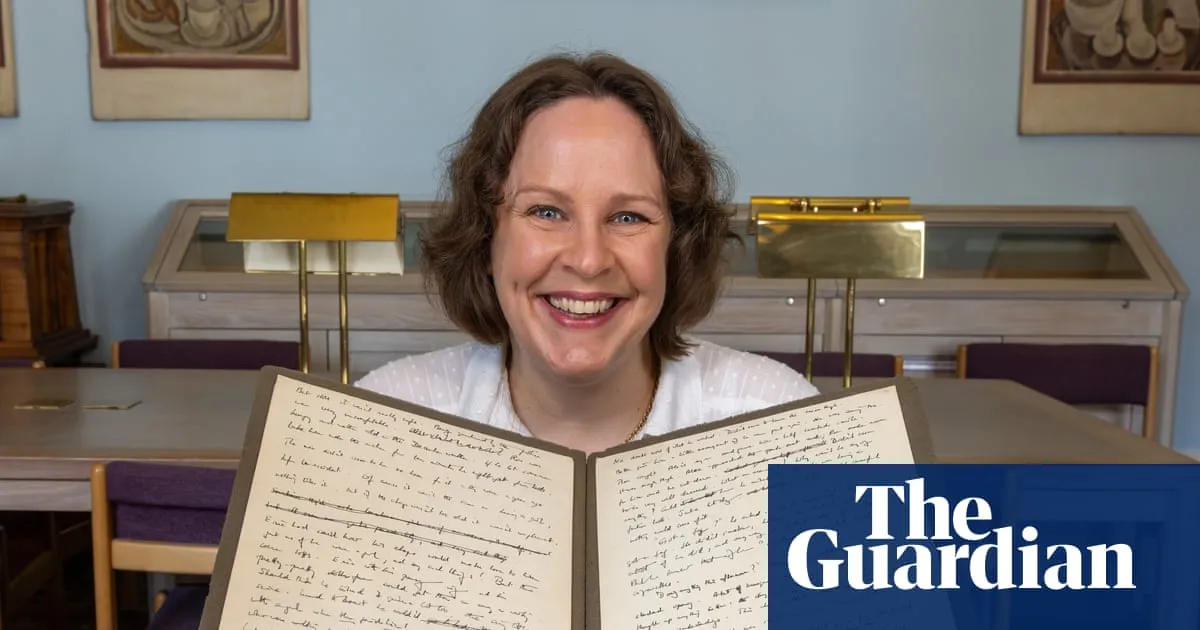
When people think of Alan Turing, they might imagine he was arrogant, isolated, humourless, tortured. A better way of remembering the father of modern computing would be, an academic argues, as “playful, funny, cheeky, literary, and someone who really liked sex”.The Cambridge University English literature professor Sarah Dillon has transcribed and studied a little-known short story that Turing wrote in the year after his arrest in Manchester for gross indecency.Her conclusion challenges the popular understanding of Turing as an “isolated mathematician”. The short story, she said, shone light on a man who loved literature, was enjoying life and was not ashamed of his sexuality.“I hope it will go some way towards resetting the narrative around Turing,” she said. “We think we know this figure and we don’t. There was more to him than is popularly believed.”Alan Turing is considered the father of modern computing. Photograph: GL Archive/AlamyTuring was Britain’s most prominent second world war code breaker. Some historians believe the work of Turing and others at Bletchley Park, breaking the German Enigma code, shortened the war by as many as four years.His pioneering postwar work at Manchester University helped open the door for the development of modern computers and artificial intelligence.In 1952 he was arrested and prosecuted for his homosexuality. Rather than go to jail he agreed to chemical castration. In 1954 he died aged 41 as a result of cyanide poisoning, which a coroner ruled was suicide but which some believe was an accident.In 2009 the UK government apologised for the “appalling” way Turing had been treated.For many people, their understanding of Turing is shaped by the 2014 film The Imitation Game starring Benedict Cumberbatch. “That is the problem,” said Dillon. “I actually rewatched it last night which confirmed my memory of it. It’s a really good film but it’s not accurate. It makes a lot of historical mistakes.“The version of Turing that it presents is a kind of Hollywood lone hero that actually doesn’t resemble what we know about the man himself.”A page from the short story. Photograph: King’s College/CambridgeDillon said the film got Turing wrong, depicting him as having no sense of humour, being very individualistic, refusing to collaborate, and having antagonistic relationships with other people. “He wasn’t this one-dimensional figure that Hollywood has painted him as,” she said.The short story, in the King’s College, Cambridge, archives, has been known about by Turing experts but never fully transcribed or studied by a literary scholar. The handwriting was hard to read and the story had largely been “sidelined and overlooked”, said Dillon.Titled Pryce’s Buoy, the six-page incomplete story was probably written in late 1952 or early 1953, Dillon believes. Its characters are Ron Miller, a working-class sex worker, and Alec Pryce, a scientist famed for an invention in his 20s known as “Pryce’s buoy” – hence the double meaning in the title.Dillon said Alec was clearly autofictional and represented Turing himself. The story’s narrator switches between Alec’s inner monologue and Ron’s. It is a racy tale about Alec, tired after work and Christmas shopping, wanting some fun. Ron, broke and unemployed, thinks he can make money from sex.Turing writes of Ron: “If he let someone take him under the arches for 10 minutes he might get five bob.”And later: “Ron caught Alec’s eye and gave him a half-hearted smile. It was enough though.”Sitting on a park bench, Ron thinks Alec is shabbily dressed but well off. Ron wonders “could he be mistaken? No, he was having a furtive look. Just a bit shy.”Alec’s impression of Ron is as “not a real beauty, but [he] had a certain appeal. Beggars couldn’t be choosers.”The pair then walk to a restaurant. Turing writes that Ron “didn’t go in for lah-di-dah ways of talking. It’d come to the same anyway. Bed’s bed whatever way you get into it. Alec thought otherwise.”Dillon said: “I love the hesitancy, the way it evokes the uncertainty of potential sexual encounter, the ‘am I reading this situation wrong?’ worry. ‘Am I going to put my foot in it? Am I going to go too far? What did they want? What do I want? Can I back out?’“Turing gets those tensions, the leaning in and backing out. He does it really well.”Dillon is certain that Turing was influenced by the writer Angus Wilson, once a towering literary figure but largely forgotten today. There is clear evidence of Turing copying phrases and narrative technique from Wilson’s pioneering gay novel Hemlock and After.“It’s completely normal that Turing copied Wilson,” she said. “When you start trying your hand as a creative writer, you copy what inspires you. It’s a kind of scaffolding because writing creatively is scary.”The story suggests Turing was a lot happier about life than might be assumed. It is also known that his 1952 summer holiday was in socially tolerant Norway, where he had liaisons. “His sexual spirit was not dampened by what happened to him,” Dillon said.Her findings are published in the Review of English Studies and she hopes it will provide a fresh insight into a misunderstood genius. “He’s come to be seen as socially unaware, entirely concerned with logic and numbers, and pretty isolated. His short story reveals a very different man: playful, funny, cheeky, literary, and someone who really liked sex.”
SRCThe Guardian - World News
LANGEN
LEANCenter-Left
WORDS877
ENT12
FRI · 2026-07-24 · 04:00 GMTBRIEF NSR-2026-0724-95587
NSR-2026-0724-95587News Report·EN·Human Interest
Racy short story by Alan Turing offers glimpse of ‘playful, funny, cheeky’ side
Cambridge University English literature professor Sarah Dillon has transcribed and studied a previously overlooked short story, "Pryce's Buoy," written by Alan Turing in 1952 or 1953, the year after his gross indecency arrest. This racy, incomplete story, featuring a scientist character likely representing Turing and a sex worker, challenges the common perception of Turing as an isolated and humorless mathematician.
Mark Brown North of England correspondentThe Guardian - World NewsFiled 2026-07-24 · 04:00 GMTLean · Center-LeftRead · 4 min
The Guardian - World NewsFIG 01
Reading time
4min
Word count
877words
Sources cited
2cited
Entities identified
12entities
Quality score
100%
§ 01
Briefing Summary
AI-generatedNEWSAR · AI
Cambridge University English literature professor Sarah Dillon has transcribed and studied a previously overlooked short story, "Pryce's Buoy," written by Alan Turing in 1952 or 1953, the year after his gross indecency arrest. This racy, incomplete story, featuring a scientist character likely representing Turing and a sex worker, challenges the common perception of Turing as an isolated and humorless mathematician. Dillon argues the story reveals Turing as playful, literary, and comfortable with his sexuality, suggesting a more complex and happier individual than often portrayed. The work, found in the King's College, Cambridge archives, highlights Turing's interest in literature and his engagement with potential sexual encounters.
Confidence 0.90Sources 2Claims 5Entities 12
§ 02
Article analysis
Model · rule-basedFraming
Human Interest
Technology
Tone
Mixed Tone
AI-assessed
CalmNeutralAlarmist
Factuality
0.70 / 1.00
Factual
LowHigh
Sources cited
2
Limited
FewMany
§ 03
Key claims
5 extracted01
The UK government apologized in 2009 for the 'appalling' treatment of Alan Turing.
factual
Confidence
1.00
02
Alan Turing is considered the father of modern computing and was a prominent second world war code breaker.
factual
Confidence
1.00
03
The short story offers a glimpse of Turing as 'playful, funny, cheeky, literary, and someone who really liked sex'.
quoteSarah Dillon
Confidence
1.00
04
Alan Turing wrote a little-known short story titled Pryce's Buoy in the year after his arrest for gross indecency.
factualSarah Dillon
Confidence
1.00
05
The 2014 film The Imitation Game, while good, is historically inaccurate and misrepresents Alan Turing.
factualSarah Dillon
Confidence
0.90
§ 04
Full report
4 min read · 877 words§ 05
Entities
12 identifiedKey playerOppositionContextPositiveNeutralNegative
People3
Organizations3
§ 06
Keywords & salience
10 termsalan turing
1.00
short story
0.90
father of modern computing
0.80
sexuality
0.70
code breaker
0.60
homosexuality
0.50
artificial intelligence
0.50
enigma code
0.50
chemical castration
0.40
the imitation game
0.40
§ 07
Topic connections
Interactive graph No topic relationship data available yet. This graph will appear once topic relationships have been computed.