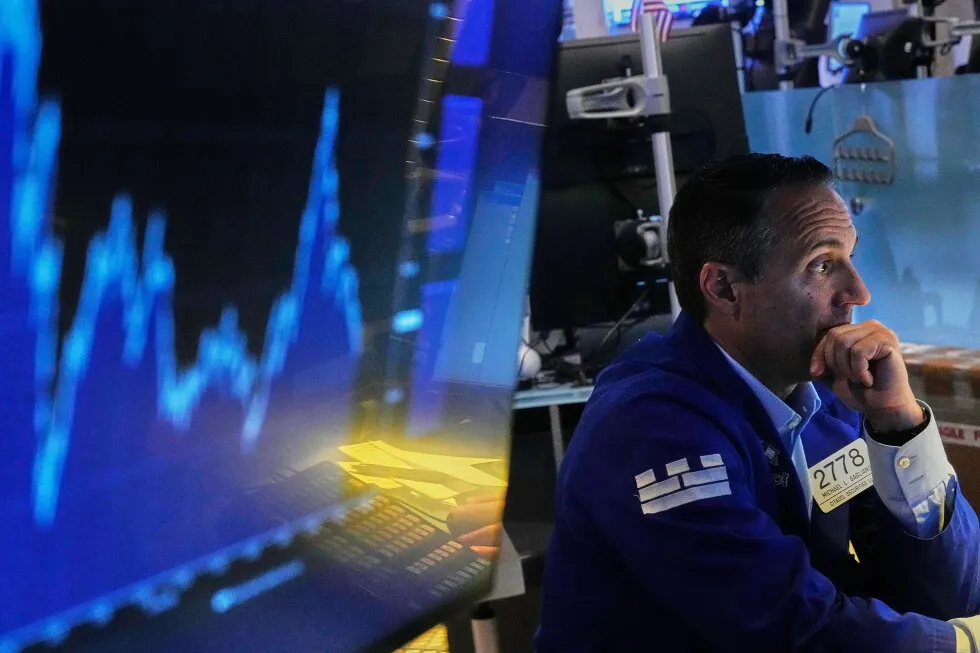
Shares skid in Asia in sell-off of AI-related shares as Brent oil tops $100 per barrel 1 of 5 | Specialist Michael Gagliano works at his post on the floor of the New York Stock Exchange, Thursday, June 25, 2026. (AP Photo/Richard Drew) 2 of 5 | An employee walks past near the screens showing the Korea Composite Stock Price Index (KOSPI) and the foreign exchange rate between U.S. dollar and South Korean won at a dealing room of Hana Bank in Seoul, South Korea, Friday, July 24, 2026. (AP Photo/Lee Jin-man) 3 of 5 | A TV cameraman prepares to film near the screens showing the Korea Composite Stock Price Index (KOSPI) and the foreign exchange rate between U.S. dollar and South Korean won at a dealing room of Hana Bank in Seoul, South Korea, Friday, July 24, 2026. (AP Photo/Lee Jin-man) 4 of 5 | A dealer walks past near the screen showing the Korea Composite Stock Price Index (KOSPI) at a dealing room of Hana Bank in Seoul, South Korea, Friday, July 24, 2026. (AP Photo/Lee Jin-man) 5 of 5 | A dealer talks on the phone near the screens showing the foreign exchange rates at a dealing room of Hana Bank in Seoul, South Korea, Friday, July 24, 2026. (AP Photo/Lee Jin-man) By ELAINE KURTENBACH Updated 7:13 AM MESZ, July 24, 2026 Add AP News on Google Add AP News as your preferred source to see more of our stories on Google. Share Share Facebook Copy Link copied Print Email X LinkedIn Bluesky Flipboard Pinterest Reddit BANGKOK (AP) — Shares skidded Friday in Asia after Brent crude shot to its highest price since May as heavy fighting in the Middle East again threatened to slow the global flow of oil and gas. U.S. futures were little changed after tumbles for two of Wall Street’s most influential companies, Alphabet and Tesla, yanked U.S. stocks to their worst loss in a month. Looming over markets: The deepening crisis in the Middle East, worries over the a potential bubble in investments in Artificial Intelligence and another round of tariff hikes by U.S. President Donald Trump. The U.S. is imposing taxes of 10% to 12.5% on imports from 60 trading partners, accounting for 99% of U.S. imports, saying they failed to fully enforce bans on goods produced by forced labor, the Trump administration said Thursday. That move came just as the clock was running out Friday on stopgap levies the president imposed after a stinging defeat for other such tariffs at the Supreme Court. Such uncertainties have helped push the U.S. dollar to a 40-year high against the Japanese yen. A dollar bought 163.83 yen early Friday, a level last seen in 1986. The euro was barely changed at $1.1378. South Korea’s Kospi stuttered lower, falling 5.9% to $6,681.98. Samsung Electronics sank 8% and shares in computer chipmaker SK Hynix dropped 7.4%. Brent oil tops $100 per barrel, as tumbles for Tesla and Alphabet yank Wall Street lower 5 MIN READ 155 Oil prices jump as fighting flares in the Middle East, while AI-led retreat pulls Asian stocks lower 2 MIN READ US stocks end mixed, weighed down by more losses for tech giants 2 MIN READ In Tokyo, the Nikkei 225 declined 3.1% to 64,377.28, led by losses for technology companies. SoftBank Group, which has massive investments in Artificial Intelligence, tumbled 7.5%. Hong Kong’s Hang Seng dropped 1.3% to 24,891.84, while the Shanghai Composite index shed 1.2% to 3,830.19. In Australia, the S&P/ASX 200 lost 1% to 8,755.10. On Thursday, the price of Brent crude shot to as high as $102 per barrel and settled at $100.69 per barrel, up 7%. Early Friday in Asia, it was down 0.3% at $100.40 per barrel. Before the Iran war began in late February it was trading around $72 per barrel. U.S. benchmark crude slipped 0.5% to $91.71 per barrel. The cause for the latest spike in prices: attacks on two Saudi oil tankers in the Red Sea. That threatens another avenue that oil companies use to move their crude from the Middle East to customers worldwide, along with the Strait of Hormuz. Underscoring the importance of the sea route for the economy, Trump threatened “major military punishment” against the Houthi rebels in Yemen, who are backed by Iran, if they keep attacking ships. U.S. stocks fell under the pressure of rising oil prices, which raise costs for businesses and cut into their customers’ ability to spend. The S&P 500 fell 1.2% and is on track for its first back-to-back weekly loss since March. The Dow Jones Industrial Average dropped 506 points, or 1%, and the Nasdaq composite sank 2.2%. Higher inflation could push the Federal Reserve and other central banks to raise interest rates, which would slow economies and undercut prices for stocks and other investments. The European Central Bank held its main interest rates steady at its meeting Thursday. Gasoline prices tend to follow oil prices higher, and a gallon of regular costs an average of $4.09 across the United States, according to AAA. That is still below highs of roughly $4.56 in May, but it was at just $3.93 a month ago. Tesla tumbled 14.5% after Elon Musk’s electric-vehicle company reported a weaker profit for the latest quarter than analysts expected. Because Tesla one of the largest stocks in the S&P 500 by market value, its stock has more influence on the index than nearly every other. One of the few that is larger is Alphabet. Its stock fell 7.1% even though the parent company of Google delivered stronger profit and revenue than analysts expected. Investors focused instead on how much Alphabet is planning to spend on AI after the company raised its forecast for capital spending. Associated Press Business Writers Matt Ott and Stan Choe contributed to this report. ELAINE KURTENBACH Based in Bangkok, Kurtenbach is the AP’s business editor for Asia, helping to improve and expand our coverage of regional economies, climate change and the transition toward carbon-free energy. She has been covering economic, social, environmental and political trends in China, Japan and Southeast Asia throughout her career. twitter mailto
SRCAssociated Press (AP)
LANGEN
LEANCenter
WORDS1 023
ENT12
FRI · 2026-07-24 · 05:23 GMTBRIEF NSR-2026-0724-95599
NSR-2026-0724-95599News Report·EN·Economic Impact
Shares skid in Asia in sell-off of AI-related shares as Brent oil tops $100 per barrel
Asian shares declined Friday as Brent crude oil surpassed $100 per barrel due to renewed Middle East conflict threatening oil and gas flows. U.S.
Associated Press (AP)Filed 2026-07-24 · 05:23 GMTLean · CenterRead · 5 min
Associated Press (AP)FIG 01
Reading time
5min
Word count
1 023words
Sources cited
1cited
Entities identified
12entities
Quality score
100%
§ 01
Briefing Summary
AI-generatedNEWSAR · AI
Asian shares declined Friday as Brent crude oil surpassed $100 per barrel due to renewed Middle East conflict threatening oil and gas flows. U.S. stocks also experienced significant losses, with Alphabet and Tesla's drops contributing to Wall Street's worst day in a month. Concerns over a potential artificial intelligence investment bubble and new U.S. tariff hikes also weighed on markets. The U.S. dollar reached a 40-year high against the Japanese yen. Attacks on Saudi oil tankers in the Red Sea were cited as the primary driver for the oil price surge. Rising oil prices are expected to increase business costs and reduce consumer spending, potentially leading to higher inflation and interest rates.
Confidence 0.90Sources 1Claims 5Entities 12
§ 02
Article analysis
Model · rule-basedFraming
Economic Impact
Conflict
Tone
Mixed Tone
AI-assessed
CalmNeutralAlarmist
Factuality
0.80 / 1.00
Factual
LowHigh
Sources cited
1
Limited
FewMany
§ 03
Key claims
5 extracted01
The U.S. dollar reached a 40-year high against the Japanese yen, with a dollar buying 163.83 yen.
statistic
Confidence
1.00
02
The U.S. is imposing taxes of 10% to 12.5% on imports from 60 trading partners.
factualTrump administration
Confidence
1.00
03
U.S. futures were little changed after tumbles for Alphabet and Tesla.
factual
Confidence
1.00
04
Shares skidded Friday in Asia after Brent crude shot to its highest price since May.
factual
Confidence
1.00
05
Heavy fighting in the Middle East threatened to slow the global flow of oil and gas.
factual
Confidence
0.90
§ 04
Full report
5 min read · 1 023 words§ 05
Entities
12 identifiedKey playerOppositionContextPositiveNeutralNegative
Organizations4
Locations5
§ 06
Keywords & salience
10 termsbrent oil
1.00
ai-related shares
1.00
middle east crisis
0.90
stock market
0.80
artificial intelligence bubble
0.70
us dollar
0.60
tariffs
0.50
alphabet
0.40
tesla
0.40
global flow of oil and gas
0.40
§ 07
Topic connections
Interactive graph Network visualization showing 51 related topics
View Full Graph Person Organization Location Event|Click node to navigate|Edge numbers = shared articles