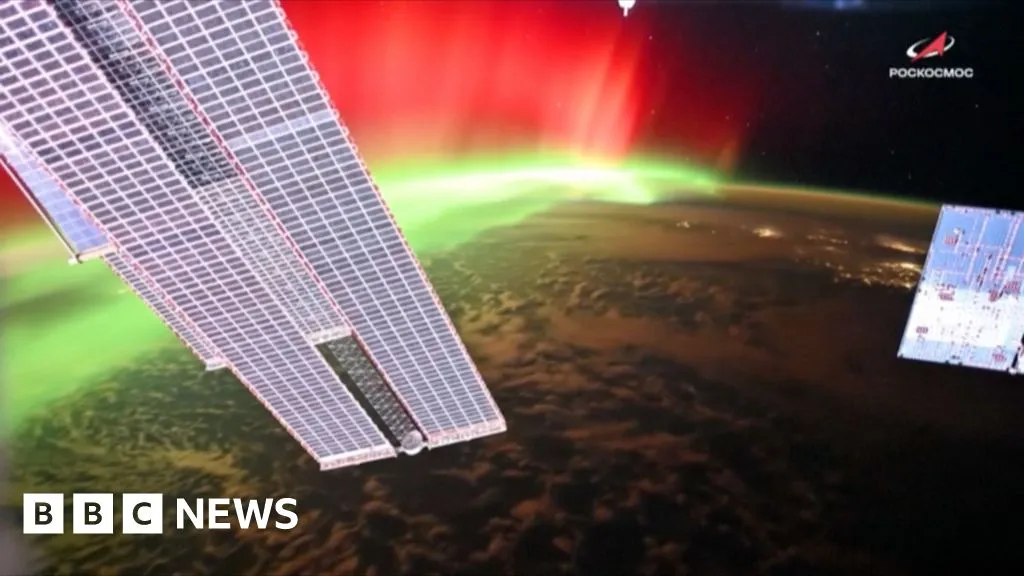
Cosmonaut Sergey Kud-Sverchkov captured breathtaking views of aurora lights over Earth, seen from the International Space Station. The lights were captured during one of the most powerful solar storms in over 20 years, according to the National Weather Service's Space Weather Prediction Center. The last solar radiation storm of comparable severity was recorded in October 2003. Auroras are caused by solar storms emitting high-speed charged particles colliding with Earth's atmosphere, creating vibrant light displays.
SRCBBC News - World
LANGEN
LEANCenter
WORDS74
ENT4
THU · 2026-01-22 · 01:02 GMTBRIEF NSR-2026-0122-9569
NSR-2026-0122-9569News Report·EN·Technology
Watch: Russian cosmonaut captures stunning aurora from space
From the International Space Station, Russian cosmonaut Sergey Kud-Sverchkov photographed a stunning aurora display. The aurora was triggered by a powerful solar storm, one of the strongest in over two decades, according to the National Weather Service's Space Weather Prediction Center.
BBC News - WorldFiled 2026-01-22 · 01:02 GMTLean · CenterRead · 1 min
BBC News - WorldFIG 01
Reading time
1min
Word count
74words
Sources cited
1cited
Entities identified
4entities
Quality score
100%
§ 01
Briefing Summary
AI-generatedNEWSAR · AI
From the International Space Station, Russian cosmonaut Sergey Kud-Sverchkov photographed a stunning aurora display. The aurora was triggered by a powerful solar storm, one of the strongest in over two decades, according to the National Weather Service's Space Weather Prediction Center. The last comparable solar radiation storm occurred in October 2003. These auroras are created when high-speed charged particles emitted from solar storms collide with Earth's atmosphere. The collision results in vibrant light displays visible from space and, under the right conditions, from Earth.
Confidence 0.85Sources 1Claims 4Entities 4
§ 02
Article analysis
Model · rule-basedFraming
Technology
Environmental
Tone
Measured
AI-assessed
CalmNeutralAlarmist
Factuality
0.90 / 1.00
Factual
LowHigh
Sources cited
1
Limited
FewMany
§ 03
Key claims
4 extracted01
Auroras are caused by solar storms emitting high-speed charged particles colliding with Earth's atmosphere.
factual
Confidence
1.00
02
The last solar radiation storm of comparable severity was recorded in October 2003.
factualNational Weather Service's Space Weather Prediction Center
Confidence
1.00
03
The auroras were seen during one of the most powerful solar storms in over 20 years.
factual
Confidence
1.00
04
Cosmonaut Sergey Kud-Sverchkov captured aurora lights over Earth from the ISS.
factual
Confidence
1.00
§ 04
Full report
1 min read · 74 words§ 05
Entities
4 identifiedKey playerOppositionContextPositiveNeutralNegative
§ 06
Keywords & salience
7 termsaurora
1.00
solar storm
0.90
international space station
0.70
space weather
0.60
earth's atmosphere
0.50
charged particles
0.50
solar radiation
0.40
§ 07
Topic connections
Interactive graph No topic relationship data available yet. This graph will appear once topic relationships have been computed.