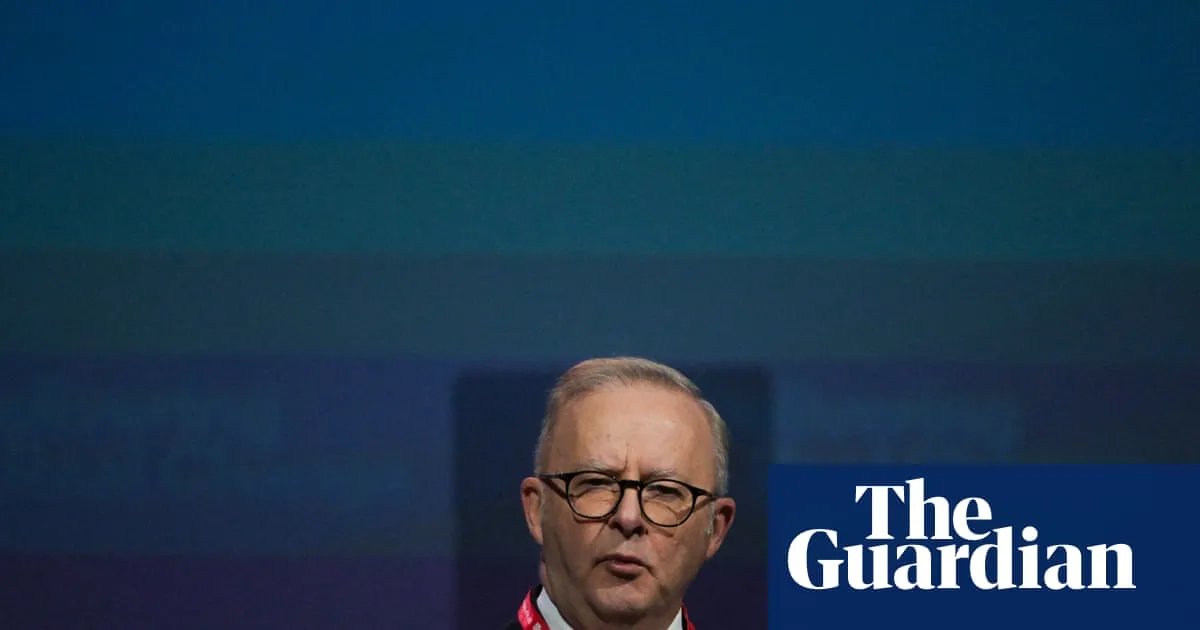
Anthony Albanese at last week’s ALP national conference. Labor’s updated platform says the party will ‘remove barriers that exist in federal law to the provision of end-of-life care’. Photograph: Tracey Nearmy/Reuters View image in fullscreen Anthony Albanese at last week’s ALP national conference. Labor’s updated platform says the party will ‘remove barriers that exist in federal law to the provision of end-of-life care’. Photograph: Tracey Nearmy/Reuters Albanese at odds with Labor policy which now says telehealth should be allowed for euthanasia consultations Campaigners say existing federal ban on phone or video calls for assisted dying consultations adversely affects people living in regional Australia Follow our Australia news live blog for latest updates Get our breaking news email, free app or daily news podcast Labor will come under pressure to allow Australians to access voluntary assisted dying through telehealth services, with the Greens and independent Kate Chaney to introduce legislation based on changes to Labor’s national platform. Last week’s national conference in Adelaide changed the ALP platform and committed Labor to overturn a Howard-era law banning people from having medical appointments regarding euthanasia via telehealth services. New language added to the platform gives Labor MPs a conscience vote on the issue, but the prime minister, Anthony Albanese, said on Sunday the government might not progress laws through parliament. The party’s platform is a set of policy principles but changes are not always immediately reflected in government legislation. Albanese said while he supported assisted dying, also known as voluntary euthanasia, he believed the telehealth change risked undermining proper medical safeguards. “It is important that people have the right to die … with dignity,” he told ABC TV. “But it’s also important that protections are placed around it. Now, if someone has a heart attack or an acute health condition, they need a doctor. They can’t do that over telehealth. “I think someone ending their life is just as important. I think it should be face-to-face recognition and face-to-face engagement. My concern is … the potential for misuse but also the potential it has to undermine the system itself.” Asked if the federal government would move to change the law to reflect the updated national platform, Albanese said the cabinet would decide on whether new legislation would be drafted, in consultation with MPs. “Governments determine what governments do around our cabinet table. What the conference does is put the general direction of what they want, and it’s clear that it’s a matter of conscience,” he said. Greens senator Sarah Hanson-Young on Sunday indicated she would quickly move ahead with a private member’s bill on the issue, an apparent attempt to force Labor’s hand. The Curtin MP, Kate Chaney, had said on Friday that she would move to reintroduce her own private member’s bill in the lower house, saying it would give Labor “the earliest opportunity to bring this cruel anomaly to an end and give country people the same access as Australians in the big cities”. “This overdue change in Labor policy on voluntary assisted dying should mean an end to the needless suffering of people in the final stages of life, particularly for those in regional areas who are currently forced to travel, sometimes repeatedly, just to access lawful medical care,” she said. Andrew Denton, a longtime campaigner and the founding director of Go Gentle, said access to care should not depend on someone’s location. “The PM is a supporter of end-of-life choice and he’s right to ask questions about the safety of using telehealth in the VAD process,” Denton said on Sunday. “For reassurance, he need look no further than the expert advice from medical groups such as the Australian Medical Association and Royal Australian College of General Practitioners, who say telehealth can and should be a safe adjunct to VAD services, certainly where the patient is too sick to travel or when a doctor cannot reach the patient in time. “It makes no sense that advice cannot be given by videoconference or scripts sent by email. Palliative care routinely discusses life-and-death decisions via telehealth and describes it as ‘particularly important’ in providing comprehensive supportive care in the last weeks of a patient’s life. There is no good reason to treat VAD any differently.” Doctors and advocates for voluntary assisted dying have long called for changes, arguing the telehealth ban adversely affects patients who live in rural and remote areas, and those whose conditions limit their movement or make travel painful. The federal criminal code prohibits the use of a carriage service to incite or encourage suicide, so health professionals risk breaking the law if they use telecommunications for many aspects of the VAD process. Fines of up to $300,000 are also possible for breaches of the law. Disparities between state and federal laws currently add to delays to patients obtaining approval for voluntary assisted dying, which is particularly problematic for those with health conditions leading to rapid decline, and who want to die at home. While state laws differ, generally, patients must make at least three requests for access to voluntary assisted dying to their doctor, and be assessed at least twice by medical professionals. Doctors require these appointments to be in person so that they do not breach federal laws. Labor’s updated national platform says the party will “remove barriers that exist in federal law to the provision of end-of-life care (including via telehealth) as part of lawful access to voluntary assisted dying in the states and territories, while maintaining appropriate clinical safeguards”. It also guarantees a conscience vote on the issue, where MPs are not bound by the government’s position on a bil Explore more on these topics Labor party Assisted dying Anthony Albanese news Share Reuse this content
SRCThe Guardian - World News
LANGEN
LEANCenter-Left
WORDS951
ENT12
SUN · 2026-07-26 · 02:22 GMTBRIEF NSR-2026-0726-96011
NSR-2026-0726-96011News Report·EN·Human Rights
Albanese at odds with Labor policy which now says telehealth should be allowed for euthanasia consultations
The Australian Labor Party's national conference has updated its platform to support removing federal barriers to voluntary assisted dying (VAD) consultations via telehealth. This change, however, places Prime Minister Anthony Albanese at odds with the new policy, as he expressed concerns about potential misuse and undermining safeguards, advocating for face-to-face engagement.
Tom McIlroy Political editorThe Guardian - World NewsFiled 2026-07-26 · 02:22 GMTLean · Center-LeftRead · 4 min
The Guardian - World NewsFIG 01
Reading time
4min
Word count
951words
Sources cited
3cited
Entities identified
12entities
Quality score
100%
§ 01
Briefing Summary
AI-generatedNEWSAR · AI
The Australian Labor Party's national conference has updated its platform to support removing federal barriers to voluntary assisted dying (VAD) consultations via telehealth. This change, however, places Prime Minister Anthony Albanese at odds with the new policy, as he expressed concerns about potential misuse and undermining safeguards, advocating for face-to-face engagement. Campaigners and some MPs argue the current federal ban on telehealth for VAD consultations disproportionately affects individuals in regional Australia and those with limited mobility. The Greens and independent MP Kate Chaney plan to introduce legislation to enact these changes, aiming to provide equitable access to VAD services. Albanese stated that cabinet will decide whether to draft legislation reflecting the updated platform, emphasizing it is a matter of conscience for MPs.
Confidence 0.90Sources 3Claims 5Entities 12
§ 02
Article analysis
Model · rule-basedFraming
Human Rights
Political Strategy
Tone
Measured
AI-assessed
CalmNeutralAlarmist
Factuality
0.60 / 1.00
Mixed
LowHigh
Sources cited
3
Well sourced
FewMany
§ 03
Key claims
5 extracted01
The ALP national conference changed the platform to give Labor MPs a conscience vote on the issue of telehealth for euthanasia consultations.
factualLabor Party
Confidence
1.00
02
Prime Minister Anthony Albanese believes allowing telehealth for euthanasia consultations risks undermining proper medical safeguards and could be misused.
quoteAnthony Albanese
Confidence
1.00
03
Labor's updated platform commits the party to overturn a Howard-era law banning telehealth for euthanasia consultations.
factualLabor Party
Confidence
1.00
04
Campaigners argue the existing federal ban on phone or video calls for assisted dying consultations adversely affects people in regional Australia.
factualCampaigners
Confidence
0.90
05
Greens senator Sarah Hanson-Young and MP Kate Chaney intend to introduce legislation to allow telehealth for voluntary assisted dying consultations.
factualSarah Hanson-Young, Kate Chaney
Confidence
0.90
§ 04
Full report
4 min read · 951 words§ 05
Entities
12 identifiedKey playerOppositionContextPositiveNeutralNegative
Organizations3
§ 06
Keywords & salience
10 termstelehealth consultations
1.00
voluntary assisted dying
1.00
labor policy
0.90
euthanasia
0.80
anthony albanese
0.70
end-of-life care
0.60
medical safeguards
0.50
federal law
0.50
regional australia
0.40
alp national conference
0.40
§ 07
Topic connections
Interactive graph Network visualization showing 51 related topics
View Full Graph Person Organization Location Event|Click node to navigate|Edge numbers = shared articles