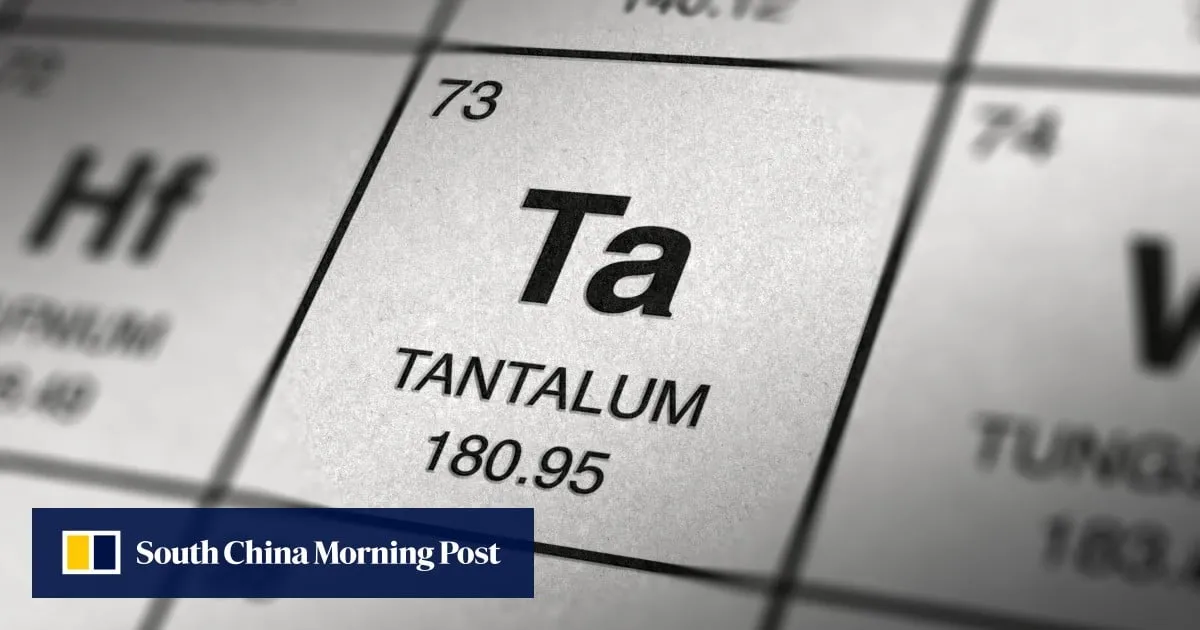
A team of Chinese scientists says it has developed an alloy that retains strength at ultra-high temperatures using tantalum – a very hard and flexible metal.For applications in aerospace, hypersonic vehicles and nuclear reactors, materials must endure both extreme heat and heavy loads. But most metals fail above 2,000 degrees Celsius (3,632 degrees Fahrenheit) – they either melt or soften to a putty-like consistency.New research is challenging that limit.According to a paper published last month in Nature, a research team led by Sun Jun at Xian Jiaotong University has developed an alloy that maintains exceptional load-bearing performance at temperatures up to 2,400 degrees.For most metals, once the temperature reaches about 60 per cent of their melting point, their internal structure changes rapidly and their strength drops. For example, the nickel-based single-crystal superalloys widely used in aeroplane engines cannot cross the 2,000-degree threshold.The team’s work focuses on a tantalum alloy. tantalum melts at nearly 3,000 degrees and alloys made using the metal are among the few materials that can carry loads above 2,000 degrees.
SRCSouth China Morning Post
LANGEN
LEANCenter-Right
WORDS173
ENT9
SUN · 2026-07-26 · 03:19 GMTBRIEF NSR-2026-0726-96014
NSR-2026-0726-96014News Report·EN·Technology
How Chinese scientists created an alloy that can survive 2,400 degrees Celsius
Chinese scientists at Xian Jiaotong University have developed a new alloy capable of maintaining strength at temperatures up to 2,400 degrees Celsius. This breakthrough, detailed in a recent Nature publication, addresses the critical need for materials that can withstand extreme heat and heavy loads in applications like aerospace, hypersonic vehicles, and nuclear reactors.
Zhang TongSouth China Morning PostFiled 2026-07-26 · 03:19 GMTLean · Center-RightRead · 1 min
South China Morning PostFIG 01
Reading time
1min
Word count
173words
Sources cited
1cited
Entities identified
9entities
Quality score
100%
§ 01
Briefing Summary
AI-generatedNEWSAR · AI
Chinese scientists at Xian Jiaotong University have developed a new alloy capable of maintaining strength at temperatures up to 2,400 degrees Celsius. This breakthrough, detailed in a recent Nature publication, addresses the critical need for materials that can withstand extreme heat and heavy loads in applications like aerospace, hypersonic vehicles, and nuclear reactors. Most metals fail above 2,000 degrees Celsius, melting or softening significantly. The new alloy utilizes tantalum, a metal that melts at nearly 3,000 degrees, and demonstrates exceptional load-bearing performance at these ultra-high temperatures, overcoming the limitations of current materials.
Confidence 0.90Sources 1Claims 5Entities 9
§ 02
Article analysis
Model · rule-basedFraming
Technology
National Security
Tone
Measured
AI-assessed
CalmNeutralAlarmist
Factuality
0.90 / 1.00
Factual
LowHigh
Sources cited
1
Limited
FewMany
§ 03
Key claims
5 extracted01
The research was published in the journal Nature.
factual
Confidence
1.00
02
Nickel-based single-crystal superalloys, used in aeroplane engines, cannot exceed the 2,000-degree threshold.
factual
Confidence
1.00
03
The new alloy uses tantalum, a metal that melts at nearly 3,000 degrees Celsius.
factual
Confidence
1.00
04
Most metals fail above 2,000 degrees Celsius, either melting or softening significantly.
factual
Confidence
1.00
05
Chinese scientists have developed an alloy that retains strength at temperatures up to 2,400 degrees Celsius.
factualSun Jun at Xian Jiaotong University
Confidence
1.00
§ 04
Full report
1 min read · 173 words§ 05
Entities
9 identifiedKey playerOppositionContextPositiveNeutralNegative
Locations1
§ 06
Keywords & salience
9 termsultra-high temperature alloy
1.00
tantalum alloy
0.90
high temperature materials
0.80
aerospace applications
0.70
hypersonic vehicles
0.60
material science
0.50
nuclear reactors
0.50
load-bearing performance
0.40
xian jiaotong university
0.40
§ 07
Topic connections
Interactive graph Network visualization showing 51 related topics
View Full Graph Person Organization Location Event|Click node to navigate|Edge numbers = shared articles