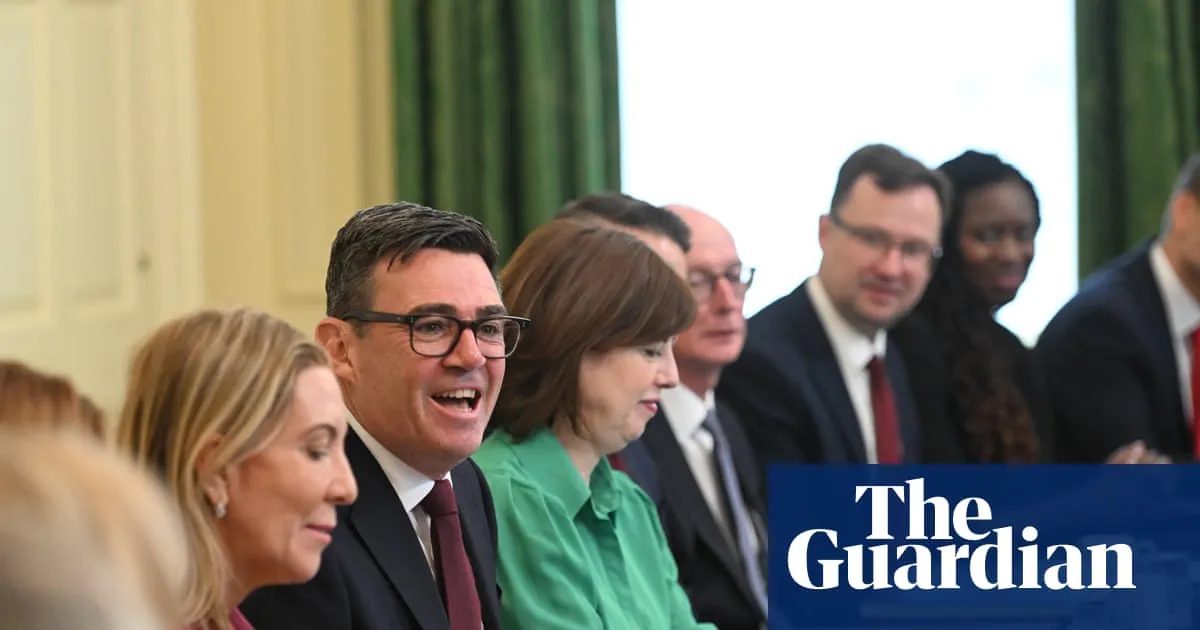
Like 20 British prime ministers before him, Andy Burnham’s new cabinet minister for AI, Kanishka Narayan, went to Eton. After graduating from the country’s most elite private school, Narayan attended Oxford" class="entity-link entity-organization" data-entity-id="171590" data-entity-type="organization">Balliol College, Oxford, where he studied – what else? – PPE (politics, philosophy and economics), like David Cameron, Rishi Sunak, Ed Miliband and a host of other senior politicians. An MBA at Stanford and a career in the City followed.But Narayan’s background is hardly typical of the British ruling class. Born in Bihar in eastern India, he moved with his family to Cardiff when he was 12. He and his younger brother were sleeping on the floor of their one-bedroom home when a teacher at his local high school suggested the bright young boy apply for some private schools. His parents, who had joined the Labour party almost as soon as they arrived in Wales, ran a petrol station. Eton was possible only thanks to a full scholarship.Class and representation in 21st-century Britain can be complicated. By some yardsticks, for example, the makeup of Burnham’s ministerial team, which was announced after he became prime minister on Monday, could be seen as a backward step. More than a fifth of his cabinet attended private schools for most of their education – at times, under Keir Starmer, every senior minister went to a state school. And a remarkable 54% of the ministers now leading government policy went to Oxford or Cambridge, up from 29% under Starmer. (Nationally, the figure is 1%.)In other ways, however, Burnham’s top team is more diverse than before, with half of those attending cabinet – including, of course, the PM – representing northern constituencies. And for the first time in history, the cabinet has equal numbers of women and men. One of them, the energy secretary, Miatta Fahnbulleh, is among those who were educated privately – this after she and her family arrived in Britain as asylum seekers from Liberia in 1986.How much does all of this matter? The prime minister’s top ministers ought to be competent – do they need to be representative too?To Nick Harrison, the chief executive of the Sutton Trust, which works to promote social mobility, the answer is an emphatic yes. “Of course, the background of the cabinet matters. If they’re meant to be representing the country, they should be representative of the country. We would absolutely say that you get better decisions if you have a wide range of views, perspectives and backgrounds around the table.”The sample size of 28 cabinet attendees may be small, but to Sam Friedman, a professor of sociology at London School of Economics whose work focuses on class and inequality, its makeup is symbolic of the wider access to power in Britain. Scrutinising those in senior positions “provides a window into a wider conversation about how people’s backgrounds shape their ability to reach the top positions in our society”, he says.Power in Britain remains overwhelmingly concentrated in the hands of a very narrow group of people, according to Friedman’s research. He points out that pupils of the nine most exclusive private schools are still, today, 52 times more likely to reach elite positions than those who go to any other type of school. Oxbridge graduates born in the 1960s and early 1970s – Burnham was born in 1970 and went to Cambridge – were more than 250 times more likely to reach the British elite than their peers who did not go to university.The cabinet – whatever its makeup – is merely the visible tip of a vast iceberg of powerbrokers, whose own elite backgrounds can be key in the way government decisions are taken, argues Friedman. According to his own research surveying attitudes among the elite, he says “those who are brought up in more privileged backgrounds tend to tilt to the right”, and “people in positions of power in the cabinet are often interacting with civil servants and business leaders who mediate their ability” to take decisions.To Lee Elliot Major, a professor of social mobility at the University of Exeter, it is legitimate to scrutinise the backgrounds of those running the country, but “counting private schools and Oxbridge degrees only tells part of the story. The real challenge is whether ministers understand how Britain’s contemporary opportunity system now works.“Traditional markers such as school attended or parents’ occupations no longer signal advantage in the straightforward way they once did. Today’s divides are increasingly shaped by wealth, place, networks and the hidden cultural codes that govern entry and progression into our elites.”The challenge goes way beyond widening access to the traditional routes to power, important though that may be, Major argues. Instead, politicians of whatever background must grapple what he calls “the profound unravelling of the promise of modern capitalism” – the fact that, for people in their 40s and younger, there are now more people experiencing downward mobility than upward, meaning they are less well-off than their parents.“The test for this government isn’t whether ministers themselves are socially mobile. It’s whether they can create a society in which many more people have genuine opportunities to flourish,” Major says.Dr Daniel Evans, a lecturer at Swansea University whose work includes a focus on politics and social class, agrees. “The origin story [of politicians] is a bit of a red herring,” he says. “The bigger story is the total collapse of the graduate premium and the debt that students are getting into in university and how brutal the job market is for graduates.“We keep talking about social mobility as if everyone can do it, but university is out of reach for loads of people financially, the job market is horrendous. No one can get a flat. The discourse hasn’t kept up.”
SRCThe Guardian - World News
LANGEN
LEANCenter-Left
WORDS952
ENT12
SUN · 2026-07-26 · 11:00 GMTBRIEF NSR-2026-0726-96084
NSR-2026-0726-96084Analysis·EN·Social Justice
Is Burnham’s Oxbridge-heavy cabinet a sign of social mobility or lack of progress on class?
Andy Burnham's new cabinet has drawn scrutiny for its educational backgrounds, with over a fifth attending private schools and 54% having gone to Oxford or Cambridge, a significant increase from the previous administration. While this might appear to be a backward step in terms of class representation, the cabinet is also more diverse in other ways, with equal numbers of men and women and a focus on northern constituencies.
Esther AddleyThe Guardian - World NewsFiled 2026-07-26 · 11:00 GMTLean · Center-LeftRead · 4 min
The Guardian - World NewsFIG 01
Reading time
4min
Word count
952words
Sources cited
2cited
Entities identified
12entities
Quality score
100%
§ 01
Briefing Summary
AI-generatedNEWSAR · AI
Andy Burnham's new cabinet has drawn scrutiny for its educational backgrounds, with over a fifth attending private schools and 54% having gone to Oxford or Cambridge, a significant increase from the previous administration. While this might appear to be a backward step in terms of class representation, the cabinet is also more diverse in other ways, with equal numbers of men and women and a focus on northern constituencies. Experts suggest that the cabinet's makeup reflects broader access to power in Britain, though traditional markers like school and university may no longer fully indicate advantage. The article questions whether ministers' backgrounds matter for competence and representation, with some arguing that diverse perspectives lead to better decisions.
Confidence 0.90Sources 2Claims 5Entities 12
§ 02
Article analysis
Model · rule-basedFraming
Social Justice
Political Strategy
Tone
Measured
AI-assessed
CalmNeutralAlarmist
Factuality
0.60 / 1.00
Mixed
LowHigh
Sources cited
2
Limited
FewMany
§ 03
Key claims
5 extracted01
Power in Britain remains overwhelmingly concentrated in the hands of a very narrow group.
quoteSam Friedman
Confidence
1.00
02
The background of the cabinet matters because they should be representative of the country.
quoteNick Harrison
Confidence
1.00
03
More than a fifth of Burnham's cabinet attended private schools.
statistic
Confidence
1.00
04
54% of Andy Burnham's current cabinet attended Oxford or Cambridge, up from 29% under Keir Starmer.
statistic
Confidence
1.00
05
Kanishka Narayan, the new cabinet minister for AI, attended Eton and Oxford, studying PPE.
factual
Confidence
1.00
§ 04
Full report
4 min read · 952 words§ 05
Entities
12 identifiedKey playerOppositionContextPositiveNeutralNegative
People4
Organizations4
§ 06
Keywords & salience
10 termsclass
1.00
social mobility
1.00
representation
0.90
oxbridge
0.80
private schools
0.70
cabinet
0.60
diversity
0.50
andy burnham
0.50
elite education
0.40
sutton trust
0.40
§ 07
Topic connections
Interactive graph Network visualization showing 51 related topics
View Full Graph Person Organization Location Event|Click node to navigate|Edge numbers = shared articles