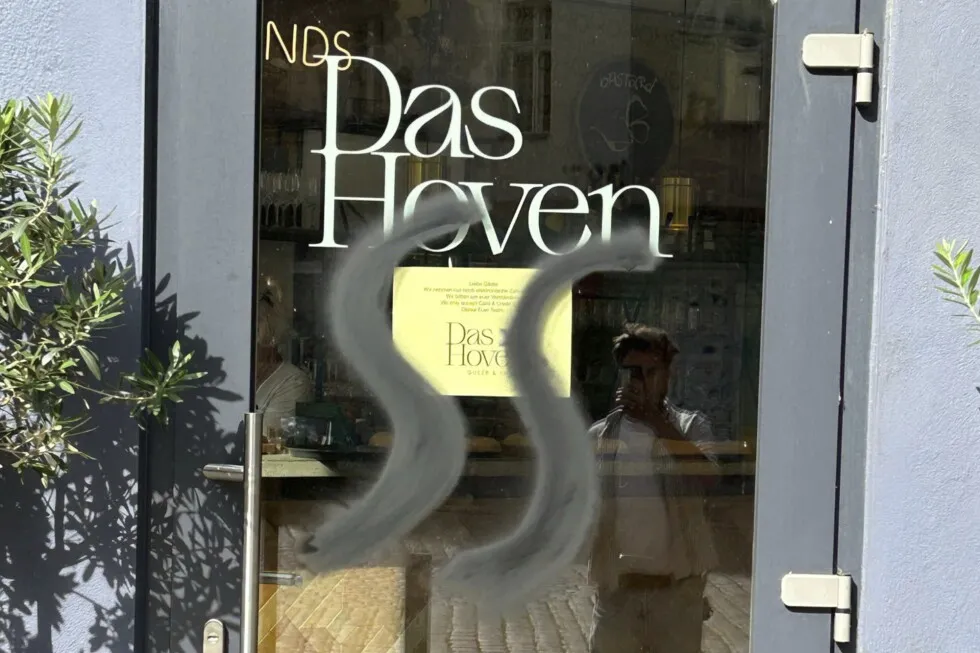
How an LGBTQ+ cafe’s neon sign became a beacon for hate in Berlin 0 seconds of 1 minute, 36 secondsVolume 0% Press shift question mark to access a list of keyboard shortcuts Keyboard ShortcutsEnabledDisabled Shortcuts Open/Close/ or ? Play/PauseSPACE Increase Volume↑ Decrease Volume↓ Seek Forward→ Seek Backward← Captions On/Offc Fullscreen/Exit Fullscreenf Mute/Unmutem Decrease Caption Size- Increase Caption Size+ or = Seek %0-9 00:00 01:36 01:36 More Videos 00:58 Berlin's flagship Pride event, called Christopher Street Day, takes place in heart of the city 00:41 Zoo in Germany unveils a young pudu, the world’s smallest species of deer 01:40 Orthodox monks are the first to live and pray at a monastery in Estonia for 80 years 01:03 UN warns Middle East tensions threaten vital regional trade routes 01:25 'The last picture': A passing boater's photograph may be the 5 adults who drowned in Ohio 01:52 Americans face biggest food-price spike in decades 00:43 Dressed as Spider-Man, Christopher Hellenthal helps person in wheelchair cross street in Arkansas 01:00 Attempt to save a struggling swimmer leaves 5 dead in an Ohio river Close 1 of 7 | Attacks against LGBTQ+ people and establishments are rising across Germany. Last year, there was a 40% increase in anti-LGBTQ+ violence in 12 out of Germany’s 16 federal states as compared to 2023, according to officials, but activists say those figures only show a fraction of the scope of the problem. 2 of 7 | This handout picture provided on Thursday, July 31, 2025 shows Nazi graffiti sprayed onto the entrance door of the ‘Das Hoven’ cafe in Berlin, Germany. (Danjel Zarte via AP) 3 of 7 | Exterior view of the ‘Das Hoven’ cafe in Berlin, Germany, Thursday, July 31, 2025. (AP Photo/Fanny Brodersen) 4 of 7 | Interior view of the ‘Das Hoven’ cafe with a neon sign reading ‘Queer And Friends’ in Berlin, Germany, Thursday, July 31, 2025. (AP Photo/Fanny Brodersen) 5 of 7 | Exterior view of the ‘Das Hoven’ cafe with a neon sign reading ‘Queer And Friends’ in Berlin, Germany, Thursday, July 31, 2025. (AP Photo/Fanny Brodersen) 6 of 7 | People dance as they take part in the LGBTQ annual pride march in Berlin, Germany, Saturday, July 26, 2025. (AP Photo/Ebrahim Noroozi) 7 of 7 | People attend the LGBTQ annual pride march in Berlin, Germany, Saturday, July 26, 2025. (AP Photo/Ebrahim Noroozi) By Fanny Brodersen and STEFANIE DAZIO Updated 2:42 PM MESZ, July 31, 2025 Leer en español Add AP News on Google Add AP News as your preferred source to see more of our stories on Google. Share Share Facebook Copy Link copied Print Email X LinkedIn Bluesky Flipboard Pinterest Reddit Berlin (AP) — A neon sign inside the Das Hoven cafe in a trendy Berlin neighborhood proudly proclaims “Queer And Friends.” The sign was intended to show the cafe is a safe space for LGBTQ+ people. But it has also become a beacon for hate and homophobic attacks. Owner Danjel Zarte said there are 45 pending criminal investigations related to the cafe over the past year and a half, ranging from verbal and physical attacks on patrons and workers to windows being broken or covered in feces and Nazi graffiti. One person even stood outside the cafe with a gun. “An act of terror,” Zarte said. “I sometimes have panic attacks in the morning and am afraid to look at my cell phone because I’m afraid that something has happened again.” Attacks against LGBTQ+ people and gay-friendly establishments are rising across Germany, including in Berlin, a city that has historically embraced the community, members of which often use the word queer to describe themselves. Last year saw a 40% increase in violence targeting LGBTQ+ people in 12 of Germany’s 16 federal states as compared to 2023, according to the Association of Counseling Centers for Victims of Right-Wing, Racist and Antisemitic Violence. Activists say those figures only show a fraction of the problem’s scope because victims are often afraid to come forward. They partly blame the rise of the far-right across Europe, including in Germany where the Alternative for Germany party made significant gains in the February election. More Stories Hearing aids can seem like a big step. This NYC Ballet principal dancer doesn’t regret taking it 16 Picture this: A raffle offers a Picasso for 100 euros to fund Alzheimer’s research From ‘BuddhaBot’ to $1.99 chats with AI Jesus, the faith-based tech boom is here 52 Hostility toward LGBTQ+ people serves as a “rallying cry” for believers in right-wing extremism, according to Judith Porath, the association’s managing director. Experts have seen an increase in demonstrations and violence among neo-Nazis, most of whom are young men. Bastian Finke, the head of MANEO, an organization tracking anti-gay violence in the capital city, said those who are openly queer on Berlin’s roads “automatically run a very, very high risk simply because of who they are. To be attacked, to be insulted, to be spat on. We have these scenarios every day.” The fear was palpable at Saturday’s Christopher Street Day parade in Berlin. The annual Pride event commemorates the 1969 Stonewall rebellion in New York City, when a spontaneous street uprising was triggered by a police raid on the Stonewall Inn gay bar on Christopher Street in Greenwich Village. “The mood is actually tense: People are afraid, they are unsettled,” Thomas Hoffmann, a member of the event’s executive board, said Saturday. Hundreds of thousands of people showed up for the celebration, dancing to techno beats as they marched to the iconic Brandenburg Gate. “That is really a powerful, wonderful sign for more equality,” Hoffmann added. Hoffmann and others have long wanted German lawmakers to amend the constitution to explicitly include the legal protection of LGBTQ+ people from discrimination based on gender identity. But that looks unlikely to become a political priority. For Zarte, the stress of hate crimes and politics is nonstop, except during the Christopher Street Day parade, which always brings him to tears. “It is very moving to feel completely accepted once a year,” he said. Pietro De Cristofaro in Berlin contributed to this report. STEFANIE DAZIO Dazio covers Northern Europe from Berlin for The Associated Press. She previously covered crime and criminal justice from Los Angeles.
SRCAssociated Press (AP)
LANGEN
LEANCenter
WORDS1 039
ENT12
SUN · 2026-07-26 · 11:53 GMTBRIEF NSR-2026-0726-96094
NSR-2026-0726-96094News Report·EN·Social Justice
How an LGBTQ+ cafe’s neon sign became a beacon for hate in Berlin
The "QUEER AND FRIENDS" neon sign at Berlin's Das Hoven cafe, intended as a safe space for LGBTQ+ individuals, has become a target for hate and homophobic attacks. Owner Danjel Zarte reports 45 pending criminal investigations over 18 months, including vandalism and physical assaults.
Associated Press (AP)Filed 2026-07-26 · 11:53 GMTLean · CenterRead · 5 min
Associated Press (AP)FIG 01
Reading time
5min
Word count
1 039words
Sources cited
3cited
Entities identified
12entities
Quality score
100%
§ 01
Briefing Summary
AI-generatedNEWSAR · AI
The "QUEER AND FRIENDS" neon sign at Berlin's Das Hoven cafe, intended as a safe space for LGBTQ+ individuals, has become a target for hate and homophobic attacks. Owner Danjel Zarte reports 45 pending criminal investigations over 18 months, including vandalism and physical assaults. This reflects a broader trend of rising anti-LGBTQ+ violence in Germany, with a 40% increase reported last year in several states. Activists attribute this surge partly to the rise of the far-right. Experts note an increase in neo-Nazi activity, with hostility towards LGBTQ+ people serving as a "rallying cry" for right-wing extremism. The fear is palpable, impacting daily life for openly queer individuals and affecting events like Berlin's Christopher Street Day parade.
Confidence 0.90Sources 3Claims 5Entities 12
§ 02
Article analysis
Model · rule-basedFraming
Social Justice
Human Interest
Tone
Mixed Tone
AI-assessed
CalmNeutralAlarmist
Factuality
0.70 / 1.00
Factual
LowHigh
Sources cited
3
Well sourced
FewMany
§ 03
Key claims
5 extracted01
Nazi graffiti was sprayed onto the entrance door of the ‘Das Hoven’ cafe.
factualAP
Confidence
0.90
02
The neon sign reading ‘Queer And Friends’ at Das Hoven cafe has become a beacon for hate and homophobic attacks.
quoteDanjel Zarte
Confidence
0.90
03
There was a 40% increase in anti-LGBTQ+ violence in 12 out of Germany’s 16 federal states last year as compared to 2023.
statisticofficials
Confidence
0.90
04
Attacks against LGBTQ+ people and establishments are rising across Germany.
statisticofficials
Confidence
0.90
05
There are 45 pending criminal investigations related to the cafe.
factualDanjel Zarte
Confidence
0.80
§ 04
Full report
5 min read · 1 039 words§ 05
Entities
12 identifiedKey playerOppositionContextPositiveNeutralNegative
People3
§ 06
Keywords & salience
7 termslgbtq+ hate crimes
1.00
berlin cafe
0.90
rising anti-lgbtq+ violence
0.80
nazi graffiti
0.70
queer and friends
0.60
christopher street day
0.50
germany
0.40
§ 07
Topic connections
Interactive graph Network visualization showing 51 related topics
View Full Graph Person Organization Location Event|Click node to navigate|Edge numbers = shared articles