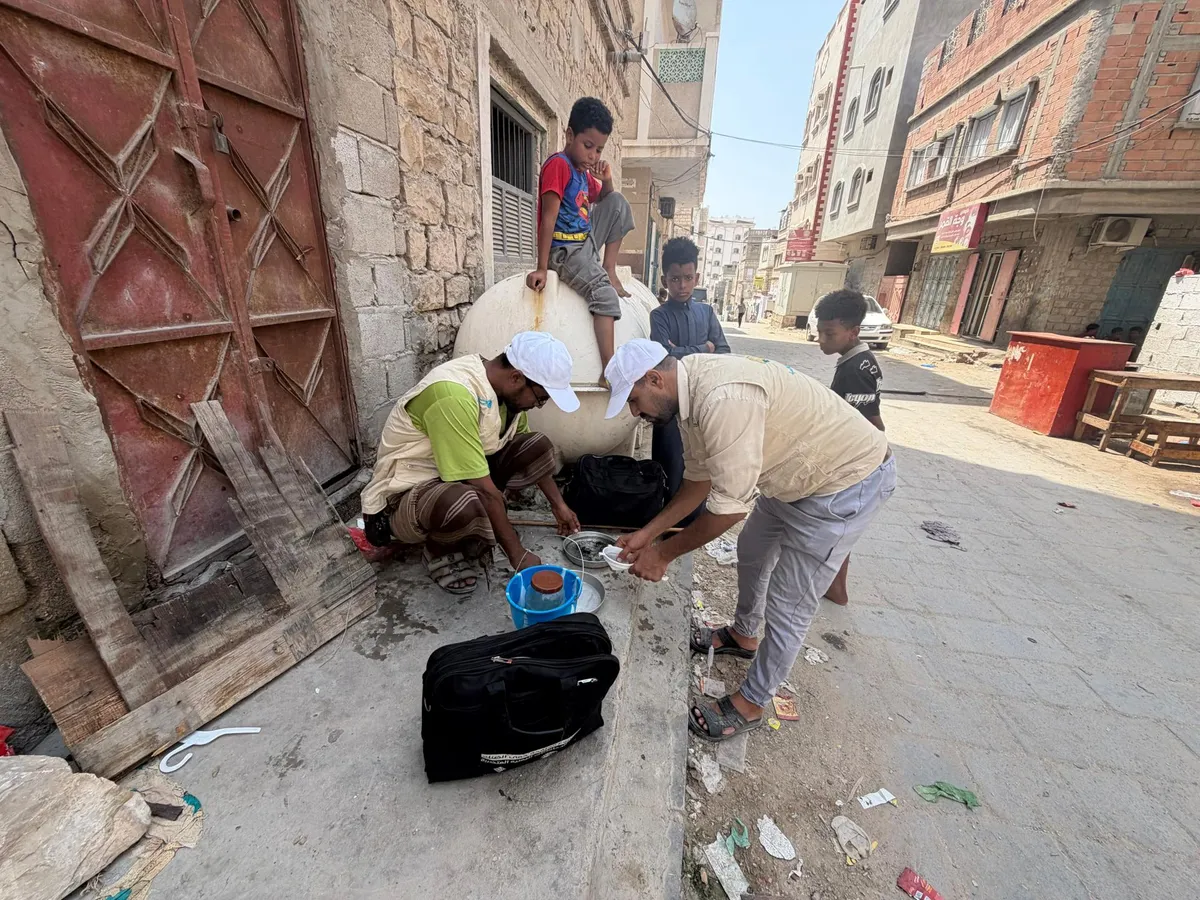
Health workers are battling to contain the mosquito-borne disease amid growing concern over rising infections.Salem bin Shabz, an insect surveillance officer, and his colleague collect water samples from an uncovered storage tank in Mukalla after identifying mosquito larvae that transmit dengue fever and malaria [Saeed Al-Batati/Al Jazeera]Published On 26 Jul 2026Mukalla, Yemen – Under the scorching sun and through heady humidity, Salem bin Shabz and his team of health workers move slowly through the narrow alleyways of Al-Koud, a densely populated slum in Yemen’s port city of Mukalla.Every time they spot a pool of stagnant water, they stop and inspect the puddle. Armed with dippers and sample containers, they are on the hunt for mosquito breeding grounds amid an outbreak of the deadly dengue fever.Makalla has become one of Yemen’s worst-hit areas for dengue fever, a viral infection spread by mosquito bites that can cause fevers, headaches, body aches, nausea, and in severe cases, death.Bin Shabz kneels beside an open drainage chamber where a puddle of stagnant water, discharged from a household air conditioner, has turned green after standing for weeks.He dips a ladle into the water and pours the contents into a shallow metal tray. Within seconds, tiny larvae begin wriggling across the surface.“These are mosquito larvae,” bin Shabz, an insect surveillance officer at the provincial office of the National malaria Control Programme (NMCP), told Al Jazeera.“This type is Anopheles, which transmits malaria, while the other is Aedes, the mosquito that spreads dengue fever. We collect the larvae, place them in containers and identify them before taking the necessary control measures.”The discovery confirms the team’s fears: Al-Koud has once again become a breeding ground for both dengue and malaria mosquitoes, despite repeated campaigns to control the spread of the insects.Mosquito larvae collected from stagnant water in a slum area of Mukalla. Health workers say the larvae develop into mosquitoes that transmit dengue fever and malaria [Saeed Al-Batati/Al Jazeera]“We carried out mosquito control campaigns in this area two months ago, combining public awareness, insecticide spraying and efforts to eliminate breeding sites,” bin Shabz says. “Now we’ve returned and found many of the same breeding sites still exist.”After draining the chamber, the team presses deeper into the neighbourhood. Minutes later, they stop outside another house where an uncovered water storage tank sits beside the entrance. Bin Shabz lowers a long-handled dipper into the tank and transfers another sample into a metal tray.“The tank is infested with both malaria and dengue larvae,” bin Shabz confirms. He asks a group of curious children to fetch the homeowner so he can explain the dangers of leaving the water tank exposed and cover the container. “A simple step like covering the tank would help protect his family and their neighbours from dengue fever,” he said.To his disappointment, the homeowner is not there, so bin Shabz leaves a message with neighbours. But the mosquito breeding site will remain untouched until the owner can be reached.“People are not cooperating with us,” he said. “In urban areas, many residents are still asleep when we carry out our morning inspections, while others are away from their homes. Whenever we identify a breeding site, we speak to the homeowner, explain the risks and advise them how to eliminate it.”Anti-dengue feverThe vector control team in Mukalla is one part of a nationwide campaign across government-controlled areas of Yemen to curb a new outbreak of dengue fever. The campaign combines the surveillance of mosquito breeding sites with public awareness campaigns, insecticide spraying, larval control, and training health workers to diagnose and treat dengue cases in hospitals and local health centres.According to the Aden-based Electronic Integrated Disease Early Warning System (eIDEWS), which monitors disease outbreaks across government-controlled areas of Yemen, 7,815 suspected dengue cases and 33 deaths were recorded between January 4 and July 18, 2026. Hadramout was the hardest-hit governorate, reporting 2,204 cases, followed by Aden (1,639), Abyan (962), Shabwa (951) and Taiz (770).The dengue fever outbreak has placed further strain on Yemen’s already fragile healthcare system, which has been pushed to the brink of collapse by years of war, chronic underfunding and repeated outbreaks of disease.Thousands of suspected dengue patients have sought treatment at hospitals across Aden, Taiz, Abyan and Hadramout, forcing overstretched health workers to cope with the surge despite limited resources.Mohammed Omer, head of the laboratory at the government-run Ibn Sina Hospital in Mukalla, recalled that at the height of the outbreak in May, the hospital received more than 60 suspected dengue cases in a single day. It placed an enormous burden on the hospital’s emergency department, which serves patients from Hadramout, Shabwa and Al Mahra governorates.“During one 24-hour shift, we used one and a half boxes of dengue testing kits to process samples from 65 suspected dengue patients,” Omer told Al Jazeera.“Patients come to our hospital because we provide free services, including laboratory testing, consultations and inpatient care,” he said.Despite the availability of free services, many patients still arrived at the hospital in critical condition, often because they delayed seeking treatment. Financial hardship prevents some from travelling to the hospital, while others initially dismissed their symptoms as an ordinary fever.Mohammed Omer, head of the laboratory at the government-run Ibn Sina Hospital in Mukalla, said his laboratory handled more than 60 suspected dengue fever cases at the peak of the outbreak in May [Saeed Al-Batati/Al Jazeera]“Many arrived late because they could not afford treatment, while others assumed it was just a passing fever and only sought medical help after it developed into severe dengue with bleeding symptoms, including nosebleeds. We also received destitute patients who could not afford medication,” he said.Mohammed Salem Hadi, head of the NMCP office, said anti‑dengue efforts in Shabwa province continue to be hampered by limited funding, low public awareness and patients delaying treatment until their condition becomes critical. These are challenges common across much of Yemen.“Many patients do not seek medical care until they develop severe dengue with haemorrhagic complications. This is often because they live far from health facilities, or because the disease is initially misdiagnosed as another illness,” he told Al Jazeera.Challenges in tackling dengue feverThe recurring dengue outbreaks have raised questions about why Yemen continues to struggle to contain dengue or reduce the number of deaths caused by the disease.Health experts and front-line workers put this down to a combination of factors, including the nature of the mosquito that transmits the virus, years of conflict that have weakened the country’s healthcare system, inadequate vector-control programmes, poor sanitation and stagnant water. There is also the challenge for health workers of limited public awareness about dengue prevention and the importance of seeking early treatment.Abdulla bin Ghouth, a professor of community medicine at Hadramout University, said dengue fever has become endemic in Yemen and that the country’s struggle to contain the disease is largely due to its biological characteristics.“There is no specific treatment for dengue fever; treatment focuses on managing symptoms and replacing lost fluids. There is also no specific vaccine available for prevention,” he told Al Jazeera. “These factors, together with environmental conditions such as household water storage and high humidity, make the disease difficult to control.”As he and his colleagues pack away their equipment and head off to search for another mosquito breeding site, bin Shabz acknowledges that eliminating the insects is an enormous challenge.Mosquito breeding sites are often hidden or difficult to access, he said, but Yemen’s economic collapse and deteriorating public services have made the problem far worse.“Many people cannot afford to build high-quality, properly sealed water tanks, so they rely on poorly constructed, uncovered tanks or even open ponds to store water,” he said. “Water shortages have forced many people to store water at home, creating ideal breeding sites for mosquitoes.”
SRCAl Jazeera
LANGEN
LEANCenter
WORDS1 282
ENT10
SUN · 2026-07-26 · 13:39 GMTBRIEF NSR-2026-0726-96099
NSR-2026-0726-96099News Report·EN·Public Health
Yemen’s health workers race to halt latest outbreak of deadly dengue fever
Yemen's health workers are actively combating a growing outbreak of deadly dengue fever, a mosquito-borne disease. In Mukalla, specifically in the Al-Koud slum, insect surveillance officers like Salem bin Shabz are identifying and attempting to eliminate mosquito breeding grounds, such as stagnant water in uncovered storage tanks and drainage chambers.
Saeed Al BatatiAl JazeeraFiled 2026-07-26 · 13:39 GMTLean · CenterRead · 6 min
Al JazeeraFIG 01
Reading time
6min
Word count
1 282words
Sources cited
1cited
Entities identified
10entities
Quality score
100%
§ 01
Briefing Summary
AI-generatedNEWSAR · AI
Yemen's health workers are actively combating a growing outbreak of deadly dengue fever, a mosquito-borne disease. In Mukalla, specifically in the Al-Koud slum, insect surveillance officers like Salem bin Shabz are identifying and attempting to eliminate mosquito breeding grounds, such as stagnant water in uncovered storage tanks and drainage chambers. Despite previous control efforts, these sites persist, highlighting challenges in public cooperation. This outbreak, with 7,815 suspected cases and 33 deaths recorded between January and July 2026 in government-controlled areas, further strains Yemen's already fragile healthcare system. The nationwide campaign includes surveillance, public awareness, insecticide spraying, and training health workers to manage the surge in patients.
Confidence 0.90Sources 1Claims 5Entities 10
§ 02
Article analysis
Model · rule-basedFraming
Public Health
Human Interest
Tone
Measured
AI-assessed
CalmNeutralAlarmist
Factuality
0.80 / 1.00
Factual
LowHigh
Sources cited
1
Limited
FewMany
§ 03
Key claims
5 extracted01
Salem bin Shabz identified mosquito larvae that transmit dengue fever and malaria in stagnant water in Mukalla.
factualSalem bin Shabz
Confidence
1.00
02
A simple step like covering water storage tanks can help protect families and neighbors from dengue fever.
factualSalem bin Shabz
Confidence
0.90
03
Despite previous control campaigns, many mosquito breeding sites still exist in the Al-Koud area of Mukalla.
factualSalem bin Shabz
Confidence
0.90
04
Mukalla has become one of Yemen’s worst-hit areas for dengue fever, a viral infection spread by mosquito bites.
factual
Confidence
0.90
05
Health workers are battling to contain the mosquito-borne disease amid growing concern over rising infections of dengue fever in Yemen.
factual
Confidence
0.90
§ 04
Full report
6 min read · 1 282 words§ 05
Entities
10 identifiedKey playerOppositionContextPositiveNeutralNegative
Organizations2
§ 06
Keywords & salience
8 termsdengue fever
1.00
health workers
0.90
mosquito-borne disease
0.80
outbreak
0.70
insect surveillance
0.60
breeding grounds
0.50
malaria
0.40
yemen
0.40
§ 07
Topic connections
Interactive graph No topic relationship data available yet. This graph will appear once topic relationships have been computed.