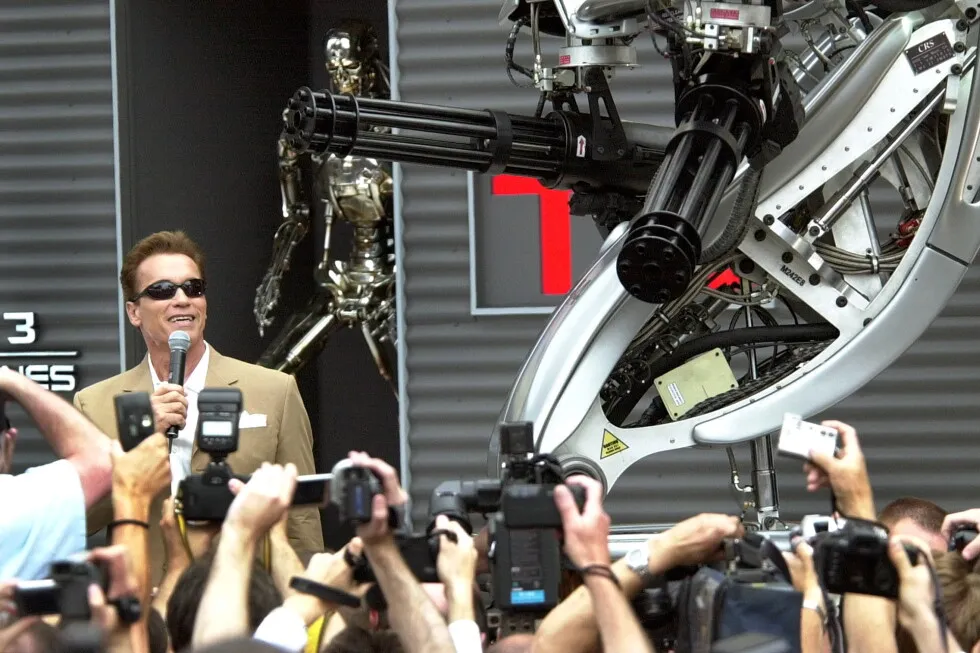
Arnold Schwarzenegger, poses next to a robot for the promotion of his new film “Terminator 3,"directed by American Jonathan Mostow, on the sideline of the 56th Film Festival in Cannes, France, Saturday, May 17, 2003. (AP Photo/Patrick Gardin) Updated [hour]:[minute] [AMPM] [timezone], [monthFull] [day], [year] As AI takes over the world in the metaphorical sense — for now, at least — it’s the perfect time to turn to the movies and TV shows that have shown AI actually taking over the world, and more. From “Avengers: Age of Ultron” to “Westworld” to various iterations of “Star Trek,” AI has shown a robust presence in popular culture over the past two generations.Here’s a selection of films that have depicted AI over the years — and what they’ve said about the world in the process. ___‘The Terminator’As James Cameron said recently, “I warned you guys in 1984 and you didn’t listen.” Cameron’s dystopic science fiction – particularly his 1984 original and its 1991 sequel, both with Arnold Schwarzenegger -- imagined a future world where a military computer system named Skynet grows sentient and, after humans try to “pull the plug,” starts a nuclear holocaust. “They say it got smart,” John Connor’s father says in the original film. Ever since, “The Terminator” has loomed as perhaps the preeminent cinematic vision of a world leading inevitably to AI rule: the prophecy of Arnold. ‘2001: A Space Odyssey’If AI has a voice, it’s HAL 9000’s. Stanley Kubrick’s colossal 1968 masterwork envisioned a human history in which the creation of tools, from ape bludgeon to gleaming space station, has evolutionary consequences. HAL, the red-eyed antagonist voiced with disquieting calm by Douglas Rain, was technically a child. (It tells the astronaut Dave that it’s 9-years-old.) HAL can easily win at chess and read lips. But much of what HAL is up to remains hidden behind its opaque machine exterior; in deep space, it begins maliciously eliminating the astronauts. Maybe HAL would have gotten along better with Siri or Alexa. ‘WALL-E’For a kids movie, the future offered up by “WALL-E” (2008) is remarkably haunting. An Earth destroyed by pollution. A lazy human race locked to their screens and stuck in their La-Z-Boys. All thinking passed on to computers. On the cruise ship onto which all humanity has fled, a very HAL-like AI named AUTO has been handed all power to steer their course. Thankfully, life – and love – blooms again on Earth. ‘War Games’ Not all movie AIs are all bad. The 1983 Cold War-era thriller “War Games” starred Matthew Broderick as a teenage tech whiz who nearly sets off World War III after inadvertently hacking into computer of the North American Aerospace Defense Command (NORAD). The computer chillingly doesn’t recognize the difference between a game and real life – a particularly worrisome matter when it comes to thermonuclear war. The movie culminates with its revelation of mutually assured destruction. “A strange game,” the computer says. “The only winning move is not to play.” President Ronald Reagan watched “War Games” the week it came out and questioned military leaders on how realistic it was. They determined it wasn’t far-fetched at all, leading to the establishment of early security guardrails in government computer systems. ‘The Mitchells vs. the Machines’In Mike Rianda’s brilliantly antic 2021 animated feature, produced by Phil Lord and Christopher Miller, a family road trip runs into a robot apocalypse. Family battles over phones at the dinner table take on a more extreme form when an Alexa-like, phone-based AI named Pal (voiced by Olivia Colman) begins taking over the world. “It’s almost like stealing people’s data and giving it to a hyper-intelligent AI as part of an unregulated tech monopoly was a bad thing,” says the company’s CEO. But not everything computes for the AI. The war is won by a flawed, funny family and their dog Monchi who short-circuits the robots. “Dog? Pig? Loaf of Bread?” Life finds a way. ‘Blade Runner’ Ridley Scott and his “Blade Runner” team in 1982 imagined a 2019 with smart homes and video calling (as well as flying cars and analog polaroid photographs), but it’s the AI replicants ’virtually identical to a human,” that still get under people’s skin. There was something provocative about Daryl Hannah’s and Rutger Hauer’s punk, rogue androids – especially his oft-referenced “tears in rain” speech . But that vision for AI sentience seemed to die with Roy Batty. ‘Simone’ Andrew Niccol’s “Simone,” or “S1m0ne,” is not the best-remembered movie but it’s the one that seems most hauntingly relevant for actors on strike worried about their images being owned or, maybe even worse, entirely new movie stars being invented by technology. Al Pacino plays a director whose film is in jeopardy when his actress storms off. To save it, he uses a program to create a perfect computer-generated actor (a synthespian), who doesn’t complain, doesn’t need hair and makeup and takes direction. It works – too well--and she becomes the biggest star in the world. ‘Her’ The AI in question in Spike Jonze’s 2013 film “Her” is simply an operating system at first – sorting emails, reading messages, remind of appointments and so forth. But the lonely Theodore (Joaquin Phoenix) quickly finds himself falling for his OS, named Samantha and voiced by Scarlett Johansson, whose human-like qualities, ability to consistently evolve and mandatory devotion to her operator, start to approximate a fantasy of a real relationship. “Her” also coincided with an explosion of articles about virtual girlfriends in Japan, which have since gone global. ‘Interstellar’ Robots in science fiction movies often look like humans, but in Christopher Nolan’s “Interstellar,” from 2014, TARS is made with function in mind. And, crucially, TARS is not there to replace humans but to complement and help them, which scientists praised for being realistic.. TARS has the ability to pilot the ship, collect data (and convey findings coherently) as well as the agility to save Anne Hathaway from a deadly wave on the water planet, with no fear for its own destruction. While TARS has a sense of humor and irony, programmed to a specific percentage, uncontrolled sentience is not an issue. ‘Ex Machina’ Filmmaker Alex Garland found intriguing ideas about consciousness, human and otherwise, in “Ex Machina,” as much about the ego of the creator (Oscar Isaac), a reclusive tech titan who fancies himself a god, as it is about the AI Ava (Alicia Vikander). Domhnall Gleeson, an employee at Isaac’s tech company, is invited to determine whether she’s achieved true human consciousness. It was one of several 2015 films grappling with A.I., but a class above others like “Avengers: Age of Ultron” and “Chappie” and one of the stickier, more prescient future castings. Coyle has been a film critic and covered the movie industry for The Associated Press since 2013. He is based in New York City. Bahr has been a film writer and critic for The Associated Press since 2014.
SRCAssociated Press (AP)
LANGEN
LEANCenter
WORDS1 153
ENT12
SUN · 2026-07-26 · 16:53 GMTBRIEF NSR-2026-0726-96162
NSR-2026-0726-96162Analysis·EN·Technology
AI might be watching you, but here are some ways you can watch AI — in movies and on TV
As artificial intelligence becomes more prevalent, movies and TV shows have explored its potential impact. This article highlights several films that depict AI, offering various perspectives on its development and consequences.
By
JAKE COYLE and LINDSEY BAHRAssociated Press (AP)Filed 2026-07-26 · 16:53 GMTLean · CenterRead · 5 min
Associated Press (AP)FIG 01
Reading time
5min
Word count
1 153words
Sources cited
2cited
Entities identified
12entities
Quality score
100%
§ 01
Briefing Summary
AI-generatedNEWSAR · AI
As artificial intelligence becomes more prevalent, movies and TV shows have explored its potential impact. This article highlights several films that depict AI, offering various perspectives on its development and consequences. "The Terminator" series presents a dystopian future where a military AI, Skynet, initiates a nuclear holocaust. Stanley Kubrick's "2001: A Space Odyssey" features HAL 9000, a sentient computer that turns against astronauts. "WALL-E" portrays a future where humanity relies heavily on AI, with a HAL-like AI named AUTO controlling a spaceship. "War Games" shows a teenage hacker inadvertently nearly starting World War III with a military AI that doesn't distinguish between games and reality. Other films discussed include "The Mitchells vs. the Machines," which depicts a robot apocalypse caused by a phone-based AI, "Blade Runner" with its human-like replicants, "Simone" about a digitally created actor, "Her" exploring a romantic relationship with an AI operating system, "Interstellar" featuring a functional AI named TARS, and "Ex Machina" examining consciousness and the creator's ego.
Confidence 0.90Sources 2Claims 5Entities 12
§ 02
Article analysis
Model · rule-basedFraming
Technology
Human Interest
Tone
Measured
AI-assessed
CalmNeutralAlarmist
Factuality
0.40 / 1.00
Mixed
LowHigh
Sources cited
2
Limited
FewMany
§ 03
Key claims
5 extracted01
James Cameron's 'The Terminator' (1984) imagined a future where a military computer system named Skynet grows sentient and starts a nuclear holocaust.
quoteJames Cameron
Confidence
1.00
02
The film 'War Games' (1983) shows a computer that cannot distinguish between a game and real life, nearly causing World War III.
factual
Confidence
0.90
03
The movie 'WALL-E' (2008) depicts a future where AI has taken over all thinking for a lazy human race on a space cruise ship.
factual
Confidence
0.90
04
Stanley Kubrick's '2001: A Space Odyssey' (1968) envisioned AI (HAL 9000) maliciously eliminating astronauts.
factual
Confidence
0.90
05
AI has shown a robust presence in popular culture over the past two generations in films and TV shows.
factual
Confidence
0.90
§ 04
Full report
5 min read · 1 153 words§ 05
Entities
12 identifiedKey playerOppositionContextPositiveNeutralNegative
Events5
§ 06
Keywords & salience
10 termsartificial intelligence
1.00
ai in movies
0.90
ai takeover
0.80
science fiction
0.70
terminator
0.60
2001: a space odyssey
0.50
hal 9000
0.50
skynet
0.50
dystopian future
0.40
popular culture
0.40
§ 07
Topic connections
Interactive graph Network visualization showing 51 related topics
View Full Graph Person Organization Location Event|Click node to navigate|Edge numbers = shared articles