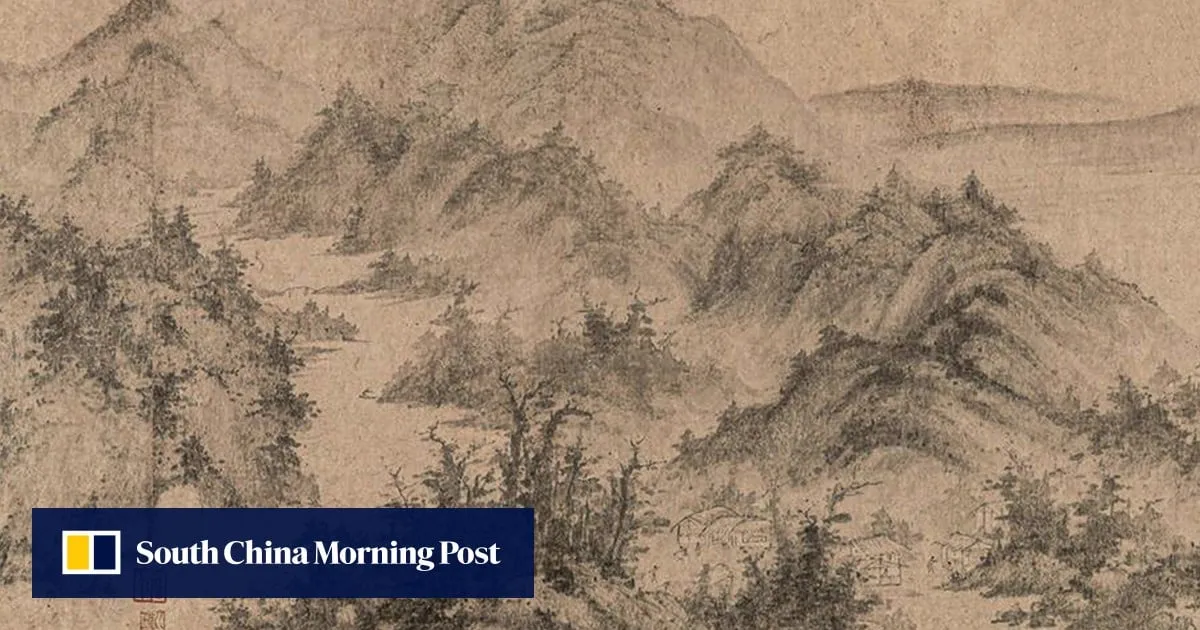
The Chinese aesthetic practice of Wo you, which literally translates to “travelling while lying down,” is an artistic tradition that merges Taoism and Confucianism, enduring for centuries and now embraced by younger generations as a symbol of slow living.The term was originally coined by the 5th-century Chinese painter Zong Bing.Zong had a love for travel in his youth, but as he aged and fell ill, he was forced into seclusion. To preserve the landscapes he had once visited, he painted them and hung his artworks on the walls of his room, allowing himself to “travel while lying down.”Over time, Wo you evolved into a traditional means of appreciating Chinese landscape painting.The Southern Song dynasty poet Lu You (1125–1210) famously noted: “No longer as bold and spirited as in my prime, I content myself with travelling the world through paintings.”Guo Jian’s contemporary masterpiece, The Landscape No 1, offers a modern canvas perfect for practising the meditative art of Wo you. Photo: Art Gallery of New South Wales/Guo JianAdditionally, a famous story from the Northern Song dynasty features poet Qin Guan (1049–1100), who experienced a miraculous recovery from intestinal disease upon receiving a copy of Tang dynasty (618–907) poet Wang Wei’s wall painting, Wangchuan Picture.Several works have been named after Wo you, including the painting album by Ming dynasty painter Shen Zhou (1427–1509), which showcases flowers, animals, and various natural landscapes.During the Southern Song dynasty (1127–1279), a painter by the surname Li created a piece titled Dream Journey over the Xiao and Xiang Rivers for a Buddhist master named Yungu, who was too old to visit the rivers himself.This work is regarded as one of the finest examples of Song dynasty landscape ink paintings.Created during the height of the Qing dynasty (1644–1912), Hua Yan’s 18th-century hanging scroll, Landscape in the Style of Mi Fu , captures the misty atmosphere ideal for mental escapism. Photo: Art Gallery of New South WalesWo you offers a distinctive way to appreciate Chinese landscape paintings, which, in contrast to Western works, feature dynamic viewpoints that facilitate an immersive viewing experience.This practice embodies a blend of the Taoist pursuit of “being totally empty and letting the heart be at peace” and the Confucian belief that “The wise find pleasure in water; the virtuous find pleasure in mountains.”Although Wo you frequently portrays magnificent landscapes, it is fundamentally seen as a tranquil and even solitary practice.Today, the ideals of Wo you continue to resonate with contemporary individuals.Further ReadingArtistic practitioners view Wo you as a precursor to immersive extended reality technologies, while others simply appreciate the slow and spiritual lifestyle it embodies.Many young people today travel to embrace nature for a personal connection, echoing the spiritual essence of Wo you as a deeply personal, tranquil, and solitary practice. Photo: ShutterstockOne Chinese social media user shared that she opted out of the May Day holiday hustle this year to stay home, engaging in handcrafts and reading books.“Travel doesn’t solely mean visiting tourist sites. Anything that allows you to escape the daily routine and discover inner peace and joy is a form of ‘travel,’” she observed.While the Wo you practice involves a position of lying down, it is distinct from the current trend of “lying flat.”Known as “tang ping” in Chinese, “lying flat” describes a mindset among many youths who choose to do the bare minimum as a reaction to societal disillusionment, feeling that their hard work fails to yield appropriate rewards while traditional benchmarks for success – such as homeownership, marriage, and parenthood – become increasingly unattainable.
SRCSouth China Morning Post
LANGEN
LEANCenter-Right
WORDS585
ENT12
MON · 2026-07-27 · 10:00 GMTBRIEF NSR-2026-0727-96387
NSR-2026-0727-96387News Report·EN·Human Interest
Wo you: Chinese ancient art of travelling without leaving bed to attain ‘peace’, ‘emptiness’
Wo you, meaning "travel while lying down," is an ancient Chinese aesthetic practice that merges Taoism and Confucianism. Coined by 5th-century painter Zong Bing, it allowed him to experience landscapes he could no longer visit by painting them and hanging them in his room.
Fran LuSouth China Morning PostFiled 2026-07-27 · 10:00 GMTLean · Center-RightRead · 3 min
South China Morning PostFIG 01
Reading time
3min
Word count
585words
Sources cited
5cited
Entities identified
12entities
Quality score
100%
§ 01
Briefing Summary
AI-generatedNEWSAR · AI
Wo you, meaning "travel while lying down," is an ancient Chinese aesthetic practice that merges Taoism and Confucianism. Coined by 5th-century painter Zong Bing, it allowed him to experience landscapes he could no longer visit by painting them and hanging them in his room. This tradition evolved into appreciating Chinese landscape paintings, offering a meditative escape and a way to achieve peace and emptiness. Contemporary younger generations embrace wo you as a symbol of slow living, finding inner peace through art and personal reflection rather than physical travel. This practice contrasts with the modern "lying flat" mindset, focusing instead on spiritual rejuvenation and an immersive appreciation of art.
Confidence 0.90Sources 5Claims 5Entities 12
§ 02
Article analysis
Model · rule-basedFraming
Human Interest
Technology
Tone
Measured
AI-assessed
CalmNeutralAlarmist
Factuality
0.70 / 1.00
Factual
LowHigh
Sources cited
5
Well sourced
FewMany
§ 03
Key claims
5 extracted01
Wo you embodies the Taoist pursuit of 'being totally empty and letting the heart be at peace' and Confucian beliefs about nature.
factual
Confidence
1.00
02
Lu You, a Southern Song dynasty poet, stated he contented himself with 'travelling the world through paintings.'
quoteLu You
Confidence
1.00
03
The term wo you was coined by the 5th-century Chinese painter Zong Bing, who painted landscapes to 'travel' while ill.
factual
Confidence
1.00
04
Wo you is a Chinese aesthetic practice of 'travelling while lying down,' merging Taoism and Confucianism.
factual
Confidence
1.00
05
Artistic practitioners view wo you as a precursor to immersive extended reality technologies.
factualArtistic practitioners
Confidence
0.90
§ 04
Full report
3 min read · 585 words§ 05
Entities
12 identifiedKey playerOppositionContextPositiveNeutralNegative
People9
§ 06
Keywords & salience
10 termswo you
1.00
chinese landscape painting
0.90
slow living
0.80
taoism
0.70
confucianism
0.70
meditative art
0.60
emptiness
0.50
peace
0.50
zong bing
0.40
lu you
0.40
§ 07
Topic connections
Interactive graph No topic relationship data available yet. This graph will appear once topic relationships have been computed.