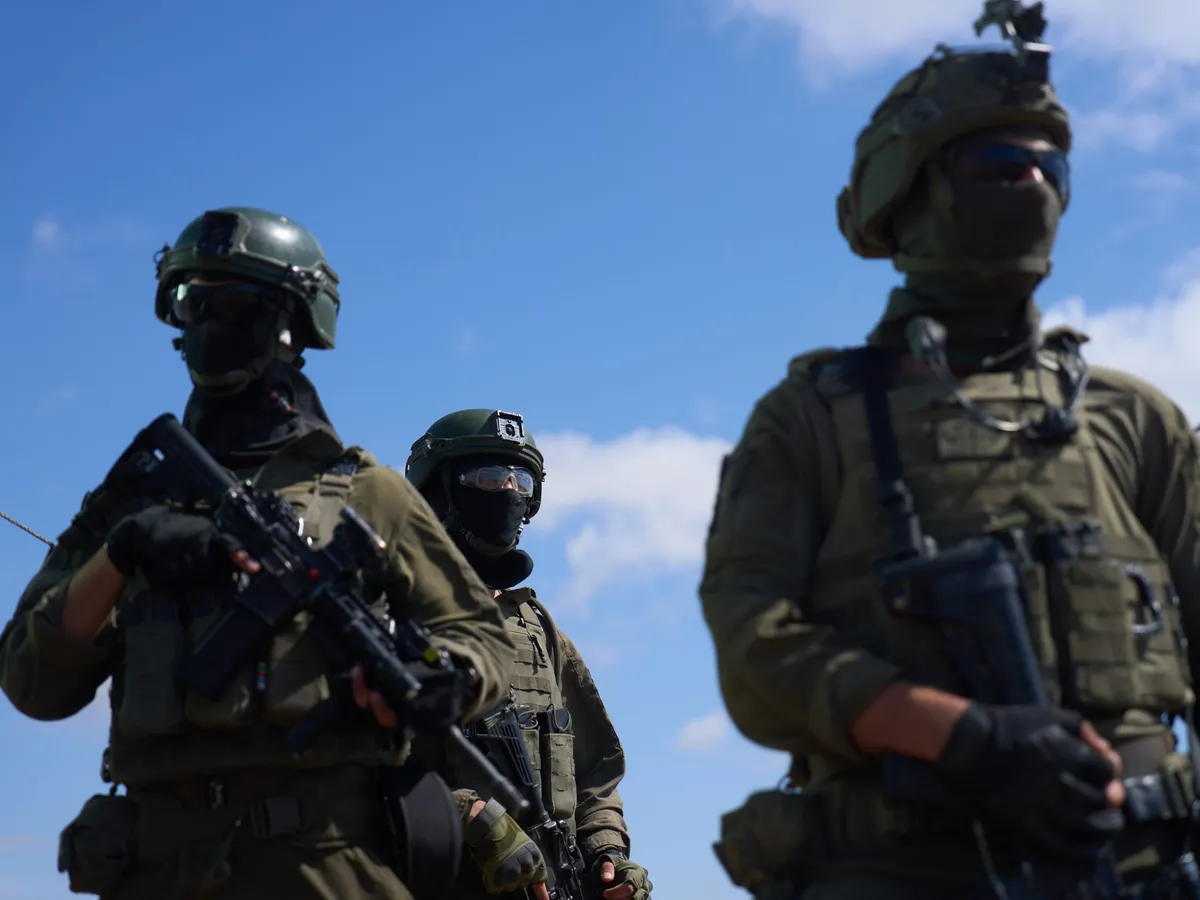
Analysts say the Israeli cabinet’s decision aims to deflect US pressure and fragment the Gaza Strip.Israeli soldiers occupy a military position overlooking the so-called 'Yellow Line' in the central Gaza Strip, on May 26, 2026 (Ariel Schalit/AP)Published On 27 Jul 2026Months after the United Nations Security Council backed a comprehensive framework to end Israel’s genocidal war on Gaza, Israel’s security cabinet has approved a highly constrained pilot project to allow foreign security forces into a narrow pocket of the devastated territory.Israeli media reported on Sunday that the so-called International Stabilization Force (ISF), part of United States President Donald Trump’s 20-point “peace plan”, will include 200 members from countries such as Morocco and Uganda deploying to a designated “test” zone in the southern city of Rafah.While international officials have welcomed the move, analysts describe the limited deployment as a calculated diplomatic gesture with little practical effect that comes as the US-backed peace process has largely stalled and as Israel’s deadly attacks continue.Instead of a genuine transition towards peace, they argue, the move is a political manoeuvre designed to deflect US pressure ahead of Prime Minister Benjamin Netanyahu’s visit to Washington this week, while simultaneously entrenching the geographic fragmentation of the Gaza Strip.“Netanyahu is going to Washington to say ‘no’ to the broader demands of withdrawal” from the Strip, says Wissam Afifa, a Gaza-based political analyst. “Instead, he is offering this alternative: ‘Take this small appetiser, take this minor achievement, and play within this highly restricted space.'”Scaled-back forces and ‘rubber batons’The Israeli daily Haaretz reported that the original plan anticipated the deployment of 500 Moroccan troops to a refugee camp in the city. The drastic reduction to just 200 troops may indicate that Israel’s political-security cabinet has decided to divide the deployment into even smaller, heavily controlled stages.The force will operate in full coordination with the Israeli military. According to the Israeli news outlet Ynet, National Security Minister Itamar Ben-Gvir was the sole cabinet member to vote against the measure, arguing that the Palestinian group Hamas had failed to fulfill its commitment to disarm and insisting that “the solution in Gaza is to encourage migration”.Israeli media also reported that the government maintains that the Israeli military will retain control of the “Yellow Line” – a unilaterally imposed boundary that effectively places up to 70 percent of the Gaza Strip under tight Israeli control – and that no withdrawal will take place until Hamas has fully disarmed.The original framework endorsed by UNSC Resolution 2803 called for the deployment of an international force alongside a transitional Palestinian administration.Earlier this month, Hamas announced it would dissolve its government in Gaza and hand over power to a new, Palestinian technocratic governing authority called the National Committee for the Administration of Gaza (NCAG).Analysts said Hamas’s move was likely designed to apply pressure on Israel and demonstrate the group’s commitment to handing over governance and allowing the rebuilding of the territory.The pilot programme also envisions the NCAG’s entry to oversee civil affairs in Gaza. Yet, according to Haaretz, the Palestinian police accompanying them will be stripped of firearms, permitted to carry only “rubber batons and tasers”.Meanwhile, preparations on the ground appear to be moving forward to accommodate this new security architecture. Israeli Army Radio recently broadcast a video showing a military base under construction in the southern “Gaza envelope” near the Karem Abu Salem (Kerem Shalom) crossing.The station reported that the sprawling facility is being built specifically to host the incoming multinational forces before their deployment.Despite the severe Israeli restrictions, Nickolay Mladenov, the high representative for the Board of Peace, welcomed the Israeli cabinet’s decision, praising it as a “critical part of the agreed framework for stabilizing Gaza, supporting demilitarization, and enabling the transition to effective Palestinian transitional administration”.A ‘sweetener’ for WashingtonTo understand the timing and motivation behind the decision, experts pointed to the diplomatic deadlock surrounding the US-brokered peace initiative. Trump’s plan envisioned a phased approach, bridged by the handover of Gaza to a technocratic committee. However, this framework has been stalled by Israel’s refusal to link a ceasefire to the broader political situation and its rejection of a phased withdrawal.Afifa said the “failure” of the US administration’s flagship initiative had left it “embarrassed” as the project that was repeatedly highlighted by Trump “as a great achievement, resulted in zero”.With Netanyahu heading to Washington, the Israeli prime minister desperately needed a deliverable, said Afifa. The cabinet’s decision, passed hastily via a telephone vote during a Knesset recess to avoid internal coalition fractures, provides exactly that, he added.Mamoun Abu Amer, an expert on Israeli affairs, echoed this assessment. He viewed the rushed cabinet vote as an attempt to preempt US pressure and present an image of compliance to Trump, while fundamentally altering the agreement’s core terms to suit Israel’s long-term security strategy.Abu Amer also said that Israel has effectively turned Resolution 2803 upside down through selective and highly conditional implementation.“This is an inverted process,” said Abu Amer. The original text implied that the NCAG would enter Gaza, the ISF would deploy and the Israeli military would withdraw to new lines to allow for stabilisation. Instead, Israel is demanding unilateral disarmament first, while keeping the technocratic committee besieged within an Israeli security envelope.Abu Amer also suggested the requirement for the Palestinian police force to only carry rubber batons and tasers reflects a premeditated Israeli strategy to strip the Palestinian administration of genuine law enforcement capabilities, reducing them to subcontractors managing municipal decay in a thoroughly devastated environment under a strict military occupation.The NCAG itself appeared to reject this Israeli paradigm. In a recent statement, the committee declared it would only assume responsibility for Gaza after UNSC approval of the force’s deployment and, crucially, a full Israeli military withdrawal.‘False witnesses’The spatial realities of the Israeli plan reveal a strategy of deep fragmentation and long-term control, experts said, pointing to the cabinet’s decision to explicitly restrict the ISF and the technocrats to operating strictly outside the “Yellow Line”.Afifa warned that transforming a small pocket of Rafah into an “experimental bubble” subverts the idea of Gaza as a single, contiguous territorial entity.“This raises a massive question about the fate of two million people,” he said. “If this entire project is reduced to a few thousand individuals selected under Israeli criteria, it means a tacit agreement from the international community to leave two million Gazans hostage to a catastrophic humanitarian crisis while Israel claims to be implementing a peace plan.”This also carries significant diplomatic risks for the participating nations. Israeli media reported the cabinet’s decision stipulated that ISF contributors must be nations that have peace agreements with Israel and do not pursue legal actions against it in international forums.“It is not wise for an Arab country like Morocco to be a party to helping Netanyahu implement his political agenda,” said Abu Amer, urging participating nations to reject the altered Israeli formula and insist on a comprehensive withdrawal.
SRCAl Jazeera
LANGEN
LEANCenter
WORDS1 144
ENT12
MON · 2026-07-27 · 12:58 GMTBRIEF NSR-2026-0727-96401
NSR-2026-0727-96401Analysis·EN·Political Strategy
Israel’s approval of limited Gaza force a calculated manoeuvre, experts say
Israel's security cabinet has approved a limited pilot project allowing 200 foreign security forces from countries like Morocco and Uganda into a designated zone in Rafah, southern Gaza. Analysts view this decision, made months after the UN Security Council backed a peace framework, as a calculated maneuver to deflect US pressure ahead of Prime Minister Netanyahu's Washington visit and to fragment the Gaza Strip.
Mohammad MansourAl JazeeraFiled 2026-07-27 · 12:58 GMTLean · CenterRead · 5 min
Al JazeeraFIG 01
Reading time
5min
Word count
1 144words
Sources cited
4cited
Entities identified
12entities
Quality score
100%
§ 01
Briefing Summary
AI-generatedNEWSAR · AI
Israel's security cabinet has approved a limited pilot project allowing 200 foreign security forces from countries like Morocco and Uganda into a designated zone in Rafah, southern Gaza. Analysts view this decision, made months after the UN Security Council backed a peace framework, as a calculated maneuver to deflect US pressure ahead of Prime Minister Netanyahu's Washington visit and to fragment the Gaza Strip. The International Stabilization Force will operate in coordination with the Israeli military, which will retain control of the "Yellow Line." This move comes as Hamas announced it would dissolve its government and hand over power to a technocratic committee, the National Committee for the Administration of Gaza (NCAG), which is also slated to oversee civil affairs, though accompanying Palestinian police will be disarmed. Despite severe restrictions, some international officials have welcomed the deployment as a step towards stabilizing Gaza.
Confidence 0.90Sources 4Claims 5Entities 12
§ 02
Article analysis
Model · rule-basedFraming
Political Strategy
Diplomatic
Tone
Measured
AI-assessed
CalmNeutralAlarmist
Factuality
0.40 / 1.00
Mixed
LowHigh
Sources cited
4
Well sourced
FewMany
§ 03
Key claims
5 extracted01
National Security Minister Itamar Ben-Gvir voted against the measure, arguing for encouraging migration.
factualarticle
Confidence
1.00
02
The force will operate in full coordination with the Israeli military.
factualarticle
Confidence
1.00
03
The move is a political manoeuvre designed to deflect US pressure ahead of Prime Minister Benjamin Netanyahu’s visit to Washington.
quoteanalysts
Confidence
1.00
04
Analysts describe the limited deployment as a calculated diplomatic gesture with little practical effect.
quoteanalysts
Confidence
1.00
05
Israel's security cabinet approved a limited pilot project to allow foreign security forces into a narrow pocket of Gaza.
factualarticle
Confidence
1.00
§ 04
Full report
5 min read · 1 144 words§ 05
Entities
12 identifiedKey playerOppositionContextPositiveNeutralNegative
People4
§ 06
Keywords & salience
10 termsisrael
1.00
gaza strip
1.00
us pressure
0.90
international stabilization force
0.80
political manoeuvre
0.70
fragmentation
0.60
benjamin netanyahu
0.50
donald trump peace plan
0.50
un security council
0.40
hamas
0.40
§ 07
Topic connections
Interactive graph Network visualization showing 51 related topics
View Full Graph Person Organization Location Event|Click node to navigate|Edge numbers = shared articles