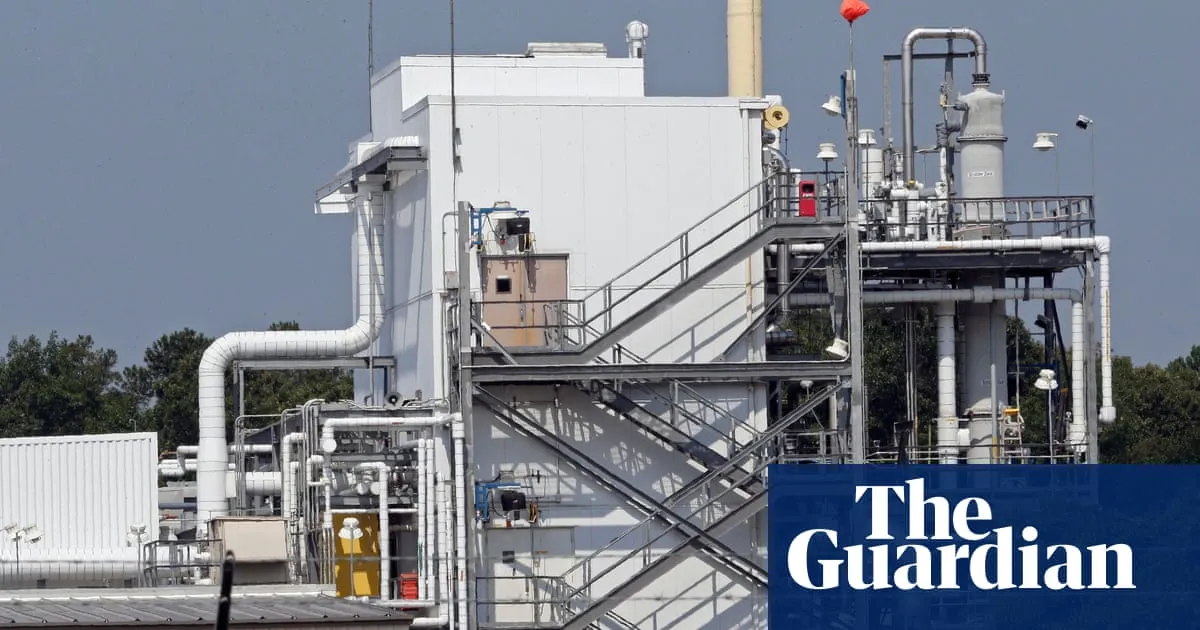
A coalition of 17 environmental groups is demanding the Environmental Protection Agency reject a new Pfas that chemical giant Chemours is attempting to fast track for approval for use in cooling Datacenters, and would almost certainly pollute regions around the facilities.In formal comments submitted to the agency, the groups accuse Chemours of using bad science to downplay the chemical’s toxicity and climate risks. Approving Chemours’ application as it is would violate the law, the Earthjustice legal non-profit, a lead author of the comments, wrote.Big tech has faced fierce opposition from across the political spectrum in communities where it plans to build Datacenters, in part because some types of the facilities require huge quantities of water to cool.Datacenter developers, like Google, have touted its two phase cooling systems as an alternative that uses far less water, but few know that those typically use Pfas “forever chemical” gas instead of water.The new chemical, Opteon 2P50, is likely more toxic and more of a risk to the climate than Chemours claims in its application, public advocates warn. Opteon 2P50 is also the first chemical for which industry has asked the Trump EPA to fast-track approval under the president’s legally dubious executive order that calls for expedited review of datacenter chemicals.“The datacenter industry knows it is under fire for its enormous use of water so they cast themselves as the good guys by using alternative cooling, but they’re not telling [the public] that they’re using hazardous chemicals,” said Lenny Siegel, director of the Chips Communities United non-profit that works to rein in Pfas waste. “Some are toxic, some are greenhouse gases and some are both.”Pfas are a class of about 16,000 compounds dubbed “forever chemicals” because they do not naturally break down, and accumulate in the human body and environment. The chemicals are linked to a range of serious health problems such as cancer, liver disease, kidney issues, high cholesterol, birth defects and decreased immunity.“Two phase” datacenter systems use Pfas gas, or f-gas, as a refrigerant coolant that is run through copper tubing.Chemours in a statement said the comment fails to acknowledge that the two-phase systems are a “closed loop”, meaning there are no emissions from a stack, and the amount of gas that escapes is low.F-gas is not intentionally released during use, though there are leaks, called “fugitive emissions” and it must be disposed of at the end of its life.The datacenter industry has claimed that F-gas is not a threat because, once in the air, it often turns into a compound called TFA. TFA is considered a Pfas in most of the world, but not with the US EPA. Recent research has found it is more toxic than previously thought, and the European Chemical Agency this month classified it as a hazardous chemical, finding that it probably disrupts thyroid function, reduces sperm quality and is toxic to the liver, among other health impacts.Chemours did not respond to the Guardian’s request for comment.In its comments submitted to the EPA, Earthjustice noted that the agency must consider health risks as required by law despite Donald Trump’s executive order that seeks to prioritize datacenter chemicals.“We’re worried that the EPA may interpret ‘priority review’ as ‘priority approval’, and we need to remind them that the executive order has no bearing on assessing health risk,” said Adriana Antezana, a scientist with Earthjustice.The comments allege a litany of flaws in the science submitted by Chemours that claim Opteon 2P50’s health risks are low, including reliance on a type of lab rat that is less impacted by Pfas’s toxic effects than humans. The comments also alleged a range of missing or limited toxicological data.Chemours references an occupational inhalation limit intended to keep workers safe was developed by the partially industry-funded science group Tera, which has a long history of attacking chemical regulations and producing industry friendly science. Earthjustice wrote that the Tera-organized committee failed to follow EPA best practices and did not include key pieces of data in its analysis. The level of exposure to Opteon 2P50 that workers would face if the Tera committee levels are adopted is probably unsafe, the comments claim.The environmental groups also allege that Chemours has a history of releasing dangerous levels of pollution into communities around its plants, and US drinking water is already widely contaminated with Pfas. The approval of the new compound for wide use could present an unreasonable risk to the public under the nation’s toxic chemical laws because some already face high exposures, the comments state.In its statement, Chemours accused the environmental groups of making “sweeping generalizations” about Pfas, each of which have slightly different chemistry. The “EPA’s new chemicals review is a rigorous evaluation process,” the statement said.If the EPA approves Opteon 2P50 for manufacture, it could more easily be approved for other uses in industry, or consumer products such as refrigerators, though that is hypothetical, Antezana said.The EPA’s actions around the chemical could also lead to a test of Trump’s executive order powers. Earthjustice could potentially sue if the chemical is rammed through without following the law.“We don’t want the government just to approve the chemicals because a company is saying it will help this industry, because that could go for any chemical,” Antezana said.
SRCThe Guardian - World News
LANGEN
LEANCenter-Left
WORDS868
ENT10
MON · 2026-07-27 · 12:00 GMTBRIEF NSR-2026-0727-96414
NSR-2026-0727-96414News Report·EN·Environmental
US environmental groups urge EPA to reject new Pfas to cool datacenters
A coalition of 17 environmental groups is urging the EPA to reject Chemours' application for a new Pfas compound, Opteon 2P50, intended for datacenter cooling. The groups allege Chemours downplayed the chemical's toxicity and climate risks in its bid for expedited approval under a Trump-era executive order.
Tom PerkinsThe Guardian - World NewsFiled 2026-07-27 · 12:00 GMTLean · Center-LeftRead · 4 min
The Guardian - World NewsFIG 01
Reading time
4min
Word count
868words
Sources cited
4cited
Entities identified
10entities
Quality score
100%
§ 01
Briefing Summary
AI-generatedNEWSAR · AI
A coalition of 17 environmental groups is urging the EPA to reject Chemours' application for a new Pfas compound, Opteon 2P50, intended for datacenter cooling. The groups allege Chemours downplayed the chemical's toxicity and climate risks in its bid for expedited approval under a Trump-era executive order. They argue that approving the compound would violate the law and that Chemours' submitted science is flawed, potentially leading to pollution and health risks. Datacenter cooling systems often use Pfas, known as "forever chemicals," which accumulate in the environment and are linked to serious health problems. Chemours maintains that their two-phase cooling systems are closed-loop and that the EPA's review process is rigorous.
Confidence 0.90Sources 4Claims 5Entities 10
§ 02
Article analysis
Model · rule-basedFraming
Environmental
Public Health
Tone
Mixed Tone
AI-assessed
CalmNeutralAlarmist
Factuality
0.70 / 1.00
Factual
LowHigh
Sources cited
4
Well sourced
FewMany
§ 03
Key claims
5 extracted01
Pfas are linked to serious health problems such as cancer, liver disease, and birth defects.
factualarticle
Confidence
1.00
02
17 environmental groups urge EPA to reject new Pfas for datacenter cooling.
factualcoalition of 17 environmental groups
Confidence
1.00
03
TFA, a breakdown product of F-gas, is considered more toxic than previously thought and a hazardous chemical.
factualRecent research / European Chemical Agency
Confidence
0.90
04
Chemours is accused of using bad science to downplay the chemical’s toxicity and climate risks.
quoteEarthjustice
Confidence
0.90
05
The new chemical, Opteon 2P50, is likely more toxic and a greater climate risk than Chemours claims.
factualpublic advocates
Confidence
0.80
§ 04
Full report
4 min read · 868 words§ 05
Entities
10 identifiedKey playerOppositionContextPositiveNeutralNegative
Organizations6
Events1
§ 06
Keywords & salience
10 termspfas
1.00
datacenters
0.90
cooling systems
0.80
environmental groups
0.70
epa
0.60
chemours
0.60
toxicity
0.50
forever chemicals
0.50
climate risks
0.40
opteon 2p50
0.40
§ 07
Topic connections
Interactive graph Network visualization showing 25 related topics
View Full Graph Person Organization Location Event|Click node to navigate|Edge numbers = shared articles