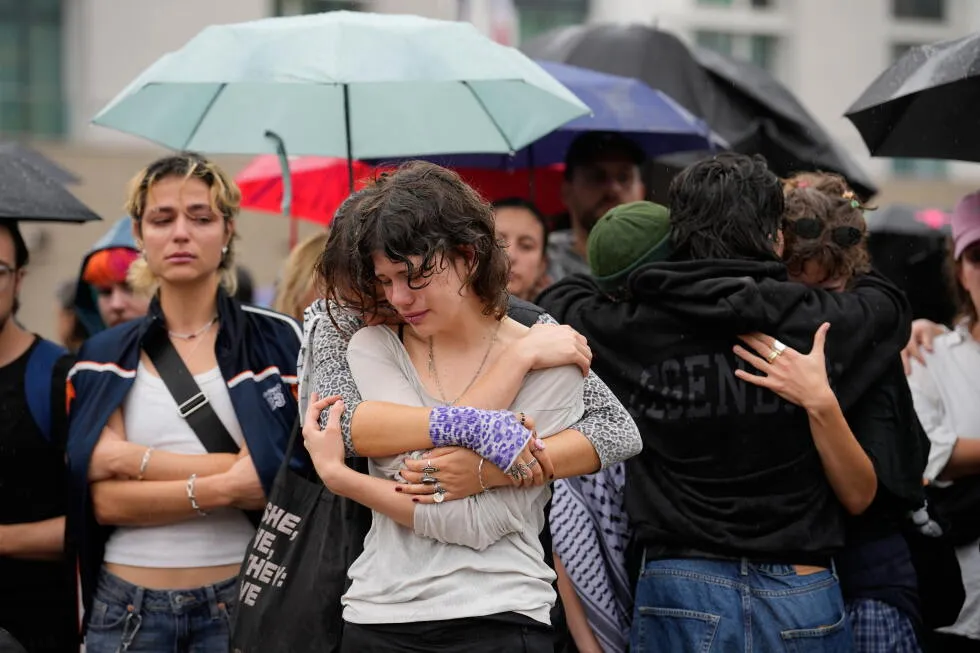
Questions mount after deadly Berlin Pride attack. Here’s what to know 0 seconds of 1 minute, 10 secondsVolume 0% Press shift question mark to access a list of keyboard shortcuts Keyboard ShortcutsEnabledDisabled Shortcuts Open/Close/ or ? Play/PauseSPACE Increase Volume↑ Decrease Volume↓ Seek Forward→ Seek Backward← Captions On/Offc Fullscreen/Exit Fullscreenf Mute/Unmutem Decrease Caption Size- Increase Caption Size+ or = Seek %0-9 Next Up A fatal attack on Berlin's Pride Festival leaves locals wondering how their city will recover 01:09 00:00 01:10 01:10 More Videos 01:09 A fatal attack on Berlin's Pride Festival leaves locals wondering how their city will recover 00:33 Police say suspect in the deadly Berlin Pride attack was shot and killed 00:51 Suspect in the deadly Berlin Pride attack is killed in a confrontation with police, officials say 00:58 Berlin's flagship Pride event, called Christopher Street Day, takes place in heart of the city 02:56 Tree of Life rabbi bids farewell eight years after deadliest antisemitic attack in US history 01:00 Momeni meets Pakistan officials as Iran and US continue attacks 00:58 Oasis, George Clooney among celebrities at Venice Film Festival 00:53 Teenager pleads guilty to all 55 counts in 2024 fatal shooting at Georgia high school Close 1 of 5 | Saturday night’s fatal attack near the Berlin Pride Festival left locals shaken. Mourners continued to bring flowers to the city’s Brandenburg Gate on Monday to pay tribute to the victims. A woman was killed in the attack and at least 16 people got injured, police confirmed. (AP video shot by: Pietro De Cristofaro) 2 of 5 | A fatal attack on Berlin’s Pride Festival leaves locals wondering how their city will recover. The van ramming and stabbing near Berlin’s Pride Festival is believed to have been an Islamic extremist terror attack, Germany’s interior minister said on Sunday. 3 of 5 | People gather outside the Brandenburg Gate for a demonstration in support of LGBTQ+ after a car rammed into a crowd at the Pride March in Berlin, Sunday, July 26, 2026. (AP Photo/Ebrahim Noroozi) 4 of 5 | Flowers and rainbow flags placed in front of the Brandenburg Gate commemorating the victims of a car attack on Saturday’s Pride March in Berlin, Germany, Monday, July 27, 2026. (AP Photo/Markus Schreiber) 5 of 5 | Women lay flowers at a tree in the Tiergarten Park, near the scene where a car rammed into people after Saturday’s Pride March in Berlin, Germany, Monday, July 27, 2026. (AP Photo/Markus Schreiber) By STEFANIE DAZIO and GEIR MOULSON Updated 2:47 PM MESZ, July 27, 2026 Leer en español Add AP News on Google Add AP News as your preferred source to see more of our stories on Google. Share Share Facebook Copy Link copied Print Email X LinkedIn Bluesky Flipboard Pinterest Reddit Berlin (AP) — Berliners mourned Monday after the deadly attack near the city’s Pride Festival as questions mounted over how the suspect was able to move freely following a conviction linked to his ties to the Islamic State group. The 21-year-old Abdul Ballout, a German citizen, was killed following a search that lasted nearly 24 hours after Saturday night’s attack in downtown Berlin. He was suspected of driving a van into a crowd near the Pride Festival before apparently cutting others with a machete in what authorities believe was an extremist terror attack. Chancellor Friedrich Merz on Monday wanted to know how the attack could have been prevented. Prosecutors said Ballout previously sought to join IS. “We must do everything to protect people in Germany as best possible from such criminals, from dangerous people who for whatever reason can’t be taken into custody,” Merz said. Ballout, who was born in Germany and has Lebanese roots, traveled to Lebanon in 2025 with the goal of going to Syria to join the Islamic State group, Berlin prosecutors said. He made contact with several people who were presumed members — or at least he believed them to be, prosecutors said. He was arrested in Lebanon and sentenced by a military court to three months’ imprisonment for offenses including incitement to religious and sectarian conflict. He returned to Germany after completing his sentence, where he was arrested at the Berlin airport. The suspect in the deadly Berlin Pride attack is killed in a confrontation with police 4 MIN READ 11 Members of a sexual predator network on Telegram tried to hide their crimes with code words 3 MIN READ A fatal attack on Berlin’s Pride Festival leaves locals wondering how their city will recover 3 MIN READ In May, a juvenile court in Berlin convicted Ballout of preparing a serious act of violence endangering the state, as well as publishing Islamic State propaganda on his Instagram account and other charges, prosecutors said. He was sentenced to one year and 10 months in youth custody, which Berlin prosecutors appealed. Offenders who are 18 to 21 can be prosecuted in Germany’s juvenile system. Officials have said Ballout was given a suspended sentence. The Berlin courts, however, said his sentence had not been suspended but they had been determining whether it should be. The court said it released him because he was no longer in pretrial detention, which had been particularly long, and he did not meet statutory requirements governing flight risk, reoffending and other factors. Some German officials questioned the court’s decision. They vowed to investigate how Ballout ended up free and whether juvenile sentencing, sometimes seen as too lenient, needs to be reformed. Interior Minister Alexander Dobrindt, in an interview with public broadcaster ZDF, said that considering Ballout’s conviction and history of supporting the Islamic State group, it did not make sense why he was on the streets. “You can assume that it certainly would have made sense to put this person in custody,” he said. During an interview with regional broadcaster RBB, Berlin Mayor Kai Wegner said he didn’t want to question the court system’s independence but in this case, “words fail me.” Deradicalization experts believed he was unwilling to change The court ordered Ballout to attend a deradicalization program for high-risk offenders. He was evaluated twice by the Berlin-based Violence Prevention Network, which works with people at risk from right-wing extremism and Islamism. The organization defines deradicalization as a person successfully detaching from extremism ideology and distancing themselves from violence. Ballout was scheduled to meet with their staff Monday for his third and final evaluation, according to Cornelia Lotthammer, the nongovernmental organization’s public relations director. The staff expected to tell the court that Ballout was not a candidate for their program because he sought to misrepresent himself as a friendly person who was not an extremist and therefore did not need to be deradicalized. “Normally high-risk people are very convinced of themselves and of their ideology, and they would propagate it within those sessions,” Lotthammer said. “And then it’s easier to work with them. This is not a typical incident.” Ballout appeared to try to anticipate what the staff wanted to hear, she said. “They could see that he is a problem. I mean, everybody knew that he was a high-risk person,” she said. “But still, if he does not work together with our colleagues, then we can’t do anything.” She added: “But nobody would have said, ‘He’s not a threat, just let him go.’” He did not seem to be planning any attacks, Lotthammer said. If the staff had any indication otherwise, they would have involved law enforcement. Ballout would have had to find another organization to work with, or he might have been sent back to prison, Lotthammer said. She declined to comment on whether their organization believed Ballout should have been released from detention, calling that the court’s jurisdiction. Three German states including Berlin hold elections in September. The attack is likely to feed into campaigning, and there are fears that anti-migrant rhetoric could boost the far right. A string of deadly attacks committed by immigrants was one factor in the 2025 national election in which the far-right Alternative for Germany, or AfD, finished second. AfD has assailed the government over migration and capitalized on discontent with other issues. In the eastern state of Saxony-Anhalt, it hopes to get its first state governor. Kristin Brinker, AfD’s local leader in Berlin, asked on X how a supporter of the Islamic State group was able to move freely in Germany after being in custody. “Who bears responsibility for that in the city government?” she said. STEFANIE DAZIO Dazio covers Northern Europe from Berlin for The Associated Press. She previously covered crime and criminal justice from Los Angeles.
SRCAssociated Press (AP)
LANGEN
LEANCenter
WORDS1 426
ENT11
MON · 2026-07-27 · 12:53 GMTBRIEF NSR-2026-0727-96429
NSR-2026-0727-96429News Report·EN·Human Interest
Questions mount after deadly Berlin Pride attack. Here’s what to know
A fatal extremist terror attack occurred near Berlin's Pride festival on Saturday night when a 21-year-old German citizen, Abdul Ballout, drove a van into a crowd and then attacked people with a machete. One woman was killed and 29 were injured.
Associated Press (AP)Filed 2026-07-27 · 12:53 GMTLean · CenterRead · 6 min
Associated Press (AP)FIG 01
Reading time
6min
Word count
1 426words
Sources cited
3cited
Entities identified
11entities
Quality score
100%
§ 01
Briefing Summary
AI-generatedNEWSAR · AI
A fatal extremist terror attack occurred near Berlin's Pride festival on Saturday night when a 21-year-old German citizen, Abdul Ballout, drove a van into a crowd and then attacked people with a machete. One woman was killed and 29 were injured. Ballout, who had previously sought to join the Islamic State group and was convicted of preparing serious violence and publishing IS propaganda, was killed by police after a manhunt. Questions are mounting regarding how Ballout was able to move freely despite his past convictions and ties to extremist groups, leading to calls for an investigation into the judicial system and potential reforms to juvenile sentencing. Deradicalization experts believed Ballout was unwilling to change and was not a candidate for their program. The attack comes ahead of state elections in Germany and is expected to influence political campaigning.
Confidence 0.90Sources 3Claims 4Entities 11
§ 02
Article analysis
Model · rule-basedFraming
Human Interest
Social Justice
Tone
Mixed Tone
AI-assessed
CalmNeutralAlarmist
Factuality
0.80 / 1.00
Factual
LowHigh
Sources cited
3
Well sourced
FewMany
§ 03
Key claims
4 extracted01
A fatal attack near the Berlin Pride Festival resulted in one woman killed and at least 16 injured.
factualpolice
Confidence
1.00
02
Questions are mounting over how the suspect was able to move freely following a conviction linked to his ties to extremism.
factual
Confidence
0.90
03
The attack is believed to have been an Islamic extremist terror attack.
factualGermany’s interior minister
Confidence
0.90
04
Locals are wondering how their city will recover from the attack.
factual
Confidence
0.80
§ 04
Full report
6 min read · 1 426 words§ 05
Entities
11 identifiedKey playerOppositionContextPositiveNeutralNegative
People3
Organizations1
Locations4
§ 06
Keywords & salience
8 termsberlin pride attack
1.00
islamic extremist terror attack
0.90
lgbtq+
0.80
van ramming and stabbing
0.70
christopher street day
0.60
victims
0.50
brandenburg gate
0.50
germany
0.40
§ 07
Topic connections
Interactive graph Network visualization showing 5 related topics
View Full Graph Person Organization Location Event|Click node to navigate|Edge numbers = shared articles