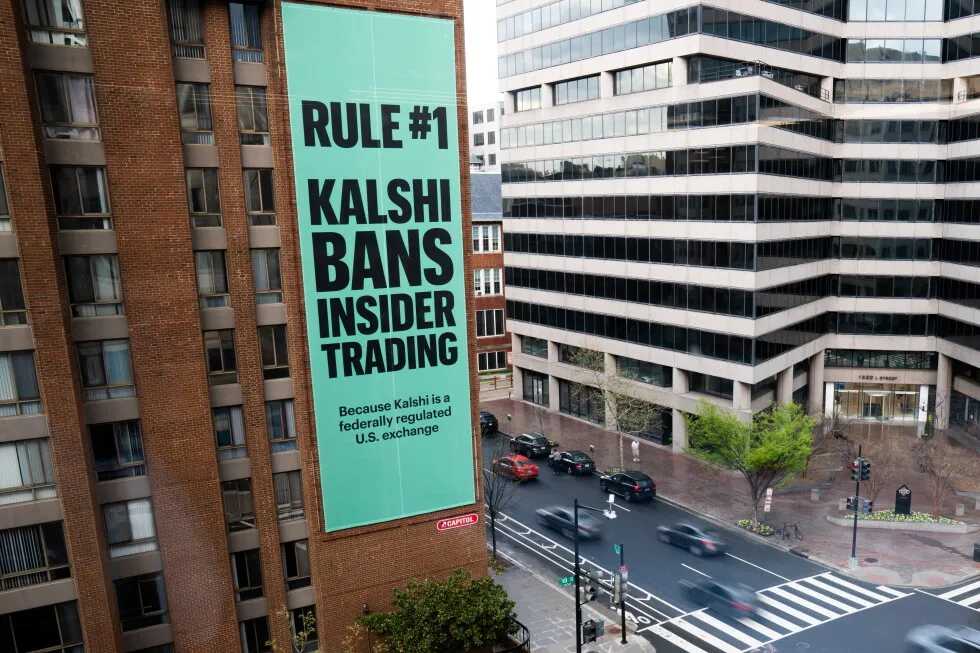
Minnesota’s first-in-the-nation law banning prediction markets is halted in federal court 1 of 2 | An for prediction market platform Kalshi hangs at 13th and L Streets in northwest Washington, April 1, 2026. (AP Photo/Allison Robbert, File) 2 of 2 | The prediction market app Polymarket is displayed on a mobile phone, April 16, 2026, in Chicago. (AP Photo/Erin Hooley, File) By MARC LEVY Updated 7:44 PM MESZ, July 28, 2026 Add AP News on Google Add AP News as your preferred source to see more of our stories on Google. Share Share Facebook Copy Link copied Print Email X LinkedIn Bluesky Flipboard Pinterest Reddit HARRISBURG, Pa. (AP) — A federal judge has temporarily blocked Minnesota’s first-in-the-nation law banning prediction markets just days before it was to take effect, the latest clash between President Donald Trump’s administration and states over who regulates operators such as Kalshi and Polymarket. Monday’s decision is the latest setback for states trying to outlaw or regulate fast-growing prediction market platforms. U.S. District Judge Katherine Menendez in Minnesota found that the U.S. Commodity Futures Trading Commission, Kalshi and Polymarket were likely to succeed in their challenge to the law and that letting it take effect would cause “irreparable harm” to the operators. The law was scheduled to take effect Saturday. It would have made it a crime to create or operate prediction markets or help administer nearly any activity connected to one. The law will remain blocked while the lawsuit proceeds. Kalshi, Polymarket and the Commodity Futures Trading Commission want the law permanently blocked and argue that federal law gives the CFTC exclusive jurisdiction to regulate the type of “event-contract transactions” offered by Kalshi and Polymarket. States argue that the vast majority of the business on prediction market platforms is sports betting, which they are empowered to regulate, and that is completely different from the commodities and futures contracts that the commission has historically regulated. Polymarket is in a high-stakes race to win back trust as it recommits to the US market 4 MIN READ 15 As gas plants rise to power AI, renewable energy allies are fighting for cleaner alternatives 5 MIN READ Feds turn over evidence in Renee Good and Alex Pretti killings to Minnesota after months of delay 5 MIN READ In a statement Tuesday, Minnesota Attorney General Keith Ellison said prediction markets are “gambling, plain and simple.” “And Minnesota has every right to keep predatory gambling out of our communities,” Ellison said. Ellison said his office disagrees with the court’s decision that the “proper ‘status quo’ to maintain is one that allows predatory gambling apps to proliferate.” But Ellison said the legal issues are complex and that he planned to continue defending the state’s law. Neal Kumar, Polymarket’s chief legal officer, said in a statement that the decision makes clear that prediction markets on commission-registered exchanges “are governed by federal law, not a patchwork of state rules.” A Kalshi spokesperson, Elisabeth Diana, said in a statement that “states cannot ban things that they don’t have jurisdiction over.” Menendez’s decision follows a declaration in February by Trump’s appointee atop the Commodity Futures Trading Commission that the agency “will no longer sit idly by” while states aim to regulate or ban prediction markets and “undermine the agency’s exclusive jurisdiction.” A tangle of lawsuits is growing, as states try to use their gambling laws to shut down Kalshi, Polymarket and other prediction market operators, declaring them to be unlicensed and illegal gambling operators. In April alone, the federal government sued Connecticut, Arizona and Illinois, challenging their efforts to regulate prediction market operators, while New York sued Coinbase and Gemini, two of the newest players in the prediction market industry. The American Gaming Association, which represents commercial casinos, estimates states have lost more than $1.2 billion in tax revenue from wagers since prediction markets began offering sports event contracts. Native American tribal leaders and gambling regulators also contend that betting on things like sporting events, elections and other outcomes is unlawful gambling. In the meantime, the Commodity Futures Trading Commission has begun a rulemaking process to consider what sorts of event contracts it would consider to be “contrary to the public interest” and bar them from being listed through a prediction market that it regulates. Follow Marc Levy at http://twitter.com/timelywriter. MARC LEVY Levy covers politics and state government for The Associated Press. He is based in Pennsylvania. twitter
SRCAssociated Press (AP)
LANGEN
LEANCenter
WORDS732
ENT10
TUE · 2026-07-28 · 17:53 GMTBRIEF NSR-2026-0728-96875
NSR-2026-0728-96875News Report·EN·Legal & Judicial
Minnesota’s first-in-the-nation law banning prediction markets is halted in federal court
A federal judge has temporarily blocked Minnesota's new law banning prediction markets, which was set to take effect this Saturday. U.S.
Associated Press (AP)Filed 2026-07-28 · 17:53 GMTLean · CenterRead · 3 min
Associated Press (AP)FIG 01
Reading time
3min
Word count
732words
Sources cited
3cited
Entities identified
10entities
Quality score
100%
§ 01
Briefing Summary
AI-generatedNEWSAR · AI
A federal judge has temporarily blocked Minnesota's new law banning prediction markets, which was set to take effect this Saturday. U.S. District Judge Katherine Menendez ruled that the Commodity Futures Trading Commission (CFTC), Kalshi, and Polymarket are likely to succeed in their challenge to the law, stating its enforcement would cause "irreparable harm." The CFTC and prediction market operators argue that federal law grants the CFTC exclusive jurisdiction over these "event-contract transactions." Minnesota Attorney General Keith Ellison maintains that prediction markets are gambling and that the state has the right to regulate them. This decision is part of a larger legal conflict between states seeking to regulate prediction markets under gambling laws and federal regulators asserting their authority. The law will remain blocked while the lawsuit proceeds.
Confidence 0.90Sources 3Claims 5Entities 10
§ 02
Article analysis
Model · rule-basedFraming
Legal & Judicial
Political Strategy
Tone
Measured
AI-assessed
CalmNeutralAlarmist
Factuality
0.80 / 1.00
Factual
LowHigh
Sources cited
3
Well sourced
FewMany
§ 03
Key claims
5 extracted01
Minnesota Attorney General Keith Ellison stated that prediction markets are 'gambling, plain and simple.'
quoteKeith Ellison
Confidence
1.00
02
U.S. District Judge Katherine Menendez found that the CFTC, Kalshi, and Polymarket were likely to succeed in their challenge and that letting the law take effect would cause 'irreparable harm'.
quoteU.S. District Judge Katherine Menendez
Confidence
1.00
03
The law was scheduled to take effect Saturday and would have made it a crime to create or operate prediction markets.
factual
Confidence
1.00
04
A federal judge has temporarily blocked Minnesota’s law banning prediction markets.
factual
Confidence
1.00
05
States argue that prediction market platforms primarily conduct sports betting, which they are empowered to regulate.
factualStates
Confidence
0.90
§ 04
Full report
3 min read · 732 words§ 05
Entities
10 identifiedKey playerOppositionContextPositiveNeutralNegative
Organizations3
Locations1
§ 06
Keywords & salience
10 termsprediction markets
1.00
federal court
0.90
lawsuit
0.80
regulation
0.80
polymarket
0.70
commodity futures trading commission
0.70
kalshi
0.70
sports betting
0.60
event-contract transactions
0.50
gambling
0.40
§ 07
Topic connections
Interactive graph No topic relationship data available yet. This graph will appear once topic relationships have been computed.