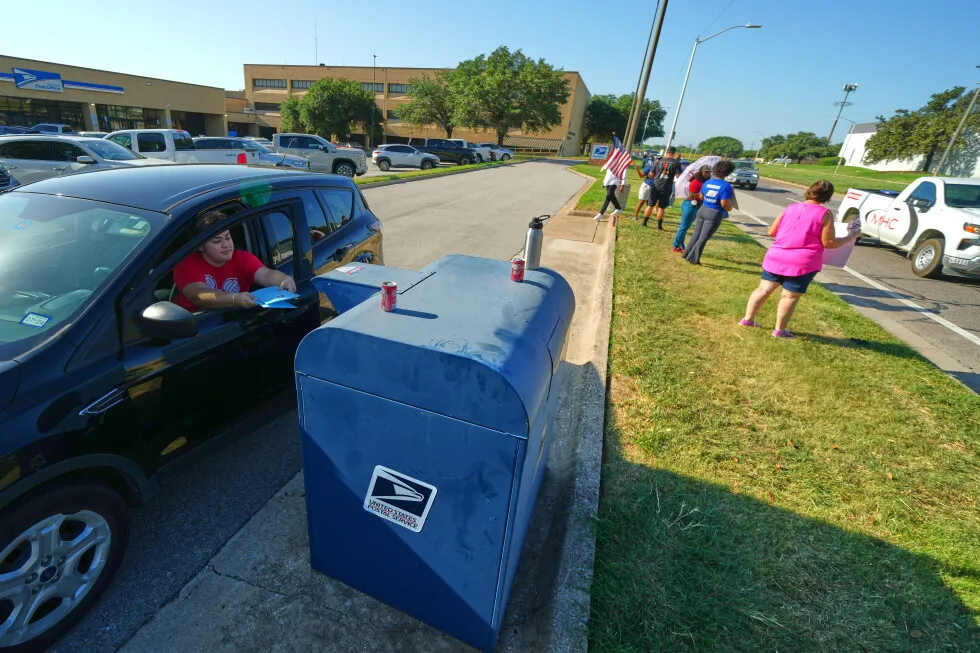
Court panel declines to block Trump’s mail ballot order, but its status for midterms remains unclear 1 of 2 | A person drops envelopes into a mailbox as postal workers participate in a national day of action outside a U.S. Post Office building, Tuesday, July 28, 2026, in Fort Worth, Texas. (AP Photo/Julio Cortez) 2 of 2 | Yvonne Daniels demonstrates against proposed changes to the U. S. Postal Service and President Donald Trump’s executive order regarding mail-in ballots Tuesday, July 28, 2026, in Miami Gardens, Fla. (AP Photo/Marta Lavandier) 1 of 2 | A person drops envelopes into a mailbox as postal workers participate in a national day of action outside a U.S. Post Office building, Tuesday, July 28, 2026, in Fort Worth, Texas. (AP Photo/Julio Cortez) 1 of 2 A person drops envelopes into a mailbox as postal workers participate in a national day of action outside a U.S. Post Office building, Tuesday, July 28, 2026, in Fort Worth, Texas. (AP Photo/Julio Cortez) Add AP News on Google Add AP News as your preferred source to see more of our stories on Google. Share 2 of 2 | Yvonne Daniels demonstrates against proposed changes to the U. S. Postal Service and President Donald Trump’s executive order regarding mail-in ballots Tuesday, July 28, 2026, in Miami Gardens, Fla. (AP Photo/Marta Lavandier) 2 of 2 Yvonne Daniels demonstrates against proposed changes to the U. S. Postal Service and President Donald Trump’s executive order regarding mail-in ballots Tuesday, July 28, 2026, in Miami Gardens, Fla. (AP Photo/Marta Lavandier) Add AP News on Google Add AP News as your preferred source to see more of our stories on Google. Share Updated [hour]:[minute] [AMPM] [timezone], [monthFull] [day], [year] A federal appellate panel on Tuesday refused to block President Donald Trump’s executive order seeking to restrict mail voting, a day after the administration asked the U.S. Supreme Court to weigh in on the proposal in a separate case.The three-judge panel of the U.S. Court of Appeals for the District of Columbia upheld a May ruling by U.S. District Court Judge Carl J. Nichols that said an injunction against the order was premature. Nichols ruled that the Democrats and voting rights groups who challenged the order couldn’t seek the injunction until the Trump administration issued formal regulations governing it. The administration started releasing those directives days later.The circuit court panel, with two judges appointed by former Democratic President Barack Obama and one by Trump, found that was proper and there were no noted dissents. But the unsigned decision noted that if the administration truly tried to force such changes in the few months remaining before November’s midterm election, it may well get halted by courts. “The action the Order contemplates would involve the President, whom the Constitution vests with no express authority over the conduct of elections, undertaking a substantial and unfunded overhaul of election procedures — including the implementation of a nationwide reform to Postal Service mail-handling processes —on the threshold of the November election. Put differently, the Order ‘may not prove feasible to implement in any manner whatsoever,’” said the ruling, quoting a prior legal opinion.In a separate case filed by Democratic state officials, a federal judge in Massachusetts last month blocked the executive order from taking effect for this year’s elections because it was already forcing states, which are granted the power under the U.S. Constitution to control their own elections, to revise their procedures on the fly. That ruling was upheld on Saturday by a Boston-based appeals court and then was appealed to the U.S. Supreme Court on Monday by the Trump administration. 3 MIN READ 4 MIN READ 5 MIN READ The Postal Service did not immediately respond to questions about what action it’s taking related to Trump’s executive order. But the union representing postal workers, which opposes having its members implement the order, said Tuesday that its members are being directed to prepare an online portal through which voters will have to submit information to be eligible for mail ballots. “The IT people in the background are moving forward with creating the portals to make sure that we can accomplish the task if given to us,” American Postal Workers Union President Jonathan Smith said in a telephone interview. Trump has repeatedly tried to unilaterally change voting procedures since he took office for the second time, only to be blocked by the courts. The push follows years of lies about vote fraud to try to explain away the president’s loss to Democrat Joe Biden in 2020.In his March executive order, Trump directed the federal government to create a list of eligible voters and the U.S. Postal Service to deliver ballots only to those on that list. Lawsuits noted that the Constitution grants states control of their elections, not the president, and that Congress can pass laws changing procedures for federal elections but has not done so.Trump signed another executive order on elections last year, just months after taking office, that would impose a nationwide voter ID requirement and force anyone registering to vote to provide documents proving they are U.S. citizens. Trump also is pushing Congress to pass a sweeping voting bill that would impose the documentary proof of citizenship requirement, but it has stalled in the Senate as it faces opposition from Democrats and some lawmakers from his own party. Associated Press writer John Hanna in Topeka, Kansas, contributed to this report.
SRCAssociated Press (AP)
LANGEN
LEANCenter
WORDS903
ENT12
TUE · 2026-07-28 · 18:53 GMTBRIEF NSR-2026-0728-96904
NSR-2026-0728-96904News Report·EN·Legal & Judicial
Court panel declines to block Trump’s mail ballot order, but its status for midterms remains unclear
A federal appellate panel has declined to block President Trump's executive order concerning mail-in voting, upholding a lower court's decision that an injunction was premature until formal regulations were issued. The court noted that implementing such changes close to the midterm elections might still face legal challenges.
By
NICHOLAS RICCARDIAssociated Press (AP)Filed 2026-07-28 · 18:53 GMTLean · CenterRead · 4 min
Associated Press (AP)FIG 01
Reading time
4min
Word count
903words
Sources cited
1cited
Entities identified
12entities
Quality score
100%
§ 01
Briefing Summary
AI-generatedNEWSAR · AI
A federal appellate panel has declined to block President Trump's executive order concerning mail-in voting, upholding a lower court's decision that an injunction was premature until formal regulations were issued. The court noted that implementing such changes close to the midterm elections might still face legal challenges. In a separate case, a federal judge in Massachusetts had previously blocked the order, a ruling that is now before the Supreme Court. The order directs the federal government to create a list of eligible voters and the Postal Service to deliver ballots only to those on the list. The union representing postal workers indicated that preparations are underway for an online portal related to mail ballot eligibility, despite opposition from the union. Trump has faced previous court blocks on his attempts to unilaterally alter voting procedures.
Confidence 0.90Sources 1Claims 4Entities 12
§ 02
Article analysis
Model · rule-basedFraming
Legal & Judicial
Political Strategy
Tone
Measured
AI-assessed
CalmNeutralAlarmist
Factuality
0.80 / 1.00
Factual
LowHigh
Sources cited
1
Limited
FewMany
§ 03
Key claims
4 extracted01
The administration started releasing formal regulations governing the order days after the May ruling.
factualTrump administration
Confidence
1.00
02
The appellate panel upheld a May ruling that an injunction against the order was premature.
factualcourt panel
Confidence
1.00
03
A federal appellate panel refused to block President Donald Trump’s executive order seeking to restrict mail voting.
factualcourt panel
Confidence
1.00
04
The court noted that if the administration tried to force changes shortly before the midterm election, it might be halted by courts.
factualcourt panel
Confidence
0.90
§ 04
Full report
4 min read · 903 words§ 05
Entities
12 identifiedKey playerOppositionContextPositiveNeutralNegative
People3
Organizations3
Locations5
§ 06
Keywords & salience
8 termsmail ballot order
1.00
trump executive order
0.90
midterm elections
0.80
voting rights
0.70
federal appellate panel
0.60
u.s. postal service
0.50
judicial review
0.40
injunction
0.40
§ 07
Topic connections
Interactive graph Network visualization showing 51 related topics
View Full Graph Person Organization Location Event|Click node to navigate|Edge numbers = shared articles