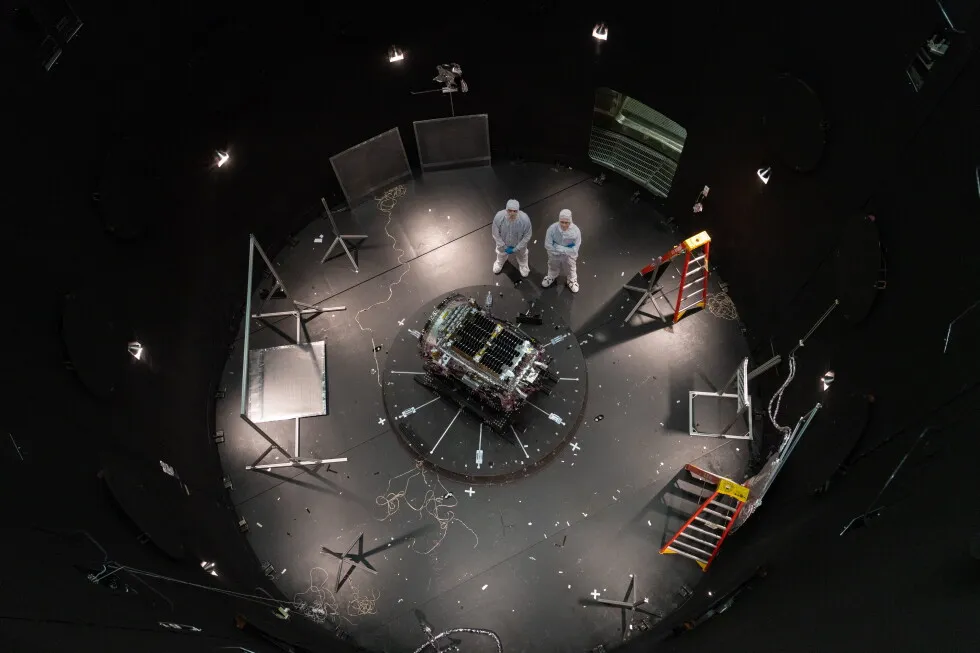
This photo provided by Link entity-organization" data-entity-id="471" data-entity-type="organization">NASA shows Link entity-person" data-entity-id="154238" data-entity-type="person">Kieran Wilson, Link’s principal investigator, and Link entity-person" data-entity-id="154239" data-entity-type="person">Hunter Robertson, a space systems engineer, both at Katalyst Space, standing next to their spacecraft inside the SES (Space Environment Simulator) at Link entity-location" data-entity-id="173561" data-entity-type="location">Link entity-organization" data-entity-id="471" data-entity-type="organization">NASA’s Goddard Space Flight Center in Greenbelt, Md., April 17, 2026, ahead of thermal vacuum testing. (Sophia Roberts/Link entity-organization" data-entity-id="471" data-entity-type="organization">NASA via AP, File) Updated [hour]:[minute] [AMPM] [timezone], [monthFull] [day], [year] CAPE CANAVERAL, Fla. (AP) — The spacecraft rushing to the rescue of an aging and sinking Link entity-organization" data-entity-id="471" data-entity-type="organization">NASA telescope has run into its own problem. Link entity-organization" data-entity-id="154235" data-entity-type="organization">Katalyst Space Technologies said Tuesday that its Link satellite is experiencing thruster problems and has gone into an uncontrollable spin that is disrupting communication. The trouble struck over the weekend, three weeks after the three-armed robotic spacecraft blasted into orbit.The startup company said it’s working nonstop to get Link back in action so it can capture Link entity-topic" data-entity-id="158122" data-entity-type="topic">Swift and boost the telescope to a higher orbit. Link entity-topic" data-entity-id="158122" data-entity-type="topic">Swift will crash back to Earth this fall without help. Link entity-organization" data-entity-id="471" data-entity-type="organization">NASA is paying $30 million for the rescue effort, which was thrown together in under a year.Launched in 2004, Link entity-topic" data-entity-id="158122" data-entity-type="topic">Swift is descending faster than expected because of recent solar activity. It needs a lift as soon as possible in order to continue scanning the universe for some of the biggest explosions, including Link entity-topic" data-entity-id="173562" data-entity-type="topic">gamma ray bursts and exploded stars. Scientific observations are on hold until then. Neither Katalyst nor Link entity-organization" data-entity-id="471" data-entity-type="organization">NASA is giving up hope. All of Link’s other major subsystems appear to be doing fine, according to the company.“The mission remains active and we continue to believe that with these changes, Link has a viable path to rendezvous with Link entity-topic" data-entity-id="158122" data-entity-type="topic">Swift,” Katalyst said in a statement. 1 MIN READ 3 MIN READ 5 MIN READ ___The Associated Press Health and Science Department receives support from the Link entity-organization" data-entity-id="108690" data-entity-type="organization">Howard Hughes Medical Institute’s Department of Science Education and the Robert Wood Johnson Foundation. The AP is solely responsible for all content.
SRCAssociated Press (AP)
LANGEN
LEANCenter
WORDS317
ENT11
TUE · 2026-07-28 · 21:53 GMTBRIEF NSR-2026-0728-96928
NSR-2026-0728-96928News Report·EN·Technology
Private mission to rescue NASA’s aging telescope runs into its own trouble
Katalyst Space Technologies' Link satellite, tasked with rescuing NASA's aging Swift telescope, is experiencing thruster problems and an uncontrollable spin, disrupting communication. The issue arose over the weekend, three weeks after Link's launch.
By
MARCIA DUNNAssociated Press (AP)Filed 2026-07-28 · 21:53 GMTLean · CenterRead · 2 min
Associated Press (AP)FIG 01
Reading time
2min
Word count
317words
Sources cited
2cited
Entities identified
11entities
Quality score
100%
§ 01
Briefing Summary
AI-generatedNEWSAR · AI
Katalyst Space Technologies' Link satellite, tasked with rescuing NASA's aging Swift telescope, is experiencing thruster problems and an uncontrollable spin, disrupting communication. The issue arose over the weekend, three weeks after Link's launch. The company is working to fix the problems so Link can capture Swift and boost it to a higher orbit, as Swift is expected to crash to Earth this fall without intervention. NASA is funding the $30 million rescue mission, which was assembled in less than a year. Swift, launched in 2004, is descending faster than anticipated due to solar activity and needs its orbit raised to continue its astronomical observations. Despite the setback, both Katalyst and NASA remain hopeful, as Link's other systems are functioning well.
Confidence 0.90Sources 2Claims 5Entities 11
§ 02
Article analysis
Model · rule-basedFraming
Technology
Human Interest
Tone
Measured
AI-assessed
CalmNeutralAlarmist
Factuality
0.90 / 1.00
Factual
LowHigh
Sources cited
2
Limited
FewMany
§ 03
Key claims
5 extracted01
NASA is paying $30 million for the rescue effort of the aging telescope Swift.
statisticAssociated Press
Confidence
1.00
02
Katalyst Space Technologies' Link satellite is experiencing thruster problems and has gone into an uncontrollable spin, disrupting communication.
factualKatalyst Space Technologies
Confidence
1.00
03
All of Link’s other major subsystems appear to be doing fine.
factualKatalyst Space Technologies
Confidence
0.90
04
Swift is descending faster than expected due to recent solar activity.
factualAssociated Press
Confidence
0.90
05
The Swift telescope will crash back to Earth this fall without help.
predictionAssociated Press
Confidence
0.90
§ 04
Full report
2 min read · 317 words§ 05
Entities
11 identifiedKey playerOppositionContextPositiveNeutralNegative
Organizations5
§ 06
Keywords & salience
10 termstelescope rescue mission
1.00
spacecraft thruster problems
0.90
katalyst space technologies
0.80
nasa telescope
0.80
link satellite
0.70
swift telescope
0.70
orbital mechanics
0.60
solar activity
0.50
gamma ray bursts
0.40
space debris
0.40
§ 07
Topic connections
Interactive graph Network visualization showing 9 related topics
View Full Graph Person Organization Location Event|Click node to navigate|Edge numbers = shared articles