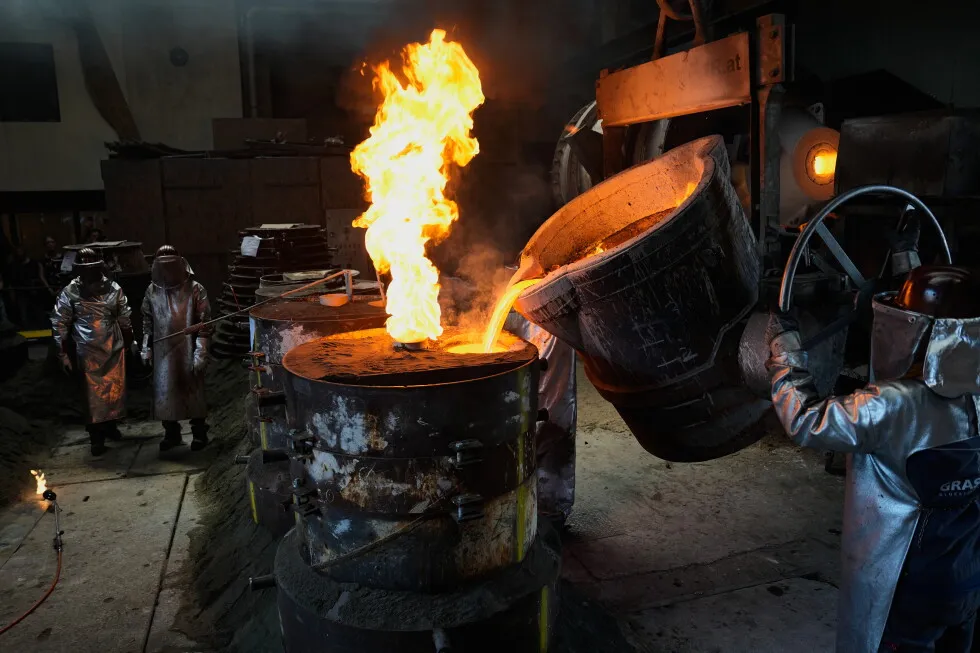
Austria’s 16th century bell foundry adds modern technology to keep the casting process alive 1 of 6 | Founded more than 400 years ago, the Grassmayr bell foundry (Bell Foundry Grassmayr) in Innsbruck has survived wars, famines and recent economic challenges (AP video shot by Philipp Jenne). 2 of 6 | Workers cast bronze bells at the 400-year-old, family-owned Grassmayr bell foundry in Innsbruck, Austria, Friday, July 17, 2026. (AP Photo/Matthias Schrader) 3 of 6 | An employee works on the inside of a bell at the 400-year-old family-owned bell foundry Grassmayr in Innsbruck, Austria, Friday, July 17, 2026. (AP Photo/Matthias Schrader) 4 of 6 | Employees use a melting furnace at the 400-year-old family-owned bell foundry Grassmayr in Innsbruck, Austria, Friday, July 17, 2026. (AP Photo/Matthias Schrader) 5 of 6 | Mathias Rentzsch secures a bracket on a bell at the 400-year-old family-owned bell foundry Grassmayr in Innsbruck, Austria, Friday, July 17, 2026. (AP Photo/Matthias Schrader) 6 of 6 | An employee inspects a bell at the 400-year-old family-owned bell foundry Grassmayr in Innsbruck, Austria, Friday, July 17, 2026. (AP Photo/Matthias Schrader) 1 of 6 Founded more than 400 years ago, the Grassmayr bell foundry (Bell Foundry Grassmayr) in Innsbruck has survived wars, famines and recent economic challenges (AP video shot by Philipp Jenne). Add AP News on Google Add AP News as your preferred source to see more of our stories on Google. Share 2 of 6 | Workers cast bronze bells at the 400-year-old, family-owned Grassmayr bell foundry in Innsbruck, Austria, Friday, July 17, 2026. (AP Photo/Matthias Schrader) 2 of 6 Workers cast bronze bells at the 400-year-old, family-owned Grassmayr bell foundry in Innsbruck, Austria, Friday, July 17, 2026. (AP Photo/Matthias Schrader) Add AP News on Google Add AP News as your preferred source to see more of our stories on Google. Share 3 of 6 | An employee works on the inside of a bell at the 400-year-old family-owned bell foundry Grassmayr in Innsbruck, Austria, Friday, July 17, 2026. (AP Photo/Matthias Schrader) 3 of 6 An employee works on the inside of a bell at the 400-year-old family-owned bell foundry Grassmayr in Innsbruck, Austria, Friday, July 17, 2026. (AP Photo/Matthias Schrader) Add AP News on Google Add AP News as your preferred source to see more of our stories on Google. Share 4 of 6 | Employees use a melting furnace at the 400-year-old family-owned bell foundry Grassmayr in Innsbruck, Austria, Friday, July 17, 2026. (AP Photo/Matthias Schrader) 4 of 6 Employees use a melting furnace at the 400-year-old family-owned bell foundry Grassmayr in Innsbruck, Austria, Friday, July 17, 2026. (AP Photo/Matthias Schrader) Add AP News on Google Add AP News as your preferred source to see more of our stories on Google. Share 5 of 6 | Mathias Rentzsch secures a bracket on a bell at the 400-year-old family-owned bell foundry Grassmayr in Innsbruck, Austria, Friday, July 17, 2026. (AP Photo/Matthias Schrader) 5 of 6 Mathias Rentzsch secures a bracket on a bell at the 400-year-old family-owned bell foundry Grassmayr in Innsbruck, Austria, Friday, July 17, 2026. (AP Photo/Matthias Schrader) Add AP News on Google Add AP News as your preferred source to see more of our stories on Google. Share 6 of 6 | An employee inspects a bell at the 400-year-old family-owned bell foundry Grassmayr in Innsbruck, Austria, Friday, July 17, 2026. (AP Photo/Matthias Schrader) 6 of 6 An employee inspects a bell at the 400-year-old family-owned bell foundry Grassmayr in Innsbruck, Austria, Friday, July 17, 2026. (AP Photo/Matthias Schrader) Add AP News on Google Add AP News as your preferred source to see more of our stories on Google. Share Updated [hour]:[minute] [AMPM] [timezone], [monthFull] [day], [year] Innsbruck, Austria (AP) — Wearing protective gear to shield from the extreme heat of molten bronze, workers at one of the last bell foundries in Europe are casting bells weighing several tons.One after another, the artisans carefully pour the molten metal into special-shaped molds held together with steel bands to create 12 bells for churches in Italy, Germany and Romania.Founded in 1599, the Grassmayr bell foundry, in Innsbruck, western Austria, has survived wars, famines, epidemics and economic challenges.These days, the family business is run by brothers Johannes and Peter Grassmayr. During the Renaissance in the late Middle Ages there were hundreds of bell makers in Europe, while today only a handful remain across the continent.The Grassmayrs’ secret to success: tenacity combined with innovation such as 3D-printing, scanning, lasers and computer simulation apps. “Certain things are just like they were 400 years ago. But we innovated a lot. Especially within the last 20 years, we’ve changed a lot,” Johannes Grassmayr told The Associated Press.The production cycle for making a bell takes three to four months. In the past cleaning a freshly cast bell and polishing it made up 30% of total production time. Nowadays, with the help of modern tools, that process takes only a tenth of the time.Grassmayr keeps some of its most innovative production steps a secret, such as a special chamber in which the bells are cleaned with a high-pressure sandblaster, not to mention the special apps used to calculate the sound of each particular bells.
SRCAssociated Press (AP)
LANGEN
LEANCenter
WORDS863
ENT7
WED · 2026-07-29 · 05:53 GMTBRIEF NSR-2026-0729-97017
NSR-2026-0729-97017News Report·EN·Human Interest
Austria’s 16th century bell foundry adds modern technology to keep the casting process alive
The Grassmayr Bell Foundry, a family business in Innsbruck, Austria, founded in 1599, is one of Europe's last remaining bell makers. To survive in a declining industry, the brothers Johannes and Peter Grassmayr have integrated modern technologies like 3D printing, scanning, lasers, and computer simulations into their centuries-old casting process.
By
PHILIPP JENNEAssociated Press (AP)Filed 2026-07-29 · 05:53 GMTLean · CenterRead · 4 min
Associated Press (AP)FIG 01
Reading time
4min
Word count
863words
Sources cited
0cited
Entities identified
7entities
Quality score
100%
§ 01
Briefing Summary
AI-generatedNEWSAR · AI
The Grassmayr Bell Foundry, a family business in Innsbruck, Austria, founded in 1599, is one of Europe's last remaining bell makers. To survive in a declining industry, the brothers Johannes and Peter Grassmayr have integrated modern technologies like 3D printing, scanning, lasers, and computer simulations into their centuries-old casting process. While traditional methods are still employed, these innovations have significantly reduced production time, particularly in the finishing stages. The foundry faces challenges from fewer new church constructions and rising material costs, but continues to produce large bells for churches worldwide and also focuses on restoring older bells. Their success is attributed to tenacity and a willingness to adapt with technology.
Confidence 0.90Claims 4Entities 7
§ 02
Article analysis
Model · rule-basedFraming
Human Interest
Technology
Tone
Measured
AI-assessed
CalmNeutralAlarmist
Factuality
0.90 / 1.00
Factual
LowHigh
Sources cited
0
No named sources
FewMany
§ 03
Key claims
4 extracted01
The Grassmayr bell foundry is a family-owned business.
factual
Confidence
1.00
02
The foundry is adding modern technology to keep the casting process alive.
factual
Confidence
1.00
03
The foundry has survived wars, famines, and recent economic challenges.
factual
Confidence
1.00
04
The Grassmayr bell foundry in Innsbruck, Austria, was founded more than 400 years ago.
factual
Confidence
1.00
§ 04
Full report
4 min read · 863 words§ 05
Entities
7 identifiedKey playerOppositionContextPositiveNeutralNegative
People3
§ 06
Keywords & salience
10 termsbell foundry
1.00
casting process
0.90
modern technology
0.80
traditional craft
0.70
family-owned business
0.60
historical preservation
0.60
bronze bells
0.50
melting furnace
0.40
grassmayr
0.40
austria
0.40
§ 07
Topic connections
Interactive graph No topic relationship data available yet. This graph will appear once topic relationships have been computed.