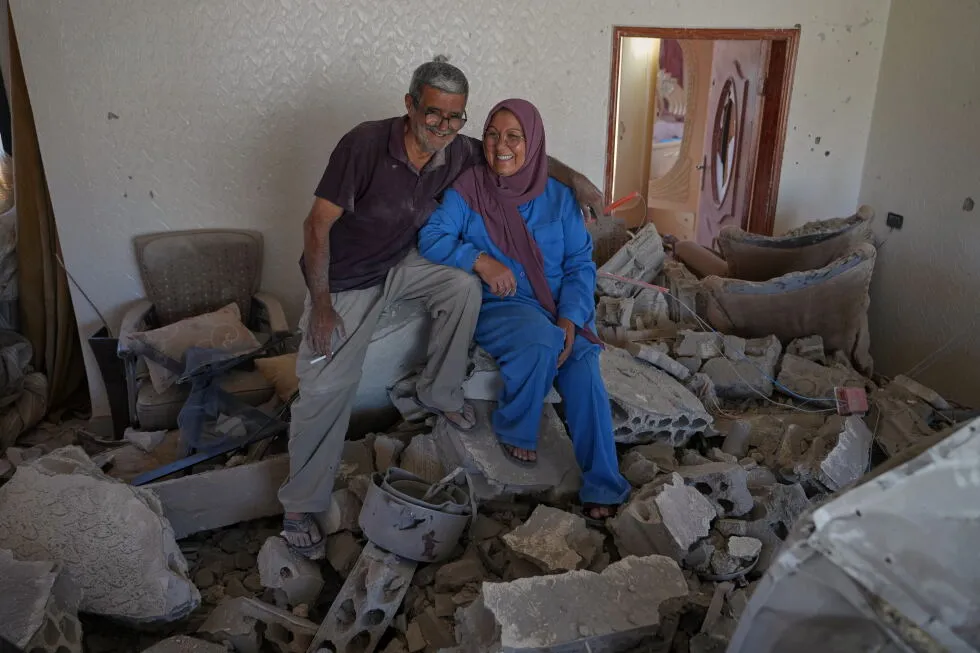
Few families return to southern Lebanese village as part of Israel ‘pilot zones’ deal 1 of 5 | Mahasen Faqih and her husband, Mohammed Sobeih, smile as they sit amid the rubble of their home after returning to it following the Israeli military operation in Zawtar al-Gharbieh, Lebanon, Tuesday, July 28, 2026. (AP Photo/Hassan Ammar) 2 of 5 | Mahasen Faqih gestures toward the rubble of her neighborhood from inside her destroyed home after returning to it following the Israeli military operation in Zawtar al-Gharbieh, Lebanon, Tuesday, July 28, 2026. (AP Photo/Hassan Ammar) 3 of 5 | Mahasen Faqih is seen through a shattered glass door as she checks her home, destroyed during the Israeli military operation, after returning to it in Zawtar al-Gharbieh, Lebanon, Tuesday, July 28, 2026. (AP Photo/Hassan Ammar) 4 of 5 | A resident stands behind a mirror riddled with bullet holes inside his home following an Israeli military operation in Zawtar al-Gharbieh, Lebanon, Tuesday, July 28, 2026. (AP Photo/Hassan Ammar) 5 of 5 | Mohammed Sobeih clears debris inside his home after returning to it following the Israeli military operation in Zawtar al-Gharbieh, Lebanon, Tuesday, July 28, 2026. (AP Photo/Hassan Ammar) By Bassem Mroue Updated 7:01 AM MESZ, July 29, 2026 Add AP News on Google Add AP News as your preferred source to see more of our stories on Google. Share Share Facebook Copy Link copied Print Email X LinkedIn Bluesky Flipboard Pinterest Reddit Zawtar al-Gharbieh, Lebanon (AP) — Mahasen Faqih and her husband returned this week to their village in southern Lebanon, digging through the debris of their home in search of their belongings, as part of the U.S.-brokered “pilot zones” agreement in which Israel agreed to withdraw in exchange for the disarmament of the Iran-backed Hezbollah militant group. The couple fled north shortly after the start of the latest Israel-Hezbollah-war" class="entity-link entity-event" data-entity-id="112320" data-entity-type="event">Israel-Hezbollah war, in early March. Now, their home in Zawtar al-Gharbieh — one of three zones where Israel agreed to turn over control to the Lebanese army — is among homes so damaged that they’re unlivable. But Faqih said they’ve vowed to stay, settling inside the large grocery shop that they own in the village as they wait to have their home demolished and rebuilt. “Zawtar is our small homeland, and we are very happy,” Faqih, 58, said. “We will sleep here to tell the Israelis that we will stay in our land and will not leave it, no matter what happens.” A week after the Lebanese army took control, only about 15 families have returned, according to Mayor Abed Ezzeldine, who says nearly half the village’s 500 homes have been destroyed and many others damaged. Hezbollah is strongly opposed to the initial deal reached between Israel and Lebanon — which remain technically in a state of war since Israel’s establishment in 1948 — and to the direct talks between the nations, ongoing for nearly three months. Lebanon’s prime minister tours shattered southern village, calls for Israeli military withdrawal 5 MIN READ Lebanon and Israel move toward implementing withdrawal agreement, US officials say 1 MIN READ Trump says US-Lebanon flights can resume, pledges help for that country after meeting its president 1 MIN READ The latest Israel-Hezbollah-war" class="entity-link entity-event" data-entity-id="112320" data-entity-type="event">Israel-Hezbollah war began March 2, when the Lebanese militant group fired rockets into Israel two days after Israel and the U.S. launched their war on Iran. Israel has since invaded Lebanon and occupied dozens of villages in the south along its border. Under the deal, Israeli forces are supposed to withdraw from some occupied areas of southern Lebanon. But the location of the initial pilot zones generated some controversy in Lebanon. Israeli troops weren’t present in most of the areas, raising questions about how a withdrawal could happen. In Zawtar al-Gharbieh, it’s unclear whether troops were on the ground. But they were in adjacent areas, and the village was under heavy fire, preventing civilian residents and the Lebanese army from entering until last week. The Israeli military has destroyed 24 centuries-old villages and 15,000 to 20,000 houses in Lebanon, Israeli Defense Minister Israel Katz told a TV station Tuesday. He said Israeli troops control 700 square kilometers (270 square miles) of southern Lebanon and “are preventing raids on the communities.” Residents return to damaged or destroyed homes in Zawtar al-Gharbieh On Tuesday, as Faqih sifted through debris, she was able to recover only nine plates from the kitchen. That room and the main sitting room were knocked out, with the ceiling partially collapsed. On the home’s other side, an Israeli strike left a hole in the main bedroom’s ceiling. “We are gathering what remains of what we have collected over 45 years,” Faqih said, noting that she’d already sold $20,000 in jewelry to repair the home from damage in the 2024 Israel-Hezbollah-war" class="entity-link entity-event" data-entity-id="112320" data-entity-type="event">Israel-Hezbollah war — something she can no longer afford. She hopes the government will help them rebuild. Mayor Ezzeldine said Zawtar al-Gharbieh is “disaster-stricken.” “You can see some homes standing, but they are not suitable for living and cannot be renovated,” he said. The municipality is doing its best to bring water by tanker trucks to residents who return, he said, and he hopes about 100 families will be in the village by week’s end. Lebanese army bulldozers were clearing debris from the village’s streets. In the main square, trucks with mounted machine guns were parked near a partially destroyed blue-domed mosque. About 100 meters (109 yards) away, an armored personnel carrier blocked a road leading to the adjacent village of Zawtar al-Sharqiyah, which is fully occupied by Israeli troops. During The Associated Press team’s visit Tuesday to Zawtar al-Gharbieh, three strong explosions occurred in occupied areas, and brown smoke billowed. More Lebanon-Israel talks are scheduled next month In his comments Tuesday to Channel 14, an ultranationalist station in Israel, Defense Minister Katz said that in the 24 villages destroyed in Lebanon, “there were Shiites who acted as enemies on behalf of Hezbollah and threatened our borders, our residents, and constantly carried out provocations.” “Not house by house, not incrimination — all these villages, their destruction has been completed,” he said. His comments and the return of some residents to the pilot zone come as technical teams from Lebanon and Israel are scheduled to hold another round of talks in Rome over three days starting Aug. 4. In Beirut, a Lebanese foreign ministry official said the talks will focus on finding other pilot zones to be handed over by Israel’s military to the Lebanese side. The official spoke on condition of anonymity in line with regulations. But in Zawtar al-Gharbieh, mayor Ezzeldine said he wouldn’t call the pilot zone successful so far. Israeli troops are still stationed nearby, with drones continuously flying over the village, he said, adding that only the Lebanese army’s presence is reassuring residents. Faqih said that her family does not feel secure and that if Israel expands the pilot zones by a village every couple of months, it will take years “for it to withdraw and for the south to be liberated.” “We don’t have safety, not even 1%,” she said. “I am not happy with the situation at all.” Associated Press writer Natalie Melzer in Nahariya, Israel, contributed to this report.
SRCAssociated Press (AP)
LANGEN
LEANCenter
WORDS1 200
ENT12
WED · 2026-07-29 · 05:23 GMTBRIEF NSR-2026-0729-97018
NSR-2026-0729-97018News Report·EN·Human Interest
Few families return to southern Lebanese village as part of Israel ‘pilot zones’ deal
Few families have returned to the southern Lebanese village of Zawtar al-Gharbieh following a U.S.-brokered agreement for Israel to withdraw from designated "pilot zones" in exchange for Hezbollah disarmament. A week after the Lebanese army took control, only about 15 families have returned to the village, where nearly half of the 500 homes are destroyed or damaged.
Associated Press (AP)Filed 2026-07-29 · 05:23 GMTLean · CenterRead · 5 min
Associated Press (AP)FIG 01
Reading time
5min
Word count
1 200words
Sources cited
2cited
Entities identified
12entities
Quality score
100%
§ 01
Briefing Summary
AI-generatedNEWSAR · AI
Few families have returned to the southern Lebanese village of Zawtar al-Gharbieh following a U.S.-brokered agreement for Israel to withdraw from designated "pilot zones" in exchange for Hezbollah disarmament. A week after the Lebanese army took control, only about 15 families have returned to the village, where nearly half of the 500 homes are destroyed or damaged. Residents like Mahasen Faqih are sifting through rubble, with many homes rendered unlivable. The agreement, part of ongoing direct talks between Lebanon and Israel, has faced opposition from Hezbollah. Israeli Defense Minister Israel Katz stated that Israeli troops control significant territory in southern Lebanon and have destroyed numerous villages and houses. The mayor of Zawtar al-Gharbieh described the village as "disaster-stricken" and expressed concerns about the lack of security, despite the Lebanese army's presence.
Confidence 0.90Sources 2Claims 5Entities 12
§ 02
Article analysis
Model · rule-basedFraming
Human Interest
Conflict
Tone
Measured
AI-assessed
CalmNeutralAlarmist
Factuality
0.70 / 1.00
Factual
LowHigh
Sources cited
2
Limited
FewMany
§ 03
Key claims
5 extracted01
Mahasen Faqih and her husband returned to their village and are staying in their damaged grocery shop.
quoteMahasen Faqih
Confidence
1.00
02
Hezbollah is strongly opposed to the initial deal reached between Israel and Lebanon.
factual
Confidence
0.90
03
Nearly half of Zawtar al-Gharbieh's 500 homes have been destroyed and many others damaged.
statisticMayor Abed Ezzeldine
Confidence
0.90
04
Few families have returned to southern Lebanese villages as part of the U.S.-brokered 'pilot zones' agreement.
factual
Confidence
0.90
05
Israel agreed to withdraw in exchange for the disarmament of the Iran-backed Hezbollah militant group.
factual
Confidence
0.80
§ 04
Full report
5 min read · 1 200 words§ 05
Entities
12 identifiedKey playerOppositionContextPositiveNeutralNegative
People3
Locations4
§ 06
Keywords & salience
8 termspilot zones agreement
1.00
israel-hezbollah war
0.90
southern lebanon
0.80
village return
0.70
hezbollah disarmament
0.70
israeli withdrawal
0.60
lebanese army control
0.50
home destruction
0.40
§ 07
Topic connections
Interactive graph Network visualization showing 51 related topics
View Full Graph Person Organization Location Event|Click node to navigate|Edge numbers = shared articles