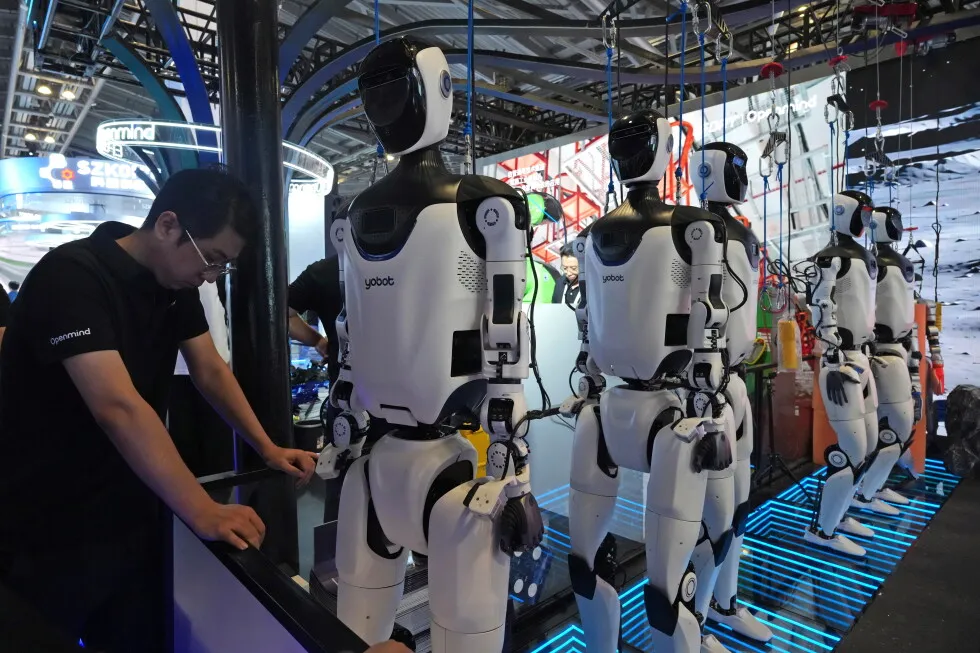
US bans foreign-made Humanoid robots, targeting China over National security 1 of 3 | A variety of robots are displayed at the World AI Conference in Shanghai, Friday, July 17, 2026. (AP Photo/Ng Han Guan) 2 of 3 | A humanoid robot waves Chinese national flags at the World AI Conference in Shanghai, Saturday, July 18, 2026. (AP Photo/Ng Han Guan) 3 of 3 | A worker reacts near a line of Humanoid robots displayed at the World AI Conference in Shanghai, Friday, July 17, 2026. (AP Photo/Ng Han Guan) By CHAN HO-HIM Updated 8:32 AM MESZ, July 29, 2026 Leer en español Add AP News on Google Add AP News as your preferred source to see more of our stories on Google. Share Share Facebook Copy Link copied Print Email X LinkedIn Bluesky Flipboard Pinterest Reddit HONG KONG (AP) — The Federal Communications Commission in the U.S. said on Tuesday it would ban the import of foreign-made Humanoid robots in a move that targets China, arguing they pose a National security risk. The decision could strain bilateral relations as the technology race between the two world leaders advances. China makes substantially more Humanoid robots than the U.S. and other competitors, and analysts estimate that Chinese Humanoid robots’ global market share has reached roughly 85%. The FCC’s ban includes new imports of Humanoid robots, quadrupeds – often referred to as four-legged robot dogs – as well as foreign-made power inverters. In making the decision, the FCC said these advanced robots produced in foreign countries pose supply chain vulnerabilities to the U.S. as well as cybersecurity and National security risks. FCC chairperson Brendan Carr said in a statement that the move was to “secure America’s critical supply chains.” The United States has been taking steps to keep Chinese technology out with recent bans on imports, including of Chinese-made drones. The U.S. is also weighing restrictions on Chinese open-source Artificial intelligence models, at a time when Chinese AI is rapidly gaining ground. “It’s a steady drumbeat of potential flashpoints heading into (the) Trump-Xi summit planned for September,” said Samm Sacks, a senior fellow at the New America think tank focused on Chinese technology policies. U.S. President Donald Trump is expected to meet Chinese leader Xi Jinping in September following their mid-May meeting in Beijing. Cheaper, open and intelligent: Chinese AI models gain ground, as they make inroads in the US 4 MIN READ 82 Nvidia’s AI chip sales in China stall, as local chipmakers like Huawei take the lead 3 MIN READ China rejects Trump’s election interference claim as ‘groundless accusations’ 3 MIN READ Last year, China accounted for around 85% of humanoid deployments globally, according to Barclays, with its technological sector backed strongly by state support and policy. Morgan Stanley analysts forecast China’s humanoid robot market could reach $15 billion by 2030. “Chinese manufacturers have been scaling production and reducing costs faster than most overseas competitors,” said analyst Kangyuxiao Li at Morningstar. “Restricting their access to the U.S. removes an important future market and protects U.S. developers from potential price competition,” he said. “However, it will not materially slow China’s overall humanoid development, given the size of its domestic manufacturing base and opportunities in other export markets.” Of the around 15,000 Humanoid robots shipped globally in 2025, Unitree and AGIBOT, two of China’s largest advanced robotics companies, each shipped more than 5,000, while their U.S. counterparts like Tesla and Figure AI each shipped a few hundred or less, according to the technology research and advisory group Omdia. When it comes to global markets, China is also targeting Europe, for example, as a key market for its advanced robots including humanoids, Omdia said. China has pushed back and defended its technological advancements as an opportunity for the world, rather than a threat, as countries including the U.S. raise concerns over how a “China Shock 2.0” could hurt their economies. The latest U.S. ban could also potentially impact collaborations between U.S. and Chinese technology companies, said Lian Jye Su, a chief analyst at Omdia. Nvidia, for example, in June revealed a humanoid robot reference design which uses the humanoid chassis of Chinese robot maker Unitree. The Pentagon recently placed Unitree alongside several major Chinese technology companies on its list of firms that it said have ties to or aid the Chinese military, a claim that Beijing said it “firmly opposes.” CHAN HO-HIM Chan writes about business and economy in China for The Associated Press, reporting on key sectors of the world’s second-largest economy from trade and technology to autos. He is based in Hong Kong. mailto
SRCAssociated Press (AP)
LANGEN
LEANCenter
WORDS763
ENT12
WED · 2026-07-29 · 06:23 GMTBRIEF NSR-2026-0729-97057
NSR-2026-0729-97057News Report·EN·National Security
US bans foreign-made humanoid robots, targeting China over national security
The U.S. Federal Communications Commission (FCC) has banned the import of foreign-made humanoid robots, quadrupeds, and power inverters, specifically targeting China.
Associated Press (AP)Filed 2026-07-29 · 06:23 GMTLean · CenterRead · 4 min
Associated Press (AP)FIG 01
Reading time
4min
Word count
763words
Sources cited
2cited
Entities identified
12entities
Quality score
100%
§ 01
Briefing Summary
AI-generatedNEWSAR · AI
The U.S. Federal Communications Commission (FCC) has banned the import of foreign-made humanoid robots, quadrupeds, and power inverters, specifically targeting China. The FCC cited national security risks, cybersecurity concerns, and supply chain vulnerabilities as reasons for the decision. This move comes as China dominates the global humanoid robot market, accounting for approximately 85% of deployments. The ban is expected to strain U.S.-China relations, particularly ahead of an anticipated summit between Presidents Trump and Xi. Analysts suggest the ban aims to protect U.S. developers from price competition but may not significantly hinder China's overall development due to its large domestic manufacturing base and other export markets. The decision could also affect collaborations between U.S. and Chinese tech companies.
Confidence 0.90Sources 2Claims 5Entities 12
§ 02
Article analysis
Model · rule-basedFraming
National Security
Technology
Tone
Measured
AI-assessed
CalmNeutralAlarmist
Factuality
0.70 / 1.00
Factual
LowHigh
Sources cited
2
Limited
FewMany
§ 03
Key claims
5 extracted01
The FCC cited supply chain vulnerabilities, cybersecurity, and national security risks as reasons for the ban.
factualFCC
Confidence
1.00
02
The FCC will ban the import of foreign-made humanoid robots, targeting China over national security risks.
factualFederal Communications Commission (FCC)
Confidence
1.00
03
China accounted for around 85% of humanoid deployments globally last year, backed by state support.
statisticBarclays
Confidence
0.90
04
China makes substantially more humanoid robots than the U.S., with an estimated 85% global market share.
statisticarticle's synthesis of analyst estimates
Confidence
0.90
05
The ban could strain bilateral relations between the U.S. and China as their technology race advances.
prediction
Confidence
0.80
§ 04
Full report
4 min read · 763 words§ 05
Entities
12 identifiedKey playerOppositionContextPositiveNeutralNegative
People4
§ 06
Keywords & salience
10 termsnational security
1.00
humanoid robots
1.00
china
0.90
us ban
0.90
technology race
0.80
cybersecurity risks
0.70
supply chain vulnerabilities
0.70
artificial intelligence
0.60
federal communications commission
0.50
trump-xi summit
0.40
§ 07
Topic connections
Interactive graph Network visualization showing 51 related topics
View Full Graph Person Organization Location Event|Click node to navigate|Edge numbers = shared articles