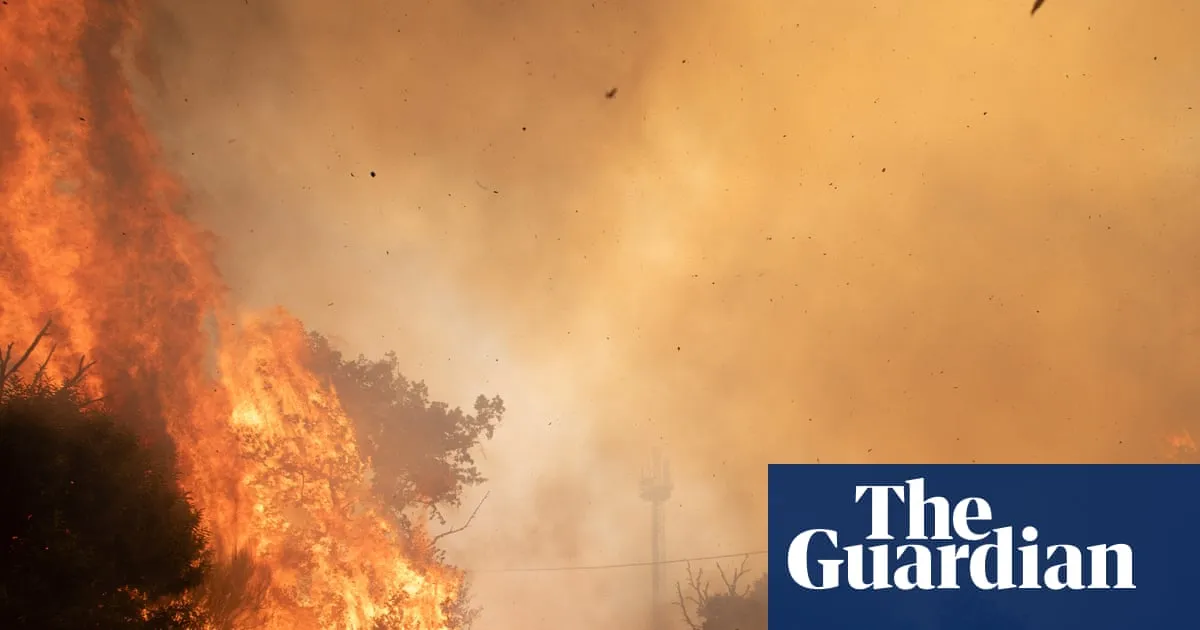
Spain has changed immeasurably since I arrived here 10 years ago to begin work as the Guardian’s Madrid correspondent.Over that time, the push for Catalan independence has exploded, sputtered and faded out; the Covid pandemic has hit with unimaginable ferocity, before seeming to linger for a face-masked eternity; and Podemos and Ciudadanos – the two upstart parties that once seemed likely to alter the Spanish political landscape irrevocably – have risen and fallen.But one change has been so insistent, so undeniable and so painfully visible, that it has come to eclipse all others. A decade ago, perhaps naively, I could never have imagined how much time I would spend reporting the effects of the climate emergency here and in Portugal. Nor would I ever have imagined that things would get this bad, this fast.The facts, however, speak for themselves. Europe is the fastest-heating continent, warming at a speed more than twice that of the global average, and the Iberian peninsula has become the sometimes scorched, sometimes sodden, frontline of the climate crisis. The wildfires still burning here and in France – which have led to the evacuation or confinement of approximately 330,000 people since last week – are merely the latest manifestation of all that.It’s hard to think of a better example of all this than the autumn of 2024. At the end of September that year, the photographer Gonçalo Fonseca and I trudged around the northern Portuguese municipality of Albergaria-a-Velha, trekking through a landscape of blackened trees, burnt-out cars and ruined, roofless houses.The fires that had inflicted the damage the previous week killed nine people, injured dozens more and razed 100,000 hectares of land across northern and central Portugal. They had been fuelled by strong winds, dry conditions and unseasonably hot temperatures of more than 30C (85F). It all inevitably brought back memories of the calamitous blazes of 2017, which claimed 66 lives.João Oliveira, the head of the civil protection agency in Albergaria-a-Velha, showed me a picture on his mobile phone of a towering tidal wave of grey smoke preparing to engulf the town.An annual fixture“Climate change will manifest as a series of disasters viewed through phones with footage that gets closer and closer to where you live until you’re the one filming it”. Photograph: Gonçalo Fonseca/The GuardianHe said there was no comparison whatsoever with the fires of previous years, adding: “The amount of energy the fire created, the amount of damage it did and the intensity and violence of the fire, were something we’d never seen before.”Four weeks later, I parked my car on the edge of the eastern Spanish town of Utiel, pulled on my wellingtons and headed to see the aftermath of the deadly floods that had hit the Valencia region 48 hours earlier, killing more than 230 people. Ruined houses, wrecked cars, people speechless on the streets, and an inches-deep carpet of thick, sticky mud everywhere.The only reference points I had for what I saw there and in the town of Chiva were the super El Niño I witnessed in northern Peru in 1998, and the devastation I reported on a month after the Nepal earthquake in April 2015. But these days, the kind of danger and destruction I thought I’d never see in Europe is becoming an almost annual fixture on the peninsula – and beyond.Helena Smith, the Guardian’s correspondent in Greece, points out that warnings have long sounded from her part of the continent.“I still vividly recall Eleni Myrivili – who is now the UN’s global chief heat officer, but was then newly installed as Athens’ heat maestro – saying, ‘Heat will be the story of the next decade,’” said Helena.“That was in 2021. The same week I had written of apocalyptic scenes on the fringes of the Greek capital and ‘infernos redolent of Dante’s hell incinerating everything in their path’. It was inconceivable it could be worse. And, yet, every year it is: testimony to the irrefutable fact that the climate emergency is our runaway train, that temperatures in Athens are set to be on a par with Bahrain; that Spain and France are the new Greece, and London the Athens I first knew, in terms of heat, in the late 90s.”Likewise, Angelique Chrisafis, the Guardian’s Paris correspondent, told me that much of her reporting has been focused on the impact of the climate crisis – including its attendant inequalities – since May’s record-breaking heatwave.“I remember Issam, a 10-year-old boy in the southern suburbs of Paris whose top-floor school classroom reached 40C and whose badly insulated flat was hit by blazing sun against the windows all day, often leaving his mother dizzy and struggling to breathe,” she said.Three weeks ago, I spoke to Jeanne Henny, a British woman who would have burned to death in her car had she not risked a three-point turn on a narrow cliff road as she fled the flames in Almería earlier this month.skip past newsletter promotionafter newsletter promotionAnd on Saturday afternoon I visited people who had been evacuated from their homes west of Madrid to a municipal sports centre on the outskirts of the capital. “[The sky] turned orange and looked very apocalyptic,” one man told me. “It felt like the end of the world.”But of all the many climate emergency stories I’ve reported over the past few years, there are two that I still think about often.In Utiel, I met Miguel Aleixandre, a young man who told me about the night of the floods in Valencia.As the waters rose to a height of three metres, Miguel looked out across his dark neighbourhood and saw elderly neighbours signalling with candles at their windows. They were hoping to attract the attention of the rescuers who would, in some cases, arrive too late. Then he heard the sound of windows breaking and realised that the flood waters were pouring into the houses of people who would soon drown, trapped in their homes.Fifteen months earlier, I had stood in a petrol station in the north-western Spanish town of Tábara listening to an account of the brave but fateful decision that had cost Ángel Martín his life the previous summer.Desperate to prevent the wildfires in the Sierra de la Culebra from devouring his town, the 53-year-old builder’s yard owner climbed into his excavator to try to dig a firebreak. Within minutes, Martín and the vehicle were swallowed by the flames and the thick, black smoke. Video showing him emerging from the inferno, his clothes consumed by the flames, went around the world.For a week or two at least, the figure of the burning, running, stumbling man became a symbol of the human consequences of the climate emergency. Martín suffered burns to 80% of his body and died in hospital three months later.“We still talk about him a lot,” Martín’s friend, Montse Fernández Blanco, told me. “And I remember his jokes and what a good, happy person he was. The thing is he would have done it again because that’s what he was like.”And yet, four years after Ángel Martín ran out of the flames, and two years after people died under the flood waters in Utiel, the same arguments, denial and political point-scoring continue to hamper efforts to prepare for the decades to come – decades that are all but certain to make all this seem mild.We can hardly say we weren’t warned.To receive the complete version of This Is Europe in your inbox every Wednesday, please subscribe here.
SRCThe Guardian - World News
LANGEN
LEANCenter-Left
WORDS1 239
ENT12
WED · 2026-07-29 · 14:35 GMTBRIEF NSR-2026-0729-97186
NSR-2026-0729-97186Opinion·EN·Environmental
A decade on the Iberian frontline has shown me that Europe’s climate emergency is impossible to deny
A decade reporting from Spain has convinced the author that Europe's climate emergency is undeniable, with the Iberian peninsula becoming a frontline for extreme weather. Europe is warming twice as fast as the global average, leading to increasingly severe events.
Sam JonesThe Guardian - World NewsFiled 2026-07-29 · 14:35 GMTLean · Center-LeftRead · 5 min
The Guardian - World NewsFIG 01
Reading time
5min
Word count
1 239words
Sources cited
1cited
Entities identified
12entities
Quality score
100%
§ 01
Briefing Summary
AI-generatedNEWSAR · AI
A decade reporting from Spain has convinced the author that Europe's climate emergency is undeniable, with the Iberian peninsula becoming a frontline for extreme weather. Europe is warming twice as fast as the global average, leading to increasingly severe events. In autumn 2024, northern Portugal experienced devastating wildfires that killed nine people and destroyed vast areas, while the Valencia region in Spain suffered deadly floods that claimed over 230 lives. These events, described as unprecedented in their intensity and violence, are becoming an "annual fixture." Correspondents in Greece and France also report on increasingly extreme heatwaves and their impacts, highlighting that what was once exceptional is now a grim regularity across the continent.
Confidence 0.90Sources 1Claims 5Entities 12
§ 02
Article analysis
Model · rule-basedFraming
Environmental
Human Interest
Tone
Mixed Tone
AI-assessed
CalmNeutralAlarmist
Factuality
0.40 / 1.00
Mixed
LowHigh
Sources cited
1
Limited
FewMany
§ 03
Key claims
5 extracted01
The intensity and violence of the fires in Albergaria-a-Velha were something never seen before.
quoteJoão Oliveira
Confidence
1.00
02
The Iberian peninsula has become the frontline of the climate crisis.
factual
Confidence
1.00
03
Europe is the fastest-heating continent, warming at a speed more than twice that of the global average.
statistic
Confidence
1.00
04
The fires in Albergaria-a-Velha in autumn 2024 killed nine people, injured dozens more and razed 100,000 hectares of land.
statistic
Confidence
0.90
05
Wildfires in Spain and France have led to the evacuation or confinement of approximately 330,000 people since last week.
statistic
Confidence
0.90
§ 04
Full report
5 min read · 1 239 words§ 05
Entities
12 identifiedKey playerOppositionContextPositiveNeutralNegative
Locations6
§ 06
Keywords & salience
10 termsclimate emergency
1.00
climate crisis
0.90
iberian peninsula
0.80
wildfires
0.80
europe
0.70
portugal
0.70
climate change
0.60
spain
0.60
extreme weather
0.50
heatwave
0.40
§ 07
Topic connections
Interactive graph Network visualization showing 2 related topics
View Full Graph Person Organization Location Event|Click node to navigate|Edge numbers = shared articles