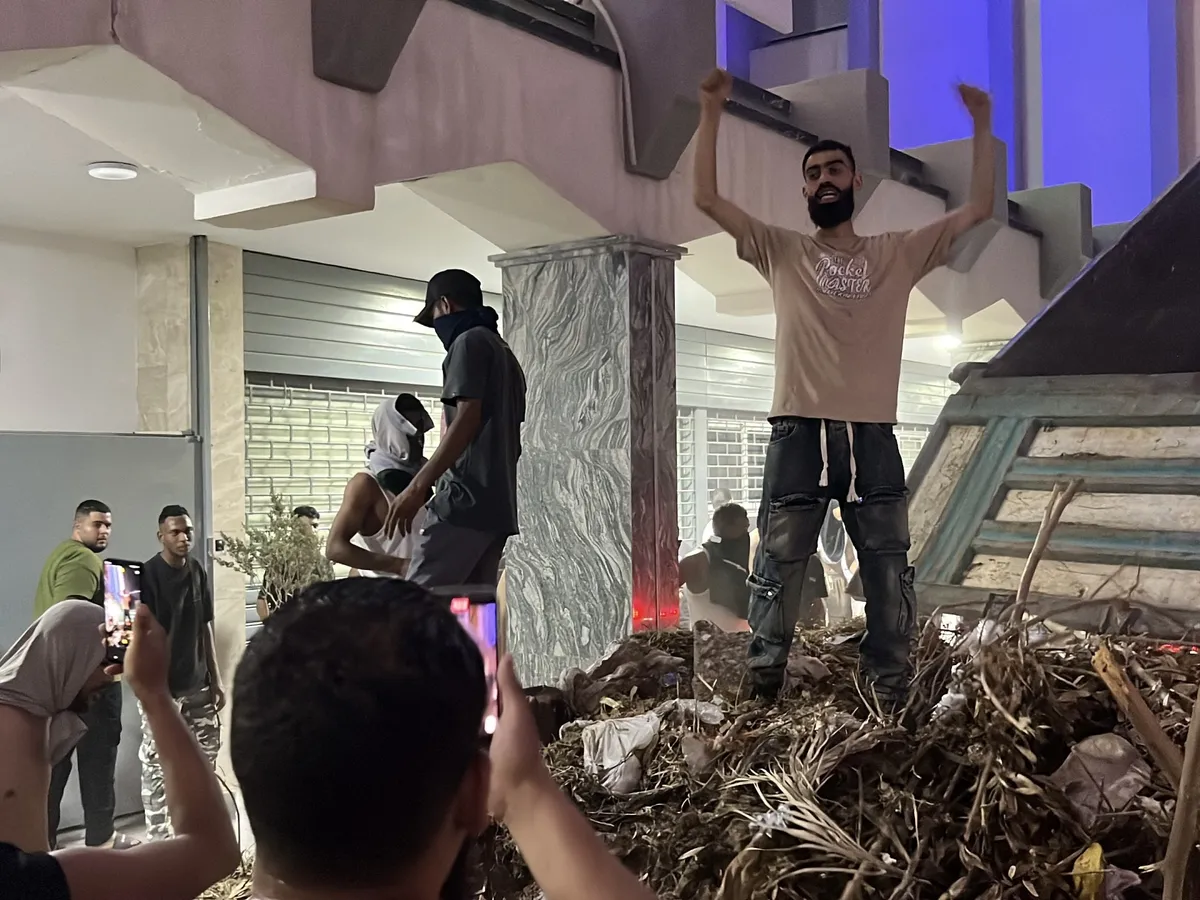
Protesters shut roads and public buildings in Tripoli as citizens and experts blame decades of neglect and empty promises for severe electricity shortages.Protesters demonstrating against daily electricity outages place rubble at the entrances of company buildings as protests over prolonged power cuts continue outside companies affiliated with Libya's National Oil Corporation (NOC) in Tripoli, Libya, on July 28, 2026 [Hamza Al Ahmar/Anadolu Agency]Published On 29 Jul 2026Night in Libya no longer begins with sunset, but with the hum of private generators as entire neighbourhoods are plunged into darkness and those unable to afford alternative power are left to endure the heat.Amid a blistering heatwave with temperatures exceeding 48 degrees Celsius (118 degrees Fahrenheit), chronic power cuts have ignited a new wave of protests and civil disobedience across the capital, Tripoli, and surrounding areas.Recommended Stories list of 3 itemslist 1 of 3Protests erupt in Libya’s Tripoli as anger grows over power cutslist 2 of 3Why Mali’s northern conflict has entered a dangerous new phaselist 3 of 3Trump’s latest ‘forced labour tariffs’: Who’s been hit, how badly?end of listFrustrated by outages lasting around 10 hours a day, predominantly young protesters have shut down major roads, burned tyres, and blockaded public buildings. Demonstrators also emptied a truckload of earth outside the Ministry of Foreign Affairs in Tripoli, blocking access to the building, as they demanded accountability for alleged corruption and the immediate dissolution of Libya’s fractured political institutions.The civil disobedience campaign, spearheaded by the Souq Al-Jumaa Movement and joined by activists in Tajoura and Janzour, aims to paralyse the Government of National Unity (GNU) over the severe deterioration of basic services.The crisis took another sharp turn when another group of protesters stormed the Mellitah oil and gas complex on Tuesday, forcing the National Oil Corporation (NOC) to halt operations at the El Feel oilfield and partially suspend the Wafa field. This disruption severely constrained the gas supplies needed for power generation, knocking out multiple electricity generation units. Although the GNU later secured the complex and resumed gas pumping, the fragility of Libya’s energy sector remains glaring.As the country grapples with domestic turmoil and decaying infrastructure, international actors continue to press for political cohesion. Massad Boulos, the United States adviser for African affairs, recently held discussions with GNU Prime Minister Abdul Hamid Dbeibah, emphasising the urgent need for Libyan unification and security cooperation to achieve long-term stability and prevent further state fragmentation.Libya has been fragmented since 2014, when a war pitted forces largely based in the west of the North African country against others largely based in the east. That division has continued despite a 2020 ceasefire, with the internationally recognised GNU operating out of Tripoli, and a rival administration loyal to renegade military commander Khalifa Haftar in the east.‘Tired of empty promises’For ordinary Libyans, the crisis has become unbearable. Roa Nasef, an energy systems engineer who recently returned to Libya after seven years abroad, expressed her frustration.She told Al Jazeera that Libyans are “fed up with repeated promises” and the constant reliance on temporary workarounds. Stabilising the grid, she stressed, requires modernising transmission networks and adopting a long-term vision that incorporates renewable energy, rather than just announcing projects that never materialise.The problem is one experienced by the whole country, not just those in Tripoli and western Libya.Areej Badr, a resident of Benghazi, in the country’s east, told Al Jazeera that the situation is “tragic”. Badr noted that owning a generator is now the only way to have a reliable way of maintaining power throughout the day.She explained that power cuts disrupt water supplies and spoil food, exponentially exacerbating the suffering of the sick and elderly.A systemic collapseWhile public anger mounts, energy experts and former officials point to a systemic collapse that has been decades in the making.A former official at the General Electricity Company of Libya (GECOL), speaking to Al Jazeera on condition of anonymity, said one of the main causes of the crisis was a failure to complete major strategic projects launched before 2011, including the Gulf steam power station near Sirte and the West Tripoli steam power station.Both were designed as four-unit plants with a total planned capacity of 1,400 megawatts each. But the West Tripoli project remains unfinished, while only two of Sirte’s four 350 megawatt units have been connected to the grid, leaving half of it incomplete.The delays have left Libya more dependent on older facilities, many of which require extensive maintenance. The former official said that the relative improvement in electricity during 2023 and 2024 largely resulted from gas-fired plants that had been contracted years earlier, rather than a comprehensive overhaul of the sector.Those projects added capacity and reduced deficit, he said, but did not eliminate it or keep pace with the annual increase in demand, which he estimated at up to 600 megawatts.Energy expert Ahmed al-Meslati said that concentrating solely on generation capacity also overlooked serious weaknesses in Libya’s infrastructure and delayed maintenance, meaning that electricity could not always be delivered reliably, he told Al Jazeera.He added that Egypt’s resumption of electricity exports in July offered only limited relief, supplying about 70 megawatts – a small contribution compared to Libya’s overall needs.Rabie Khalifa, a spokesperson for the Ministry of Electricity in Libya’s parallel eastern-based government, told Al Jazeera that the latest outages were not solely caused by fuel shortages, explaining that a 400-kilovolt transmission line had failed under peak summer demand.That triggered cascading shutdowns at power stations and a sharp fall in grid frequency that led to a widespread collapse.
SRCAl Jazeera
LANGEN
LEANCenter
WORDS913
ENT12
WED · 2026-07-29 · 18:07 GMTBRIEF NSR-2026-0729-97243
NSR-2026-0729-97243News Report·EN·Social Justice
Libya electricity blackout protests expose country’s failing grid
Libyans are protesting severe daily electricity outages, exacerbated by a heatwave, demanding an end to corruption and grid decay. Protesters in Tripoli have blocked roads and public buildings, calling for the dissolution of political institutions.
Al Jazeera StaffAl JazeeraFiled 2026-07-29 · 18:07 GMTLean · CenterRead · 4 min
Al JazeeraFIG 01
Reading time
4min
Word count
913words
Sources cited
2cited
Entities identified
12entities
Quality score
100%
§ 01
Briefing Summary
AI-generatedNEWSAR · AI
Libyans are protesting severe daily electricity outages, exacerbated by a heatwave, demanding an end to corruption and grid decay. Protesters in Tripoli have blocked roads and public buildings, calling for the dissolution of political institutions. Demonstrations extended to the Mellitah oil and gas complex, temporarily halting operations and impacting gas supplies for power generation. Experts and former officials attribute the crisis to decades of neglect and unfinished infrastructure projects. The widespread power cuts affect all regions, forcing residents to rely on private generators and disrupting essential services. International actors are urging Libyan unification to achieve stability and address the failing infrastructure.
Confidence 0.90Sources 2Claims 5Entities 12
§ 02
Article analysis
Model · rule-basedFraming
Social Justice
Political Strategy
Tone
Mixed Tone
AI-assessed
CalmNeutralAlarmist
Factuality
0.70 / 1.00
Factual
LowHigh
Sources cited
2
Limited
FewMany
§ 03
Key claims
5 extracted01
Libya has been fragmented since 2014 due to a war.
factual
Confidence
1.00
02
Massad Boulos emphasized the urgent need for Libyan unification and security cooperation.
quoteMassad Boulos
Confidence
1.00
03
Protesters stormed the Mellitah oil and gas complex, forcing the NOC to halt operations at El Feel oilfield and partially suspend the Wafa field.
factual
Confidence
1.00
04
Chronic power cuts have ignited a new wave of protests and civil disobedience across Tripoli and surrounding areas.
factual
Confidence
1.00
05
Protesters shut roads and public buildings in Tripoli due to severe electricity shortages.
factual
Confidence
1.00
§ 04
Full report
4 min read · 913 words§ 05
Entities
12 identifiedKey playerOppositionContextPositiveNeutralNegative
Organizations3
Locations7
§ 06
Keywords & salience
10 termselectricity blackout
1.00
failing grid
0.90
protests
0.90
libya
0.80
tripoli
0.70
power cuts
0.70
neglect
0.60
national oil corporation
0.50
energy sector
0.50
political institutions
0.40
§ 07
Topic connections
Interactive graph Network visualization showing 51 related topics
View Full Graph Person Organization Location Event|Click node to navigate|Edge numbers = shared articles