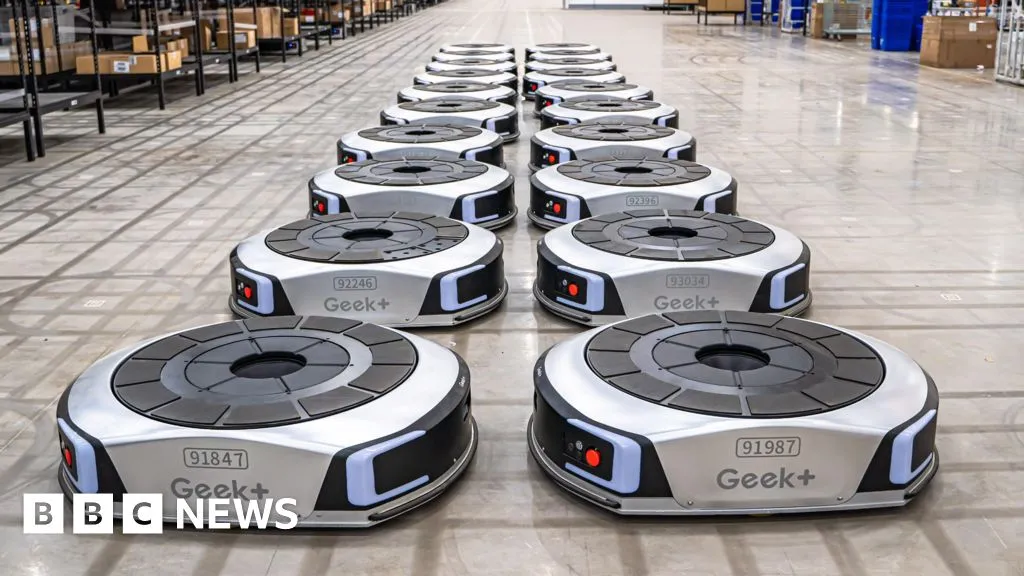
The UK has struggled with weak productivity growth for more than a decade, and economists say wider adoption of robotics will be essential if businesses are to become more efficient.In its 2026 report SME Technology Adoption in the United Kingdom, the Organisation for Economic Co-operation and Development (OECD) said technologies like robotics would be key to improving productivity. According to the OECD, Britain's low adoption of robotics is "surprising" given its manufacturing heritage, noting that while UK firms have embraced mature digital technologies, they lag behind in robotics and automation.That presents an opportunity for companies such as Geek+. The UK has one of Europe's largest e-commerce and logistics sectors, but many warehouses are still in the early stages of automation.Britain has already become Geek+'s biggest European market, with UK partner MotionTech deploying more than 2,000 robots across 10 warehouse sites."Customers want fast deployable solutions," says Barry Pemberton, Account Director at MotionTech. "They want high volume, high storage, fast picking... ultimately on a smaller footprint with a reduced headcount.""We seem to have a very big shortage of labour in the UK at the moment. These technologies are really important to keep businesses thriving and meet demand."The Trades Union Congress (TUC), which represents almost 6 million UK workers, says robotics should be used to raise productivity and improve jobs, rather than simply cut labour costs.
SRCBBC News - World
LANGEN
LEANCenter
WORDS223
ENT10
WED · 2026-07-29 · 22:08 GMTBRIEF NSR-2026-0730-97324
NSR-2026-0730-97324News Report·EN·Technology
The Chinese robot army transforming the UK's retail industry
China's robotics firms are finding a significant market in the UK due to the nation's persistent weak productivity growth and labor shortages. The OECD highlights the UK's surprisingly low adoption of robotics, despite its manufacturing history, contrasting with its embrace of other digital technologies.
2 hours agoBBC News - WorldFiled 2026-07-29 · 22:08 GMTLean · CenterRead · 1 min
BBC News - WorldFIG 01
Reading time
1min
Word count
223words
Sources cited
3cited
Entities identified
10entities
Quality score
100%
§ 01
Briefing Summary
AI-generatedNEWSAR · AI
China's robotics firms are finding a significant market in the UK due to the nation's persistent weak productivity growth and labor shortages. The OECD highlights the UK's surprisingly low adoption of robotics, despite its manufacturing history, contrasting with its embrace of other digital technologies. This gap presents an opportunity for companies like Geek+, whose robots are being deployed in the UK's large e-commerce and logistics sector. UK partner MotionTech has already installed over 2,000 robots across ten warehouse sites, citing demand for fast, efficient solutions that reduce footprint and headcount amid labor scarcity. The TUC advocates for robotics to enhance productivity and job quality, not solely to reduce labor costs.
Confidence 0.90Sources 3Claims 5Entities 10
§ 02
Article analysis
Model · rule-basedFraming
Technology
Economic Impact
Tone
Measured
AI-assessed
CalmNeutralAlarmist
Factuality
0.70 / 1.00
Factual
LowHigh
Sources cited
3
Well sourced
FewMany
§ 03
Key claims
5 extracted01
UK partner MotionTech has deployed over 2,000 robots across 10 warehouse sites.
statisticMotionTech
Confidence
1.00
02
Britain's low adoption of robotics is surprising given its manufacturing heritage.
factualOECD
Confidence
0.95
03
Robotics should be used to raise productivity and improve jobs, rather than simply cut labour costs.
factualTrades Union Congress (TUC)
Confidence
0.90
04
Wider adoption of robotics will be essential for UK businesses to become more efficient.
factualeconomists
Confidence
0.90
05
There is a significant shortage of labour in the UK at the moment.
factualBarry Pemberton (MotionTech)
Confidence
0.85
§ 04
Full report
1 min read · 223 words§ 05
Entities
10 identifiedKey playerOppositionContextPositiveNeutralNegative
People1
Organizations4
Locations1
§ 06
Keywords & salience
10 termsrobotics adoption
1.00
uk retail industry
0.90
productivity growth
0.80
automation
0.70
e-commerce logistics
0.60
warehouse operations
0.60
labour shortage
0.50
geek+
0.40
motiontech
0.40
oecd
0.40
§ 07
Topic connections
Interactive graph Network visualization showing 24 related topics
View Full Graph Person Organization Location Event|Click node to navigate|Edge numbers = shared articles