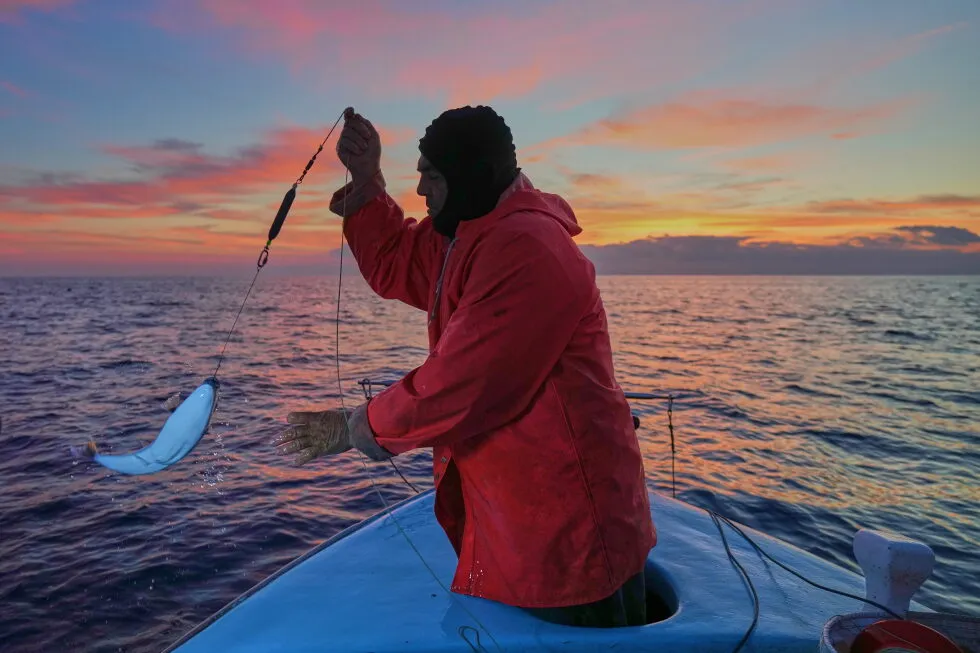
The Mediterranean’s warming waters are drawing hundreds of invasive species 1 of 6 | Scientists claimed that Climate Change, caused mainly by burning oil, coal and gas, is making the Mediterranean Sea hotter, bringing hundreds of new and invasive fish species that decimate indigenous populations. (AP Video by: Maria Grazia Murru; Production by Silvia Stellacci) 2 of 6 | Fisherman Photis Gaitanos catches a toadfish while fishing from his boat off the coast of Larnaca, Cyprus, in the eastern Mediterranean, early Saturday, Dec. 20, 2025. (AP Photo/Petros Karadjias) 3 of 6 | Fisherman Photis Gaitanos catches a toadfish while fishing from his boat off the coast of Larnaca, Cyprus, in the eastern Mediterranean, early Saturday, Dec. 20, 2025. (AP Photo/Petros Karadjias) 4 of 6 | lionfish lie on a fishing boat off the coast of Larnaca, Cyprus, in the eastern Mediterranean, early Saturday, Dec. 20, 2025. (AP Photo/Petros Karadjias) 5 of 6 | A lionfish lies on a fishing boat off the coast of Larnaca, Cyprus, in the eastern Mediterranean, early Saturday, Dec. 20, 2025. (AP Photo/Petros Karadjias) 6 of 6 | Fisherman Photis Gaitanos catches a toadfish while fishing from his boat off the coast of Larnaca, Cyprus, in the eastern Mediterranean, early Saturday, Dec. 20, 2025. (AP Photo/Petros Karadjias) 1 of 6 Scientists claimed that Climate Change, caused mainly by burning oil, coal and gas, is making the Mediterranean Sea hotter, bringing hundreds of new and invasive fish species that decimate indigenous populations. (AP Video by: Maria Grazia Murru; Production by Silvia Stellacci) Add AP News on Google Add AP News as your preferred source to see more of our stories on Google. Share 2 of 6 | Fisherman Photis Gaitanos catches a toadfish while fishing from his boat off the coast of Larnaca, Cyprus, in the eastern Mediterranean, early Saturday, Dec. 20, 2025. (AP Photo/Petros Karadjias) 2 of 6 Fisherman Photis Gaitanos catches a toadfish while fishing from his boat off the coast of Larnaca, Cyprus, in the eastern Mediterranean, early Saturday, Dec. 20, 2025. (AP Photo/Petros Karadjias) Add AP News on Google Add AP News as your preferred source to see more of our stories on Google. Share 3 of 6 | Fisherman Photis Gaitanos catches a toadfish while fishing from his boat off the coast of Larnaca, Cyprus, in the eastern Mediterranean, early Saturday, Dec. 20, 2025. (AP Photo/Petros Karadjias) 3 of 6 Fisherman Photis Gaitanos catches a toadfish while fishing from his boat off the coast of Larnaca, Cyprus, in the eastern Mediterranean, early Saturday, Dec. 20, 2025. (AP Photo/Petros Karadjias) Add AP News on Google Add AP News as your preferred source to see more of our stories on Google. Share 4 of 6 | lionfish lie on a fishing boat off the coast of Larnaca, Cyprus, in the eastern Mediterranean, early Saturday, Dec. 20, 2025. (AP Photo/Petros Karadjias) 4 of 6 lionfish lie on a fishing boat off the coast of Larnaca, Cyprus, in the eastern Mediterranean, early Saturday, Dec. 20, 2025. (AP Photo/Petros Karadjias) Add AP News on Google Add AP News as your preferred source to see more of our stories on Google. Share 5 of 6 | A lionfish lies on a fishing boat off the coast of Larnaca, Cyprus, in the eastern Mediterranean, early Saturday, Dec. 20, 2025. (AP Photo/Petros Karadjias) 5 of 6 A lionfish lies on a fishing boat off the coast of Larnaca, Cyprus, in the eastern Mediterranean, early Saturday, Dec. 20, 2025. (AP Photo/Petros Karadjias) Add AP News on Google Add AP News as your preferred source to see more of our stories on Google. Share 6 of 6 | Fisherman Photis Gaitanos catches a toadfish while fishing from his boat off the coast of Larnaca, Cyprus, in the eastern Mediterranean, early Saturday, Dec. 20, 2025. (AP Photo/Petros Karadjias) 6 of 6 Fisherman Photis Gaitanos catches a toadfish while fishing from his boat off the coast of Larnaca, Cyprus, in the eastern Mediterranean, early Saturday, Dec. 20, 2025. (AP Photo/Petros Karadjias) Add AP News on Google Add AP News as your preferred source to see more of our stories on Google. Share Updated [hour]:[minute] [AMPM] [timezone], [monthFull] [day], [year] ROME (AP) — The Mediterranean of our ancestors is no more.Scientists say Climate Change, caused mainly by burning oil, coal and gas, is making the Mediterranean Sea hotter, bringing hundreds of new and invasive fish species that decimate indigenous populations.As biodiversity diminishes, coastal communities will struggle to make ends meet in the ways they’ve known for generations.“The Mediterranean of our grandfathers, of our elders, and of the Greeks, of ancient Greece is lost forever. So many of those changes are irreversible,” said Ernesto Azzuro, a marine biologist with the Italian National Research Council’s Institute for Marine Biological Resources and Biotechnology.Warmth can’t dissipate in the Mediterranean’s basinScientists have designated the Mediterranean as a Climate Change “hot spot,” with its waters expected to warm by 2 to 6 degrees Celsius (3.6 to 10.8 degrees Fahrenheit) by 2100. Heat waves are likely to become more frequent and more extreme, according to the Mediterranean Experts on Climate and Environmental Change, an independent network of scientists. Ronan McAdam, an oceanographer with the Euro-Mediterranean Center on Climate Change, said a key factor in the warming is that the sea is an enclosed basin and warmth can’t dissipate like in the vastness of the oceans. 2 MIN READ 4 MIN READ 4 MIN READ The warming waters have made an inviting new home for invasive species like the spotted puffer fish, a voracious predator and the “worst invader,” Azzuro said.These species are now heading toward France and Spain after entering the Mediterranean through the Suez Canal. The U.N. food and agriculture body’s General Fisheries Commission for the Mediterranean said such invasive species have been present for decades, but their spread accelerated after the early 2000s, coinciding with rising sea temperatures. For example, the lionfish was first recorded in the eastern Mediterranean in 2012 and has expanded rapidly westward.“The Mediterranean will be even poorer, even with less species, simply because Climate Change is really making this part of the Mediterranean, especially the eastern part of the Mediterranean, really unsuitable for native species,” Azzuro said. Cyprus, due to its proximity to the Suez Canal, was first to feel the impact of these invasive fish. lionfish supplanted indigenous stocks like the red mullet to the dismay of fishers, who have seen local varieties popular with customers greatly diminish.Then there are rabbitfish that can devour algae from the sea bottom, destroying the habitat for many indigenous species.“We know what should be done. We should reduce the use of fossil (fuels),” said Piero Genovesi Papik, a zoologist with Italy’s Higher Institute for Environmental Protection and Research. “But that’s definitely an urgent matter for the humanity, and we all know the solutions, but of course they require a global and joint vision.”About 1,000 invasive species have been identifiedAzzuro said about 1,000 invasive species have been identified in the Mediterranean, with 800 of them firmly established.The changes are stark. Azzuro said the shallows of the eastern Mediterranean have lost 93% of their mollusk population. Along the Adriatic coast, once abundant with mussels, nearly all have died off because of the sea temperatures that at times have exceeded 30 degrees Celsius (86 degrees Fahrenheit).From Venice in the north to Bari in the south, “the die-off was spectacular,” he said. “Unless we … find population able to survive through these different climates, the future of mussels is not a happy future, at least in the Adriatic Sea.” Azzuro said his institute and its partner a few years ago launched a campaign, “Beware of those four,” to raise awareness about the dangers that invasive species pose to human health.For instance, puffer fish is toxic and potentially lethal if consumed by humans. The lionfish’s poisonous spikes can badly hurt anyone who’s stung. Experts say the spread of invasives can’t be reversedScientists are discussing how coastal communities can cope. One way is to commercialize invasive species that are edible. Another is to pay fishers to catch inedible ones like the puffer fish so they can be incinerated. Some species, like the lionfish, have “clear economic benefits because it’s sold at very high prices, especially in some countries,” Azzuro said. But fishers haven’t taken advantage of the invasive dusky spinefoot, whose population has grown significantly in Italian waters.Papik, the zoologist, said that while it’s “too late” to reverse the spread of invasive species in the Mediterranean, there are practical ways to mitigate the impact.First is to prevent their further migration by enforcing an international treaty obliging national authorities to treat ballast waters inside incoming ships that may carry such species.“This is something that is technically doable and that can reduce the number of ... new alien species by 95 to 99%,” he said. Another tactic is treating ship hulls with special paint that thwarts unwanted hitchhikers from latching on.Papik also said fishing policies are being amended that would allow native species to reclaim some of their number, like growing mollusks that are less susceptible to the alien blue crab. “In the coming years, I think that the challenge will be to restore, to find new ways to restore the environment,” Papik said. Stellacci covers events throughout Southern Europe, Italy, and the Vatican for The Associated Press based in Rome. Hadjicostis covers a challenging and ever-evolving region where the interests of Europe and the Middle East, West and East intersect with consequences that reverberate globally. He is based in Cyprus.
SRCAssociated Press (AP)
LANGEN
LEANCenter
WORDS1 584
ENT11
THU · 2026-07-30 · 04:23 GMTBRIEF NSR-2026-0730-97398
NSR-2026-0730-97398News Report·EN·Environmental
The Mediterranean’s warming waters are drawing hundreds of invasive species
Warming Mediterranean waters, driven by climate change from burning fossil fuels, are leading to an influx of hundreds of invasive species that threaten native populations and coastal communities. Scientists have identified the Mediterranean as a climate change "hot spot," with its enclosed basin exacerbating warming.
By
SILVIA STELLACCI and MENELAOS HADJICOSTISAssociated Press (AP)Filed 2026-07-30 · 04:23 GMTLean · CenterRead · 7 min
Associated Press (AP)FIG 01
Reading time
7min
Word count
1 584words
Sources cited
1cited
Entities identified
11entities
Quality score
100%
§ 01
Briefing Summary
AI-generatedNEWSAR · AI
Warming Mediterranean waters, driven by climate change from burning fossil fuels, are leading to an influx of hundreds of invasive species that threaten native populations and coastal communities. Scientists have identified the Mediterranean as a climate change "hot spot," with its enclosed basin exacerbating warming. Invasive species, such as the spotted pufferfish and lionfish, are entering through the Suez Canal and spreading, decimating indigenous species like mollusks and red mullet. Approximately 1,000 invasive species have been identified, with 800 established, leading to significant biodiversity loss. While reversing the spread is considered too late, mitigation efforts include preventing further migration by treating ballast water and applying special hull paints. Some invasive species are being commercialized for food, while others are being incinerated.
Confidence 0.90Sources 1Claims 5Entities 11
§ 02
Article analysis
Model · rule-basedFraming
Environmental
Human Interest
Tone
Measured
AI-assessed
CalmNeutralAlarmist
Factuality
0.70 / 1.00
Factual
LowHigh
Sources cited
1
Limited
FewMany
§ 03
Key claims
5 extracted01
Lionfish were observed on a fishing boat off the coast of Larnaca, Cyprus.
factualAP Photo/Petros Karadjias
Confidence
1.00
02
Fisherman Photis Gaitanos caught a toadfish off the coast of Larnaca, Cyprus.
factualAP Photo/Petros Karadjias
Confidence
1.00
03
Climate change, primarily caused by burning fossil fuels, is heating the Mediterranean Sea.
factualScientists
Confidence
0.95
04
Warming Mediterranean waters are attracting hundreds of invasive fish species.
factualScientists
Confidence
0.90
05
Invasive fish species decimate indigenous populations in the Mediterranean.
factualScientists
Confidence
0.85
§ 04
Full report
7 min read · 1 584 words§ 05
Entities
11 identifiedKey playerOppositionContextPositiveNeutralNegative
People4
Organizations1
§ 06
Keywords & salience
10 termsclimate change
1.00
invasive species
1.00
warming waters
0.90
mediterranean sea
0.80
indigenous populations
0.70
marine ecosystems
0.60
sea temperature
0.50
fish species
0.50
fossil fuels
0.40
biodiversity loss
0.40
§ 07
Topic connections
Interactive graph Network visualization showing 8 related topics
View Full Graph Person Organization Location Event|Click node to navigate|Edge numbers = shared articles