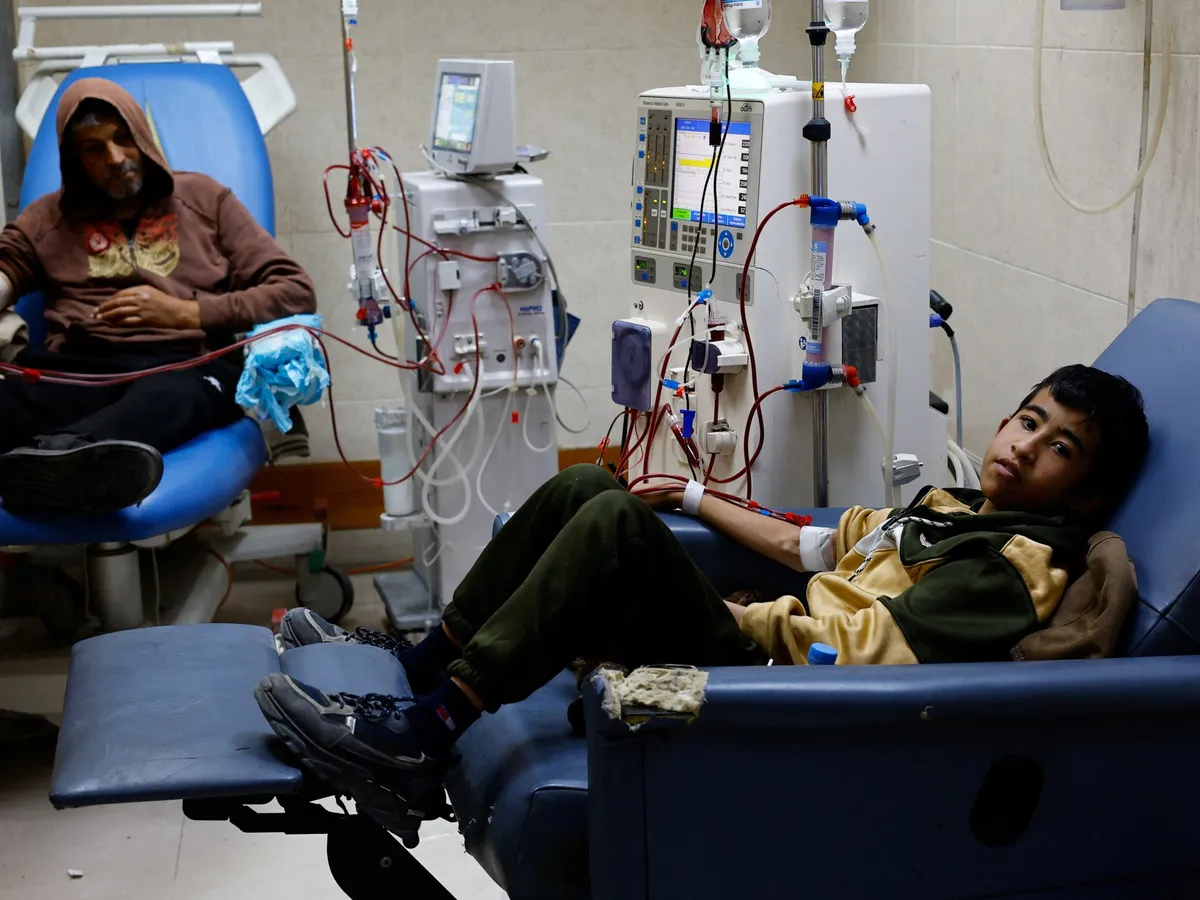
Gaza’s collapsing health system leaves dialysis patients, amputees and trauma survivors without vital care.Palestinian patients with kidney failure undergo dialysis treatment at Al-Aqsa Martyrs Hospital, in Deir el-Balah, central Gaza Strip [File: Mahmoud Issa/Reuters]Published On 30 Jul 2026Gaza City, Gaza Strip – On the dialysis floor of Gaza City’s al-Shifa Hospital, the same scene repeats itself every day. Machines run without stopping. Patients sit in closely arranged rows. Medical tubes connect bodies to life for limited hours.In one of the chairs sits 14-year-old Muntasir-abdul-karim" class="entity-link entity-person" data-entity-id="174589" data-entity-type="person">Ruwaa Muntasir Abdul Karim, from Jabalia in northern Gaza. Her small size makes her stand out in a crowded room full of patients.Recommended Stories list of 3 itemslist 1 of 3Why Saudi Arabia holds the key to Palestinian statehoodlist 2 of 3A safe space for Gaza women: A sanctuary to speak, heal and share amid warlist 3 of 3Israel kills Palestinian, destroys mosque in Gazaend of listHer left hand is connected to a dialysis machine. Her eyes follow the movement of the medical staff inside the room, but she remains silent throughout the session – the whole process has exhausted her.Her father, Muntasir, sits next to her, his face full of concern.“My daughter used to walk and play before the illness. Her life changed after surgeries and dialysis,” Muntasir said. “Every dialysis session keeps her alive. Any interruption causes her severe fatigue and shortness of breath.”But the hospital department keeping Ruwaa alive is struggling itself, under the constant pressure to support the thousands of people in Gaza in need of treatment, without the necessary resources to do so.Israel’s genocidal war on Gaza has decimated the Palestinian enclave’s medical sector through repeated attacks on hospitals, including al-Shifa, as well as harsh limitations on what can enter Gaza.According to the Palestinian Ministry of Health, 50 percent of dialysis machines in Gaza have stopped working completely due to an ongoing shortage of sodium bicarbonate, which is required to operate the machines.On top of that, the number of hospitals equipped to handle kidney failure patients has been reduced to four from seven, with some, such as the Noura al-Kaabi Dialysis Centre, destroyed by Israeli forces during the war.The consequences mean that kidney failure patients are dying at an alarming rate in Gaza. Ministry of Health statistics show that there were 1,200 kidney failure patients before the war. That number has now dropped to about 700 patients after the death of more than 470, due to missed dialysis sessions and a lack of essential medications, according to the Palestinian Centre for Human Rights.Waiting for salvationOsama Abu Rahma is head of the kidney department at Al-Aqsa Hospital in central Gaza, one of the four hospitals that can still treat kidney failure patients in Gaza.“We have 51 dialysis machines, but 25 of them are completely out of service,” he said, adding that this had placed severe pressure on the facility and negatively affected the 240 patients receiving treatment there.The facility has been forced to reduce both the number of sessions provided each week and the duration of each session.Medical complications among patients are rising: general weakness, shortness of breath, heart and lung problems, and dangerously high levels of potassium in the blood.Abu Rahma is clear – the situation is putting the lives of hundreds of patients at direct risk.Back at al-Shifa Hospital, Ruwaa stares at the ceiling. Some of the older patients are asleep; the scene inside the ward reflects a state of continuous exhaustion.Ruwaa’s father, Muntasir, watches the medical monitor next to her constantly, fixing his gaze on the vital indicators.He remembers when she was in better health, but her condition has since deteriorated. Her weight has dropped from 65kg to 35kg (143 pounds to 77 pounds), while the number of dialysis sessions she receives each week has fallen from three to two.The only permanent solution – a kidney transplant – should be within reach. “Everything is ready for a kidney transplant,” Muntasir said. “Her mother is the donor. The tests match.”But Israel is once again hindering Ruwaa’s treatment. Her trip abroad – Israel must approve all journeys out of Gaza – has been pending for six months. The reality of Gaza’s healthcare situation means that the transplant cannot take place in the enclave. And so Ruwaa must wait.The need for prostheticsThe lack of access to treatment evident at Gaza’s dialysis facilities is a common issue across the Strip’s healthcare system.Israel’s war has left more than 43,000 people in Gaza with injuries described by the World Health Organization (WHO) as “life-changing” – including thousands of severe limb injuries that resulted in amputations and permanent disabilities.Even after being treated for the initial injury, Palestinians in Gaza who have had amputations then face a new challenge: rehabilitation and access to basic mobility aids.In Khan Younis, southern Gaza, physiotherapist Aya al-Shaltouni explained that the lack of prosthetics, wheelchairs, and crutches has become part of patients’ daily reality, with demand far exceeding supply.“There is a clear and major shortage of mobility aids,” al-Shaltouni said. “Many patients wait for long periods, and some do not receive anything.”She noted that this shortage does not only affect physical suffering but completely changes the patient’s life path. Ultimately, access to proper rehabilitation tools can determine whether a patient is able to recover to some form of independent life.“We create treatment plans, but without proper assistive tools we cannot reach the desired results, and progress remains limited,” al-Shaltouni said.The physiotherapist added that rehabilitation centres in Gaza are operating with limited resources and cannot compensate for the major shortage in essential equipment, leaving a clear gap in the treatment system.Zaki Jumaa Salem Abu Harb has seen both sides of the coin. A 60-year-old farmer from northern Gaza, he lost a leg after being injured in an Israeli attack in March 2025.“My whole day changed in a moment,” he said. “After the attack, I woke up injured and couldn’t move like before.”Having spent his life active in his fields, his movement was suddenly severely limited, and he depended on others to move between home and hospital, with continuous medical visits and follow-ups.But after months of waiting, he was recently able to receive a prosthetic limb. It’s been a major positive development, but Zaki is also aware of the others – WHO estimates that there are between 5,000 and 6,000 amputees as a result of the war as of October 2025 – most of whom are still waiting for prosthetics.“There are many people who don’t have wheelchairs or crutches,” Zaki said. “They are forced to find any way to move, sometimes using a tree trunk or any piece of wood.”“There are children who lost their limbs,” he added. “Some of them don’t have devices to help them walk properly. When I see them, I feel deeply affected. You feel they’ve been deprived of the simplest rights in life.”Mental health supportWith Gaza’s limited resources, the focus has often been on prioritising treatment for physical injuries. But the healthcare crisis in the Palestinian territory does not stop there, and extends into the psychological and social traumas that are the natural result of nearly three years of devastating war.On the outskirts of al-Aqsa Hospital, inside a small tent surrounded by other displacement tents, 22-year-old Hadeel sits in front of a simple fire used for cooking. Instead of sitting in a university classroom preparing for exams, Hadeel divides her time between caring for her seven siblings, securing their needs inside the tent, and trying to continue a life that stopped at the beginning of the war.
SRCAl Jazeera
LANGEN
LEANCenter
WORDS1 247
ENT12
THU · 2026-07-30 · 05:21 GMTBRIEF NSR-2026-0730-97401
NSR-2026-0730-97401News Report·EN·Public Health
War and shortages push Gaza hospitals to breaking point
Gaza's healthcare system is collapsing under the strain of war and shortages, leaving critically ill patients without vital care. Dialysis machines are inoperable due to a lack of sodium bicarbonate, and some treatment centers have been destroyed.
Eman Abu ZayedAl JazeeraFiled 2026-07-30 · 05:21 GMTLean · CenterRead · 5 min
Al JazeeraFIG 01
Reading time
5min
Word count
1 247words
Sources cited
3cited
Entities identified
12entities
Quality score
100%
§ 01
Briefing Summary
AI-generatedNEWSAR · AI
Gaza's healthcare system is collapsing under the strain of war and shortages, leaving critically ill patients without vital care. Dialysis machines are inoperable due to a lack of sodium bicarbonate, and some treatment centers have been destroyed. This has led to a significant increase in deaths among kidney failure patients, with hundreds dying due to missed sessions and medication shortages. Amputees and trauma survivors also face a lack of rehabilitation and access to prosthetics. The article highlights the case of a 14-year-old girl needing a kidney transplant whose travel abroad for the procedure has been pending for six months due to Israeli approval requirements. The ongoing conflict and restrictions on essential supplies are severely impacting the health and survival of thousands in Gaza.
Confidence 0.90Sources 3Claims 5Entities 12
§ 02
Article analysis
Model · rule-basedFraming
Public Health
Human Interest
Tone
Mixed Tone
AI-assessed
CalmNeutralAlarmist
Factuality
0.70 / 1.00
Factual
LowHigh
Sources cited
3
Well sourced
FewMany
§ 03
Key claims
5 extracted01
25 out of 51 dialysis machines at Al-Aqsa Hospital are out of service.
statisticOsama Abu Rahma
Confidence
0.90
02
The number of hospitals equipped for kidney failure patients has reduced from seven to four.
factual
Confidence
0.90
03
50 percent of dialysis machines in Gaza have stopped working due to shortage of sodium bicarbonate.
statisticPalestinian Ministry of Health
Confidence
0.90
04
Gaza's health system is collapsing, leaving patients without vital care.
factual
Confidence
0.90
05
Over 470 kidney failure patients have died due to missed dialysis sessions and lack of medications.
statisticPalestinian Centre for Human Rights
Confidence
0.80
§ 04
Full report
5 min read · 1 247 words§ 05
Entities
12 identifiedKey playerOppositionContextPositiveNeutralNegative
People3
Organizations4
Locations4
§ 06
Keywords & salience
10 termshealth system collapse
1.00
gaza hospitals
1.00
dialysis patients
0.90
war
0.90
shortages
0.80
kidney failure
0.70
vital care
0.70
medical sector
0.60
trauma survivors
0.50
al-shifa hospital
0.40
§ 07
Topic connections
Interactive graph Network visualization showing 51 related topics
View Full Graph Person Organization Location Event|Click node to navigate|Edge numbers = shared articles