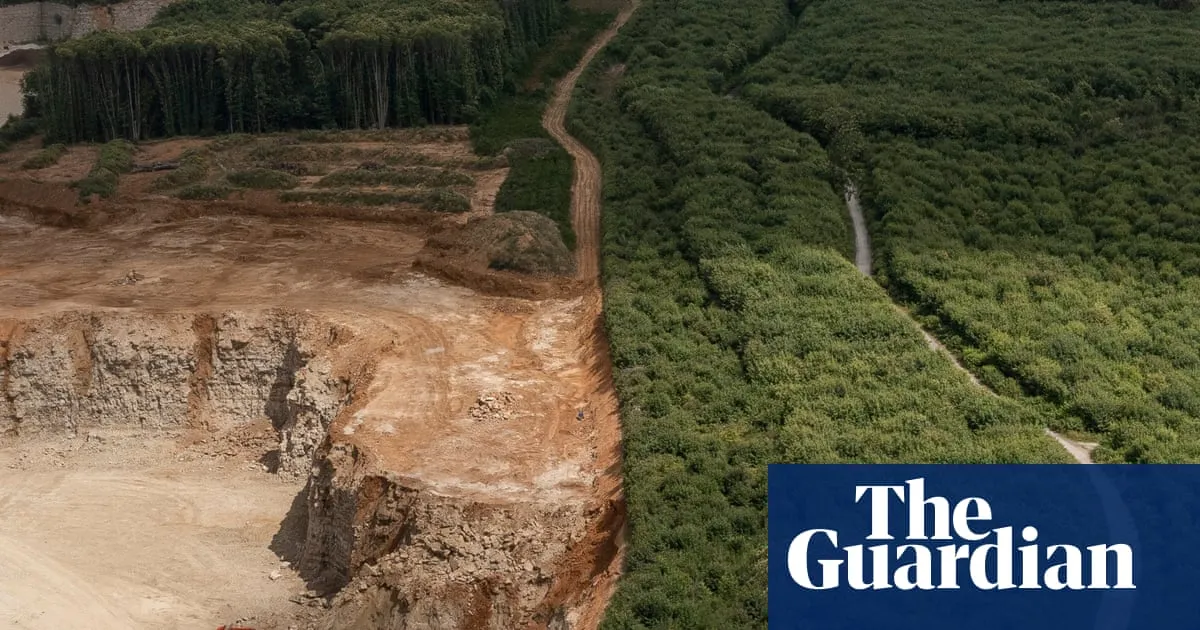
It was at the confluence of seven forest paths that Allison Sweetman came to a stop. Trees rose on all sides, save for a recently coppiced section to the north-east. The noon heat had silenced most birds, but the quiet was peaceful.“This is what they call Seven Wents,” she said. For centuries, the people of Kent had travelled this way, from East Malling to Barming, from Ditton to Teston, for church, commerce and friends. “It’s on maps going back 400 years.”That may be about to end. Seven Wents is part of Oaken Wood, 40 hectares (100 acres) of which is all but condemned to be razed. Developers want the stone beneath. Kent-county-council" class="entity-link entity-organization" data-entity-id="174654" data-entity-type="organization">Kent county council, led by Reform, this month voted to include it in their mineral sites plan. That makes it a potential site of expansion for the quarry next door.The council said its decision does not yet amount to planning permission – the plan needs government approval before that can happen. However, it does mean that they have identified the ground beneath the forest as an essential source of stone for building and restoration projects. Now, campaigners are on the march.Rachel Rodwell, Allison Sweetman, Julie Read and Brontie Ansell walk through Oaken Wood. Photograph: Graeme Robertson/The GuardianContinuously wooded since at least 1600, Oaken Wood is a plantation on ancient woodland site (paws), which means it is the site of an ancient forest that has been replanted. For centuries it has been worked as a sweet chestnut coppice, with whole sections felled in rotation, allowing the stumps to regrow.The sun shone almost directly overhead, but the air was cool beneath the forest canopy. Sweetman, who knows the wood intimately and is a Green party councillor for the local area, led the way through green corridors flanked by almost impenetrable stands of plantation forest to another recently coppiced site.With her were Rachel Rodwell, also a Green councillor; Julie Read, a campaigner; and Brontie Ansell, the managing director of Lawyers for Nature, who has been supporting their campaign to save the woods.“It takes about seven years before they’re ready to be coppiced again,” Sweetman said. “And in the time they grow they’re actually absorbing more carbon from the atmosphere than a fully grown tree … Likewise their roots continue to grow, and that absorbs the surface water from rain.”Whole sections of the wood are felled in rotation allowing stumps to regrow and as they do so absorb more carbon from the atmosphere than a fully grown tree. Photograph: Graeme Robertson/The GuardianThe wood is also a critical ecological site, supporting wildlife including dormice, nightjars and owls. Alongside the sweet chestnut coppices stand veteran trees, including old oaks. Bluebells and other wildflowers bloom here. The soil itself, bound by a mycorrhizal network that has built up over aeons, is a seed bank and a carbon sink, says Kent Wildlife Trust.It is what is beneath the soil that developers want. Kentish ragstone has been quarried since at least the time of the Romans and was the building block of Roman London. Kent-county-council" class="entity-link entity-organization" data-entity-id="174654" data-entity-type="organization">Kent county council says it is crucial for the conservation of ancient buildings, including the Tower of London and Canterbury cathedral. Their opponents say it is wrong to place the conservation of the built environment over the conservation of nature. The council declined to comment.Opponents of the plan to raze the area say it is wrong to place the conservation of the built environment over the conservation of nature. Photograph: Graeme Robertson/The GuardianThere is little to distinguish Oaken Wood from any other ancient woodland site, said Ansell. “It’s protected in exactly the same way, legally, because it’s not just about the fact that there’s newish growth of trees,” she said. “You’ve got all the soils, you’ve got the fungi, you’ve got all of the wildlife.” But, she added: “It is still irreplaceable. You couldn’t just create this somewhere else.”But that is precisely the plan, should development go ahead. Gallagher Group, which runs the Hermitage quarry, said the soil beneath the wood would be “translocated and retained” – dug up and moved elsewhere. The “non-native” chestnut trees, which have been in the UK since the time of the Roman empire, would be removed and they would “put back more than double the tree planting in restored, native woodland”.skip past newsletter promotionafter newsletter promotionCampaigners are sceptical. “Essentially they lift a lot of the topsoil … and then they chuck the topsoil down somewhere and go: ‘There you go, it’s been replaced,’” Ansell said. Rodwell added: “It’s just treated like garden topsoil. And they forget the interconnectivity. It’s not [just] the soil, it’s a living system.”Last year, more than 25,000 voiced their concerns in a consultation on the plan. The Woodland Trust and Kent Wildlife Trust are opposed. Maidstone borough council, on which Sweetman and Rodwell sit, are to pass a rights of nature motion soon.On from Seven Wents, the group walked north, towards the site of the existing quarry, which swallowed up 80 acres of the wood just over a decade ago. With every step, the sounds of machinery grew louder.Near the quarry, white powder – apparently rock dust – lays in a film across the forest foliage. Photograph: Graeme Robertson/The GuardianSoon the air was thick with the smell of exhaust fumes and the ra-ta-ta-ta-tat of pneumatic hammers against stone. White powder, apparently rock dust, lay in a film across the forest foliage. A dead shrew lay on the floor. “You can breathe it, you can smell it, you can feel it in your lungs,” Rodwell said.In the course of just a few short minutes’ walk, the group had travelled from a sylvan idyll to what felt like a zone of war against nature.“We’re treating nature as a commodity or a resource and we’re forgetting we’re part of the same system. And it’s this sense of entitlement that we can just strip it away and plunder it,” added Rodwell.“It’s replicated across the country, across the globe.”
SRCThe Guardian - World News
LANGEN
LEANCenter-Left
WORDS990
ENT12
THU · 2026-07-30 · 06:00 GMTBRIEF NSR-2026-0730-97413
NSR-2026-0730-97413News Report·EN·Environmental
‘It’s irreplaceable’: Fury over Reform plans to expand quarry in ancient Kent woodland
Reform-run Kent county council has identified 40 hectares of Oaken Wood, an ancient woodland site, as a potential expansion area for an adjacent quarry. Developers seek the Kentish ragstone beneath the wood, which is crucial for building and restoration projects, including historic sites like the Tower of London and Canterbury Cathedral.
Damien Gayle Environment correspondentThe Guardian - World NewsFiled 2026-07-30 · 06:00 GMTLean · Center-LeftRead · 4 min
The Guardian - World NewsFIG 01
Reading time
4min
Word count
990words
Sources cited
3cited
Entities identified
12entities
Quality score
100%
§ 01
Briefing Summary
AI-generatedNEWSAR · AI
Reform-run Kent county council has identified 40 hectares of Oaken Wood, an ancient woodland site, as a potential expansion area for an adjacent quarry. Developers seek the Kentish ragstone beneath the wood, which is crucial for building and restoration projects, including historic sites like the Tower of London and Canterbury Cathedral. Campaigners, including local Green councillors and environmental groups, are protesting the plan, arguing that the irreplaceable ecological value of the ancient woodland, its wildlife, and its carbon-sequestering soil outweighs the need for the stone. The council states this decision is not planning permission and that the government must approve the mineral sites plan. Developers propose to translocate the soil and replant more trees elsewhere, a plan met with skepticism by opponents who emphasize the interconnectedness of the woodland's living system.
Confidence 0.90Sources 3Claims 5Entities 12
§ 02
Article analysis
Model · rule-basedFraming
Environmental
Human Interest
Tone
Mixed Tone
AI-assessed
CalmNeutralAlarmist
Factuality
0.70 / 1.00
Factual
LowHigh
Sources cited
3
Well sourced
FewMany
§ 03
Key claims
5 extracted01
Developers want the Kentish ragstone that lies beneath the soil of Oaken Wood.
factualarticle
Confidence
1.00
02
Oaken Wood is a plantation on ancient woodland site (paws), continuously wooded since at least 1600.
factualarticle
Confidence
1.00
03
Kent county council, led by Reform, voted to include Oaken Wood in their mineral sites plan.
factualarticle
Confidence
1.00
04
The wood supports wildlife including dormice, nightjars and owls, and wildflowers bloom there.
factualarticle
Confidence
0.90
05
Coppiced sections of the wood absorb more carbon from the atmosphere than fully grown trees.
factualAllison Sweetman
Confidence
0.90
§ 04
Full report
4 min read · 990 words§ 05
Entities
12 identifiedKey playerOppositionContextPositiveNeutralNegative
Organizations3
§ 06
Keywords & salience
9 termsancient woodland
1.00
quarry expansion
0.90
oaken wood
0.80
conservation
0.70
kent county council
0.60
reform party
0.60
coppicing
0.50
carbon absorption
0.50
mineral sites plan
0.40
§ 07
Topic connections
Interactive graph No topic relationship data available yet. This graph will appear once topic relationships have been computed.