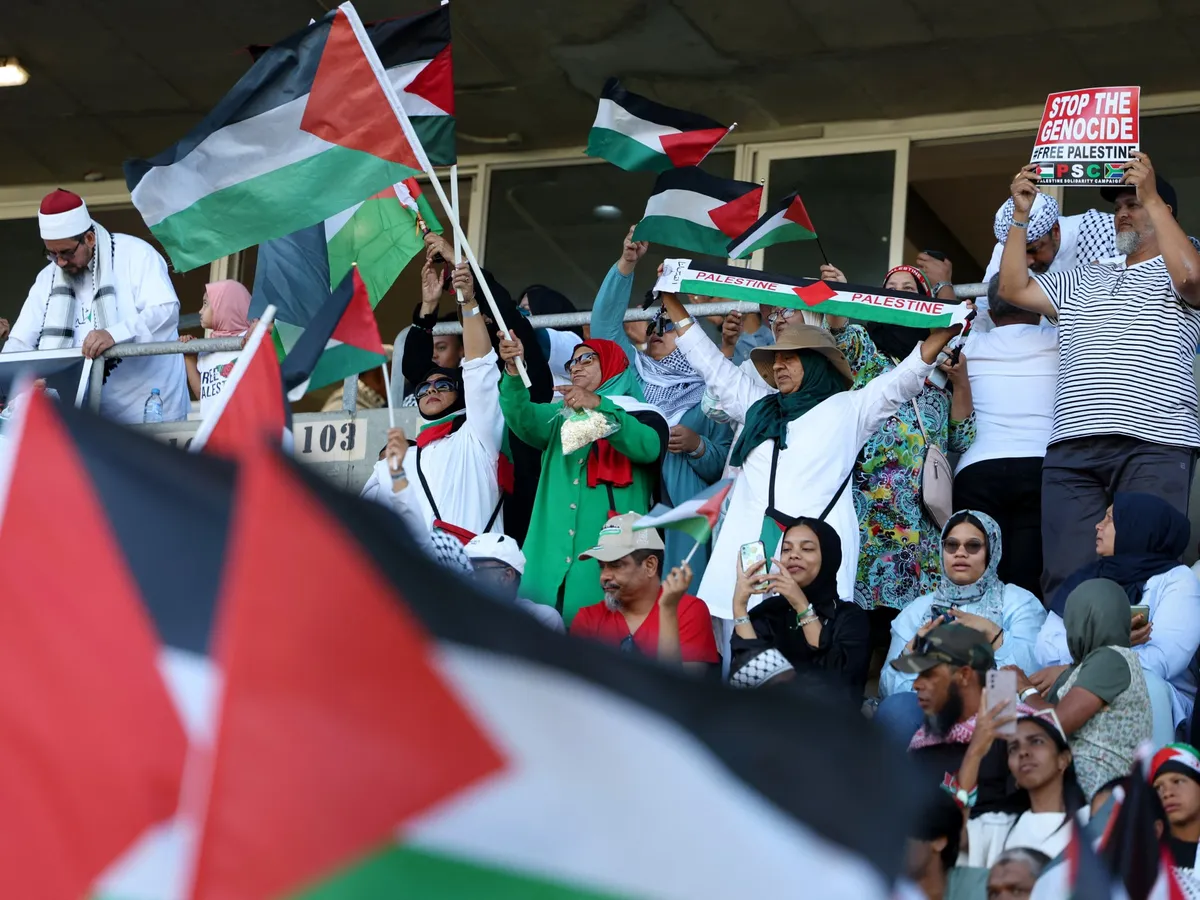
South African universities must resist donors who use financial power to impose political obedience.Al Jazeera columnist.Published On 30 Jul 2026People display Palestine flags and chant in support of Palestinians in Athlone Stadium, Cape Town, South Africa on February 18, 2024 [Esa Alexander/Reuters]The University of Cape Town (UCT) has lost 250 million rand ($15.2m) in donor funding after adopting two resolutions on Israel’s war on Gaza. Vice-Chancellor Mosa Moshabela disclosed the losses to Parliament in June, explaining that the Donald Gordon Foundation had withdrawn the remaining funding under a 200 million rand ($12.1m), 10-year commitment to a neuroscience institute. Other benefactors withheld another 50 million rand ($3m), including 15 million rand ($910,000) annually for bursaries.This blow lands in a country ranked by the World Bank as the world’s most unequal. UCT’s student debt exceeded one billion rand ($60.7m) by December 2025, while approximately 1,400 students still faced registration holds in February 2026.At UCT and across South Africa, poor Black families depend on public assistance and private bursaries because Apartheid denied them the land, income, schooling and inherited assets that continue to ease white access to higher learning.As a graduate of UCT, I understand what the institution’s resources and principles mean to students who enter it carrying the weight of these inequalities. But nothing in its progressive resolutions justifies such harsh and callous retaliation.The first of the contentious resolutions demanded a ceasefire, humanitarian assistance, the return of captives and the reconstruction of Gaza’s shattered education system. Equally principled, the second barred UCT academics from relations with any research group or network whose authors were affiliated with the Israeli military or the broader Israeli military establishment.Crucially, neither measure targeted Israeli or Jewish scholars because of their identity, and UCT has not even implemented the restriction on military-linked research.Court filings indicate that the Donald Gordon Foundation made its support conditional on UCT adopting the definition of anti-Semitism issued in 2016 by the International Holocaust Remembrance Alliance (IHRA), an intergovernmental body promoting Holocaust education.Seven of the IHRA definition’s 11 illustrative examples concern Israel, creating a framework that conflates opposition to Zionism or Israeli policy with anti-Jewish hatred.UCT instead endorsed the Jerusalem Declaration, developed by scholars in 2021 and now signed by more than 400 academics. It condemns anti-Semitism while protecting criticism of Israel and advocacy for Palestinian rights.The foundation’s insistence that UCT adopt the IHRA definition was therefore an attempt to shape the boundaries of academic speech and action. UCT rightly rejected this private donor veto.This is therefore not simply a dispute over a donation. It is an attempt to use private wealth, accumulated within an Apartheid economy, to determine the political and intellectual boundaries of a South African university.The foundation’s leverage comes from Donald Gordon’s fortune, built through the financial-services company Liberty Life under Apartheid.Liberty began operating in 1957, as Apartheid converted Black dispossession into white capital. Land seizures, forced resettlement, suppressed wages and job reservation impoverished Africans while concentrating property, salaries and investable income among whites.In 1970, African per-capita income stood at only 6.8 percent of the white level. By 1995, white per-capita income remained 7.4 times the African income, while approximately 82 million hectares (202 million acres) of commercial farmland, representing 86 percent of all farmland, remained in white hands.Gordon established the Donald Gordon Foundation in August 1971, as Liberty expanded within this racially engineered market. Its growth did not take place alongside Apartheid’s racial order, but within an economy whose incomes, assets and capacity to invest had been deliberately organised along racial lines.Political liberation in April 1994 did not fully recover the resources extracted from Black communities or redistribute the wealth produced by their exploitation. A 2024 study estimated that 45 percent of white adults possessed at least 250,000 rand ($15,200) in inheritable assets, compared with just three percent of Black adults.This enduring injustice deepens UCT’s solidarity with Palestinians confronting land theft, settler violence, homelessness and enforced poverty. Apartheid-era wealth is now being used to penalise that exemplary stand.The foundation’s withdrawal formed part of a wider donor response that also cost UCT 15 million rand ($910,000) annually in bursary funding. The burden falls most heavily on Black students, young people from families denied comparable assets through colonialism and white minority rule.South Africa knows, all too well, how oppression weaponises education, because Apartheid used schooling to control Black possibility. In 1975-76, the state spent 644 rand ($38) on each white pupil but only 42 rand ($2.50) on each Black child, preparing one population to govern and another to serve.Having seized the ground beneath Black communities, the regime restricted the knowledge and qualifications they needed to challenge white command over land, labour and national resources.That history gives South African universities a particular responsibility to recognise the destruction of education as an instrument of domination.Israeli forces have made safe learning almost impossible across Gaza. By April 2026, nearly 98 percent of school buildings were damaged, 81 percent had been directly hit, and 93 percent required major rehabilitation or complete reconstruction. By June, more than 179 public schools and 63 university buildings had been reduced to ruins.For years, Al-Israa University, located south of Gaza City, housed medical and engineering laboratories and a national museum. Israeli troops occupied its campus for weeks before intentionally demolishing it in January 2024.The school buildings directly hit once served almost half a million Palestinian children. Their ruin imperils the institutions Palestinians need to educate another generation, sustain national life and determine their future.Palestinian scholar Karma Nabulsi coined the term “scholasticide” during Israel’s 2008-09 offensive to describe its war on education. The Oxford academic named a practice already decades old, extending from the 1948 Nakba through the military rule imposed in 1967 to Lebanon and Gaza today.Since October 2023, that decades-long assault has escalated into the systematic destruction of the people who sustain Palestinian education. Israeli forces have killed 1,048 education workers, 19,101 school students and 1,379 university students.UCT is being economically punished for refusing to ignore this genocidal slaughter. Yet in September 2025, a United Nations commission of inquiry formally concluded that Israel had committed genocide against Palestinians in the Gaza Strip.The Donald Gordon Foundation’s intervention is not an isolated South African dispute. By making donations conditional on ideological compliance, it forms part of a wider Western campaign that uses money, disciplinary action and policing to raise the price of defending Palestinians.In the United States, the administration of President Donald Trump invoked allegations of anti-Semitism surrounding pro-Palestinian campus protests to cancel $400m in federal grants and contracts to Columbia University and freeze $2.2bn at Harvard University while demanding changes to governance, discipline and academic oversight.
SRCAl Jazeera
LANGEN
LEANCenter
WORDS1 095
ENT10
THU · 2026-07-30 · 09:24 GMTBRIEF NSR-2026-0730-97454
NSR-2026-0730-97454Opinion·EN·Social Justice
Apartheid wealth cannot buy silence on Gaza
The University of Cape Town (UCT) has lost 250 million rand in donor funding after passing resolutions supporting a ceasefire in Gaza and restricting academic ties with the Israeli military. The Donald Gordon Foundation withdrew its remaining funding, and other donors withheld additional money, including for student bursaries.
Tafi MhakaAl JazeeraFiled 2026-07-30 · 09:24 GMTLean · CenterRead · 5 min
Al JazeeraFIG 01
Reading time
5min
Word count
1 095words
Sources cited
2cited
Entities identified
10entities
Quality score
100%
§ 01
Briefing Summary
AI-generatedNEWSAR · AI
The University of Cape Town (UCT) has lost 250 million rand in donor funding after passing resolutions supporting a ceasefire in Gaza and restricting academic ties with the Israeli military. The Donald Gordon Foundation withdrew its remaining funding, and other donors withheld additional money, including for student bursaries. This financial pressure is seen as an attempt to influence UCT's political and intellectual stance, with the foundation reportedly demanding UCT adopt a definition of anti-Semitism that conflates criticism of Israel with anti-Jewish hatred. UCT rejected this, endorsing the Jerusalem Declaration instead. The article highlights that the wealth of some donors, like Donald Gordon, was accumulated during apartheid, an era that created significant economic inequality which disproportionately affects Black students relying on bursaries.
Confidence 0.90Sources 2Claims 5Entities 10
§ 02
Article analysis
Model · rule-basedFraming
Social Justice
Economic Impact
Tone
Measured
AI-assessed
CalmNeutralAlarmist
Factuality
0.40 / 1.00
Mixed
LowHigh
Sources cited
2
Limited
FewMany
§ 03
Key claims
5 extracted01
UCT's resolutions demanded a ceasefire, humanitarian assistance, return of captives, and reconstruction of Gaza's education system.
factual
Confidence
0.90
02
Apartheid denied Black families land, income, schooling, and inherited assets, contributing to current inequalities in higher education access.
factual
Confidence
0.90
03
The University of Cape Town (UCT) lost 250 million rand ($15.2m) in donor funding after adopting two resolutions on Israel's war on Gaza.
statisticVice-Chancellor Mosa Moshabela
Confidence
0.90
04
The IHRA definition's examples conflate opposition to Zionism or Israeli policy with anti-Jewish hatred.
factual
Confidence
0.80
05
The Donald Gordon Foundation withdrew funding, citing a condition related to UCT adopting the IHRA definition of anti-Semitism.
factualCourt filings
Confidence
0.80
§ 04
Full report
5 min read · 1 095 words§ 05
Entities
10 identifiedKey playerOppositionContextPositiveNeutralNegative
People1
Organizations4
§ 06
Keywords & salience
10 termsgaza
1.00
university of cape town
1.00
apartheid
1.00
donor funding
0.90
political obedience
0.80
inequalities
0.70
ceasefire
0.60
ihra definition
0.50
anti-semitism
0.40
zionism
0.40
§ 07
Topic connections
Interactive graph Network visualization showing 2 related topics
View Full Graph Person Organization Location Event|Click node to navigate|Edge numbers = shared articles