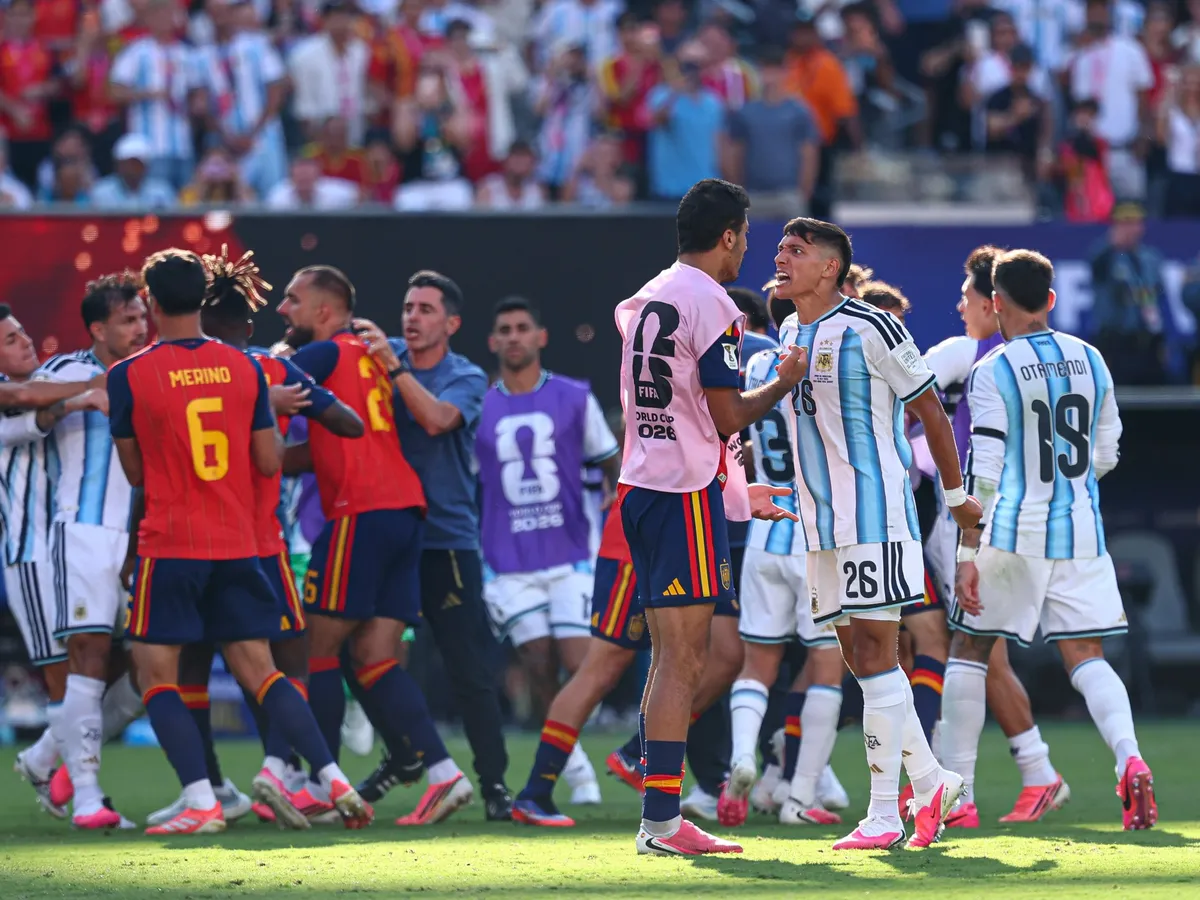
What do the charges brought against Argentina’s FA, their players and their fans mean, and what action could FIFA take?Argentina defender Nahuel Molina argues with Spain midfielder Rodri as players scuffle after the FIFA World Cup final, July 19, 2026 [Vincent Carchietta/Imagn Images via Reuters]Published On 30 Jul 2026Argentina’s appearance in the FIFA-world-cup" class="entity-link entity-event" data-entity-id="2382" data-entity-type="event">2026 FIFA World Cup final left much to be desired.Spain’s 1-0 victory, after extra time, did not tell the story of what was a dominant display that barely gave the Argentinians a sight of goal – let alone a shot.Recommended Stories list of 4 itemslist 1 of 4South Africa’s le Clos breaks Commonwealth Games medal recordlist 2 of 4Storm apologize after co-owner berates teen girls for support of Cunninghamlist 3 of 4Indian Premier League’s business value skyrockets to $20bnlist 4 of 4Viral finger-clicker suspended as cricket storm remains in global spotlightend of listWhat followed the final whistle, however, turned a poor performance into a pitiful and pathetic showing from one of the world’s greatest football nations.The tussle, led by Argentinian players, was the latest in a series of dubious decisions and actions that left the defending champions facing questions about their conduct throughout the tournament.Now FIFA, football’s global governing body, has issued charges against the South Americans and their fans. Al Jazeera Sport explores what those charges are and what they could mean for the team who celebrated victory at Qatar 2022.What has FIFA charged Argentina with following the World Cup?There are numerous charges against Argentina and its football association, the AFA, that relate to the final, the semifinal and the conduct of the players and fans across the tournament.Two Argentina players face disciplinary charges, while the AFA has been charged for a political banner displayed by the players.Also included on the list of disciplinary cases opened by FIFA against Argentina on Wednesday are “discriminatory chants and gestures” by fans, alleged assault by an assistant coach and “throwing of objects by spectators in relation to several matches” at the World Cup.What FIFA charges against Argentina relate to the final?The image that will be associated with Argentinian football at World Cup 2026 is the brawl that followed the final against Spain.As the Spanish squad and coaches rushed onto the pitch at the full-time whistle to celebrate with the on-field players, Argentina’s Leandro Paredes was seen lashing out at Spain’s Gavi.The midfielder now faces three charges of assault, while his teammate Nahuel Molina faces two charges and assistant coach Roberto Ayala one, all under the charge of the same offence as Paredes.Gavi was thrown to the ground in the incident, while other Spanish players rushed to defend him. The midfielder has been charged with unsporting behaviour for his part in the melee that followed, as have Molina and Thiago Almada.Following Argentina’s semifinal win against England, several players were seen with a banner that read: “Las Malvinas son Argentinas” — “The Malvinas are Argentine”.The slogan relates to the Falkland Islands, which Argentina refers to as Islas Malvinas.The South American nation, under orders from Argentina’s then-military dictatorship, invaded the Falklands in 1982, triggering a 10-week war won by Britain.The formal charge handed to the AFA on Wednesday was “using a sports event for demonstrations of a non-sporting nature”.The action violated FIFA rules that ban political protests and displays, and British government officials urged FIFA to investigate.What are the charges against Argentina relating to their fans?Although the image of the brawl at the end of the final will long be associated with Argentina, the numerous allegations of racism against the country as a whole will haunt the South Americans.Hollywood actor Samuel L Jackson was among the prominent voices that spoke out on the subject, with the 77-year-old American urging Black people in an Instagram story not to support Argentina, which he dubbed one of “the most racist countries in the world”.During the tournament, FIFA condemned racism in a statement after an Argentinian supporter told a Black US influencer, known as IShowSpeed, who later performed at the World Cup final, to go “cry at the zoo” during a livestream.FIFA has subsequently issued disciplinary charges against the AFA for “discriminatory chants and gestures” by fans.Charges have also been listed against Argentina for the “throwing of objects by spectators in relation to several matches”.What disciplinary action could Argentina’s players face from FIFA?Possible sanctions against individual players if the assault allegations are upheld include Paredes receiving a multi-match suspension and potentially an extended ban if FIFA concludes there were multiple acts of violent conduct.Nahuel Molina could also receive a suspension, albeit unlikely to be as heavy as that possibly faced by Paredes, while Ayala could face a touchline ban or suspension from the stadiums for a certain number of matches.Almada and Gavi’s charges are likely to result in shorter suspensions or warnings if found guilty of unsporting conduct rather than violent conduct.What disciplinary action could Argentina’s federation face from FIFA?The list of options available to FIFA in sanctioning the AFA is extensive, including a substantial financial fine, a formal warning or reprimand and an order to improve crowd control and match organisation.International teams have been forced to play matches behind closed doors or face limits on supporter attendance at FIFA competitions in the past.Could Argentina be suspended from future World Cups?This is, of course, an option to FIFA, but it is extremely unlikely.Should the charges relate directly to Argentina and their fans, as opposed to the charges against their players and coach, then any repeat offences in continental competitions or at future World Cups could thereafter carry the threat of suspension from competing at those levels.Are there any precedents for the suspension of nations?The best example of a nation being suspended from competitions came in the 1980s and 90s when English football was hit with a domestic suspension from European football.The ban related to numerous examples of crowd trouble involving English club fans both domestically and on the continent during European competition.The English national team was also plagued by crowd trouble at the time, but there were no international sanctions that resulted in a ban from the World Cup or the European Championship.
SRCAl Jazeera
LANGEN
LEANCenter
WORDS1 016
ENT9
THU · 2026-07-30 · 13:15 GMTBRIEF NSR-2026-0730-97501
NSR-2026-0730-97501News Report·EN·Legal & Judicial
World Cup: What has FIFA charged Argentina with, what could punishment be?
FIFA has charged Argentina's Football Association (AFA), its players, and fans with multiple offenses stemming from the 2026 World Cup. Charges include unsporting behavior and assault by players following the final match against Spain, with specific accusations against Leandro Paredes, Nahuel Molina, and assistant coach Roberto Ayala.
Kevin HandAl JazeeraFiled 2026-07-30 · 13:15 GMTLean · CenterRead · 5 min
Al JazeeraFIG 01
Reading time
5min
Word count
1 016words
Sources cited
1cited
Entities identified
9entities
Quality score
100%
§ 01
Briefing Summary
AI-generatedNEWSAR · AI
FIFA has charged Argentina's Football Association (AFA), its players, and fans with multiple offenses stemming from the 2026 World Cup. Charges include unsporting behavior and assault by players following the final match against Spain, with specific accusations against Leandro Paredes, Nahuel Molina, and assistant coach Roberto Ayala. The AFA also faces charges for displaying a political banner referencing the Falkland Islands during the semifinal, violating FIFA's rules against non-sporting demonstrations. Additionally, fans are accused of discriminatory chants and gestures, and throwing objects during several matches. Potential punishments for players could include multi-match suspensions, while the AFA might face fines or other sanctions.
Confidence 0.90Sources 1Claims 5Entities 9
§ 02
Article analysis
Model · rule-basedFraming
Legal & Judicial
Human Interest
Tone
Mixed Tone
AI-assessed
CalmNeutralAlarmist
Factuality
0.70 / 1.00
Factual
LowHigh
Sources cited
1
Limited
FewMany
§ 03
Key claims
5 extracted01
FIFA has issued charges against Argentina's FA, players, and fans related to the World Cup final and tournament conduct.
factualAl Jazeera Sport
Confidence
1.00
02
Leandro Paredes faces three charges of assault for his actions after the final whistle.
factualAl Jazeera Sport
Confidence
0.90
03
FIFA is investigating 'discriminatory chants and gestures' by fans and 'throwing of objects' during matches.
factualAl Jazeera Sport
Confidence
0.90
04
Argentina's AFA has been charged for a political banner displayed by players.
factualAl Jazeera Sport
Confidence
0.90
05
Argentina defender Nahuel Molina faces disciplinary charges, including assault.
factualAl Jazeera Sport
Confidence
0.90
§ 04
Full report
5 min read · 1 016 words§ 05
Entities
9 identifiedKey playerOppositionContextPositiveNeutralNegative
Organizations2
§ 06
Keywords & salience
10 termsargentina football
1.00
fifa world cup
1.00
fifa charges
0.90
disciplinary action
0.80
player conduct
0.70
fan behavior
0.70
football governing body
0.60
tournament misconduct
0.50
political banner
0.40
discriminatory chants
0.40
§ 07
Topic connections
Interactive graph Network visualization showing 51 related topics
View Full Graph Person Organization Location Event|Click node to navigate|Edge numbers = shared articles