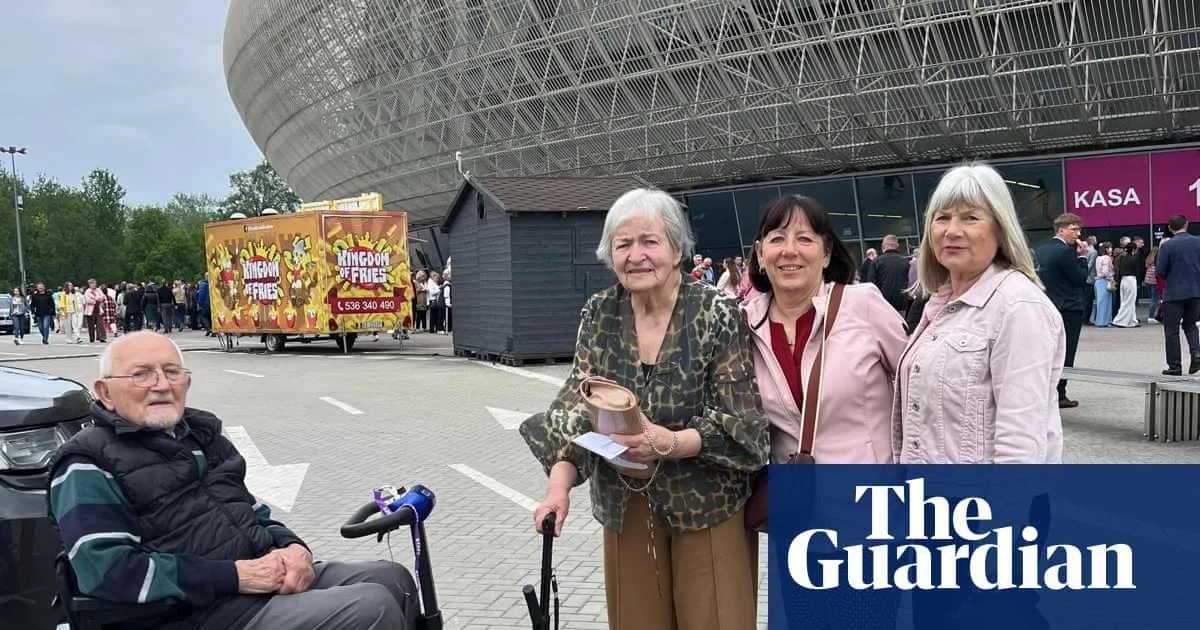
Two Polish citizens who have lived in the UK for nearly 80 years after their parents fled the Second World War have spoken of their terrifying experience after being told they did not have Post-Brexit rights to return to the UK.In May, while visiting Poland, they learned that although they had been welcomed as refugees after the war, they now needed special Post-Brexit paperwork to return to their home in Bury.Maria Krupa, 85, and her husband, Czeslaw, 92, who met in the UK and went on to marry and settle in Bury in Greater Manchester, were issued with “aliens’ registration cards” and have travelled extensively as adults without anyone asking them for their immigration status.Maria and Czeslaw Krupa in Kraków airport. Photograph: Image courtesy of Stephanie Postle Krupa/The Krupa familyCzeslaw, who came from Lviv which was then part of Poland, and Maria, who left her home town in what is now Belarus as an infant, had travelled to Poland in May to meet surviving family members.But Ryanair refused to allow them to board the flight for their return journey on the grounds that they had neither proof of the right to live in the UK nor the new electronic travel authorisation (ETA) now required for foreign tourists entering the UK.“It was a big shock,” said Maria. “We were very very disappointed and a bit upset because my husband takes a lot of medicine because of a stroke to his spinal cord.”They arrived in Southhampton in 1947 and 1948 as the young dependants of displaced Polish service members who had been evacuated from their homes in 1940 and later became part of Gen Władysław Anders’ Polish army that served in Persia, India, the Middle East and Africa.Anders’ army played a key role in the defeat of the Third Reich and had integrated into the British military command structure after friction with the Soviets in 1942.“We tried to explain to Ryanair that our fathers fought for Poland and England in the war, but they refused to let us on the plane because they said they would have to pay a big fine,” said Maria.Czeslaw Krupa, left, with his brother and cousin in Africa in 1944. Photograph: Image courtesy of Stephanie Postle Krupa/The Krupa family“My husband was really upset,” she said, explaining that he was in a mobility scooter and was on a lot of medication after the stroke. He has difficulty getting in and out of cars and “just wanted to get home”, she added.They are speaking out to help others who might be in the same position. “It was a big, big shock because we never heard of this and we never thought for one minute that after nearly 80 years someone would tell us we couldn’t go home,” said Maria.Kate Smart, the chief executive of Settled, who helped the Krupas, said the charity was seeing “thousands of cases” like the Krupas. “It is a really common occurrence, almost on a daily basis,” she said.The EU settlement scheme was launched in 2019 to give EU citizens living in the UK the documentary evidence needed to travel as they had done under the pre-Brexit, free-movement rules.skip past newsletter promotionafter newsletter promotionMaria Krupa when she was child in Karachi, which was then part of India, where her father was stationed in 1943. Displaced Polish people were housed in refugee camps. Photograph: Image courtesy of Stephanie Postle Krupa/The Krupa familyMany of the people seen by Settled are elderly people who have British children and grandchildren. “They have nobody in their family circle who thinks like immigrants so they don’t talk about things like ‘settled status’,” said Smart.Maria said she had never thought to get a British passport as she had never needed it in the previous 80 years and it had never crossed her mind. “It was really important. I didn’t think of it as sort of weakening my identity. I love England. I mean, I always say, I’m very grateful to England, you know, to have taken so many people, you know thousands after the war. But I just thought it was important that we stay Polish,” she said.After being forced to leave the airport late on a Sunday night in May, they returned the next day with an ETA but the couple had to pose as tourists, claiming they lived in Poland as the online form would not accept their British address.Maria and Czeslaw Krupa celebrate Czeslaw’s 90th birthday in Bury. Photograph: Image courtesy of the Krupa family/The Krupa familyMaria said: “When we arrived in England we were terrified. We had to be careful about what we said. We were terrified because they started asking questions and we thought we are not going to lie again and have to tell the truth.”After going to Citizens Advice in Bury, they were connected with Settled. Smart commended the Home Office resolution centre for its swift action after the charity submitted a no-time-limit application that resulted in settled status for the Krupas last week.She appealed to the government to take note of the issues with the EU settlement scheme, arguing “a process should have kicked in at the airport” when an issue such as this one arose.The Home Office has been approached for comment.
SRCThe Guardian - World News
LANGEN
LEANCenter-Left
WORDS869
ENT12
THU · 2026-07-30 · 13:10 GMTBRIEF NSR-2026-0730-97505
NSR-2026-0730-97505News Report·EN·Human Interest
‘It was a big shock’: new border rules left couple stuck in Krakow after living in UK for 80 years
Maria and Czeslaw Krupa, Polish citizens who have lived in the UK for nearly 80 years, were prevented from boarding a flight back to their home in Bury, Greater Manchester, in May. The couple, who arrived in the UK as dependents of displaced Polish service members after World War II, were told by Ryanair they lacked the necessary post-Brexit documentation to re-enter the country.
Lisa O’Carroll Senior correspondentThe Guardian - World NewsFiled 2026-07-30 · 13:10 GMTLean · Center-LeftRead · 4 min
The Guardian - World NewsFIG 01
Reading time
4min
Word count
869words
Sources cited
2cited
Entities identified
12entities
Quality score
100%
§ 01
Briefing Summary
AI-generatedNEWSAR · AI
Maria and Czeslaw Krupa, Polish citizens who have lived in the UK for nearly 80 years, were prevented from boarding a flight back to their home in Bury, Greater Manchester, in May. The couple, who arrived in the UK as dependents of displaced Polish service members after World War II, were told by Ryanair they lacked the necessary post-Brexit documentation to re-enter the country. This was a shock as they had previously traveled extensively without issue. After being forced to leave the airport, they eventually returned the next day with an electronic travel authorization, but had to falsely claim residency in Poland to complete the application. The charity Settled assisted the Krupas, who were subsequently granted settled status by the Home Office.
Confidence 0.90Sources 2Claims 5Entities 12
§ 02
Article analysis
Model · rule-basedFraming
Human Interest
Legal & Judicial
Tone
Mixed Tone
AI-assessed
CalmNeutralAlarmist
Factuality
0.70 / 1.00
Factual
LowHigh
Sources cited
2
Limited
FewMany
§ 03
Key claims
5 extracted01
The couple arrived in the UK in 1947 and 1948 as dependants of Polish service members who fought in World War II.
factual
Confidence
1.00
02
Maria and Czeslaw Krupa, aged 85 and 92 respectively, were told they needed special post-Brexit paperwork or an electronic travel authorisation (ETA) to return to the UK.
factual
Confidence
1.00
03
Two Polish citizens who lived in the UK for nearly 80 years were denied boarding a flight back to the UK due to new post-Brexit border rules.
factual
Confidence
1.00
04
The charity Settled is seeing 'thousands of cases' similar to the Krupas', describing it as a 'really common occurrence, almost on a daily basis'.
factualKate Smart (Settled)
Confidence
0.90
05
Ryanair refused to allow them to board the flight, citing the need for proof of the right to live in the UK or an ETA, and the risk of a large fine.
factualRyanair (as reported by Maria Krupa)
Confidence
0.90
§ 04
Full report
4 min read · 869 words§ 05
Entities
12 identifiedKey playerOppositionContextPositiveNeutralNegative
Locations6
§ 06
Keywords & salience
8 termspost-brexit rights
1.00
border rules
0.90
immigration status
0.80
electronic travel authorisation
0.70
displaced persons
0.60
second world war
0.50
polish citizens
0.50
ryanair
0.40
§ 07
Topic connections
Interactive graph No topic relationship data available yet. This graph will appear once topic relationships have been computed.