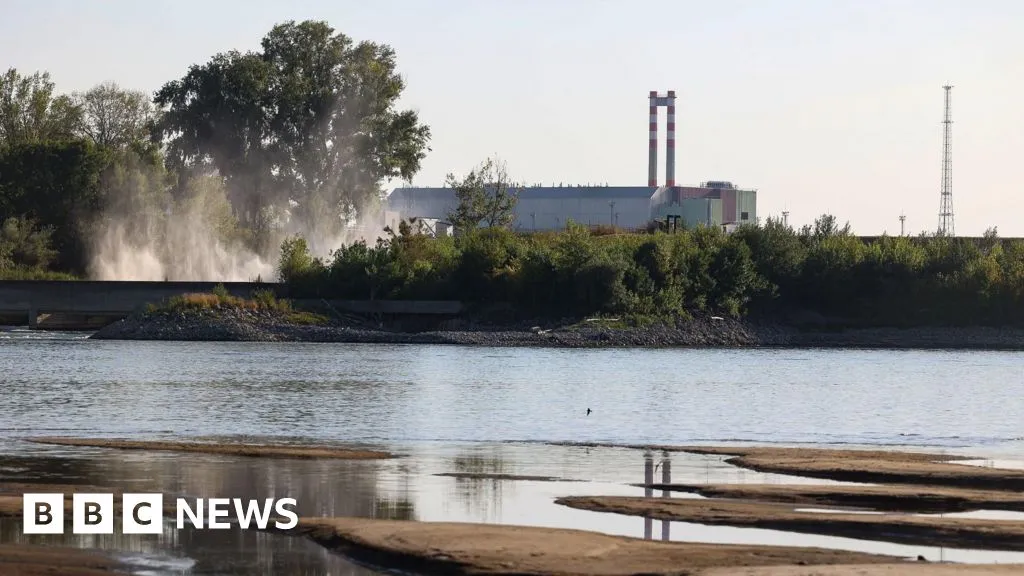
In Romania, one of the country's only two nuclear reactors has been shut down at the Cernavoda power plant, which provides about 20% of the country's power.The first of the two 706-megawatt reactors was shut down earlier this week because the Danube's levels were so low, and state-owned company Nuclearelectrica was trying to avoid closing down the other on Thursday. If the second reactor is shut down Romania will, like Hungary, be temporarily without any nuclear energy production.Climate change is driving up temperatures around the world - but particularly in Europe.It is the fasting warming content, heating up twice as fast as the global average, according to the Copernicus climate service. This is causing increased summer heatwaves, greater pressure on Europe's waters and more intense wildfires. ReutersAmong the wrecks exposed by the low levels of the Danube was a World War Two German warship at Prahovo in SerbiaRomania's National Institute of Hydrology says the average river flow where the Danube enters the country is 4,700 cubic metres per second in July, whereas on Wednesday it was down to less than a third of that, at 1,600cm per second. The institute forecast it would continue to fall to 1,500cm per second by Tuesday.The Danube runs 2,857km (1,775 miles) through 19 countries.The Upper Danube goes from Germany to the Slovak capital Bratislava, the middle basin runs from Bratislava to the border between Serbia and Romania and the Lower Danube extends through Romania and Bulgaria into the three main branches of the Danube Delta that flow into the Black Sea.
SRCBBC News - World
LANGEN
LEANCenter
WORDS257
ENT12
THU · 2026-07-30 · 17:55 GMTBRIEF NSR-2026-0730-97596
NSR-2026-0730-97596News Report·EN·Economic Impact
Danube's record low levels force shutdown of Hungary's only nuclear plant
Record low water levels in the Danube River, exacerbated by prolonged heatwaves and low rainfall, have forced the shutdown of one of Romania's two nuclear reactors at the Cernavoda power plant. This shutdown, occurring earlier this week, is to prevent the closure of the second reactor, which together supply approximately 20% of Romania's power.
20 minutes agoShareSaveAdd as preferred on GoogleLaura GozziandPaul Kirby,Europe digital editorBBC News - WorldFiled 2026-07-30 · 17:55 GMTLean · CenterRead · 2 min
BBC News - WorldFIG 01
Reading time
2min
Word count
257words
Sources cited
2cited
Entities identified
12entities
Quality score
100%
§ 01
Briefing Summary
AI-generatedNEWSAR · AI
Record low water levels in the Danube River, exacerbated by prolonged heatwaves and low rainfall, have forced the shutdown of one of Romania's two nuclear reactors at the Cernavoda power plant. This shutdown, occurring earlier this week, is to prevent the closure of the second reactor, which together supply approximately 20% of Romania's power. Hungary's only nuclear plant has also been shut down due to the low Danube levels. Europe is experiencing rapid warming, leading to increased heatwaves and pressure on water resources. The Danube's flow where it enters Romania has fallen significantly, with further decreases forecast.
Confidence 0.90Sources 2Claims 5Entities 12
§ 02
Article analysis
Model · rule-basedFraming
Economic Impact
Environmental
Tone
Measured
AI-assessed
CalmNeutralAlarmist
Factuality
0.80 / 1.00
Factual
LowHigh
Sources cited
2
Limited
FewMany
§ 03
Key claims
5 extracted01
A World War Two German warship was exposed by the low water levels of the Danube in Serbia.
factual
Confidence
1.00
02
Europe is warming twice as fast as the global average, according to the Copernicus climate service.
statisticCopernicus climate service
Confidence
1.00
03
The Cernavoda power plant provides about 20% of Romania's electricity.
factual
Confidence
1.00
04
One of Romania's two nuclear reactors at the Cernavoda power plant has been shut down due to record low levels of the Danube River.
factual
Confidence
1.00
05
Average July river flow of the Danube entering Romania is forecast to fall to 1,500 cubic metres per second by Tuesday.
predictionRomania's National Institute of Hydrology
Confidence
0.90
§ 04
Full report
2 min read · 257 words§ 05
Entities
12 identifiedKey playerOppositionContextPositiveNeutralNegative
Locations8
§ 06
Keywords & salience
8 termsdanube river low levels
1.00
nuclear plant shutdown
1.00
climate change
0.90
energy production
0.80
cernavoda power plant
0.70
europe warming
0.60
river flow
0.50
world war two warship
0.40
§ 07
Topic connections
Interactive graph Network visualization showing 51 related topics
View Full Graph Person Organization Location Event|Click node to navigate|Edge numbers = shared articles