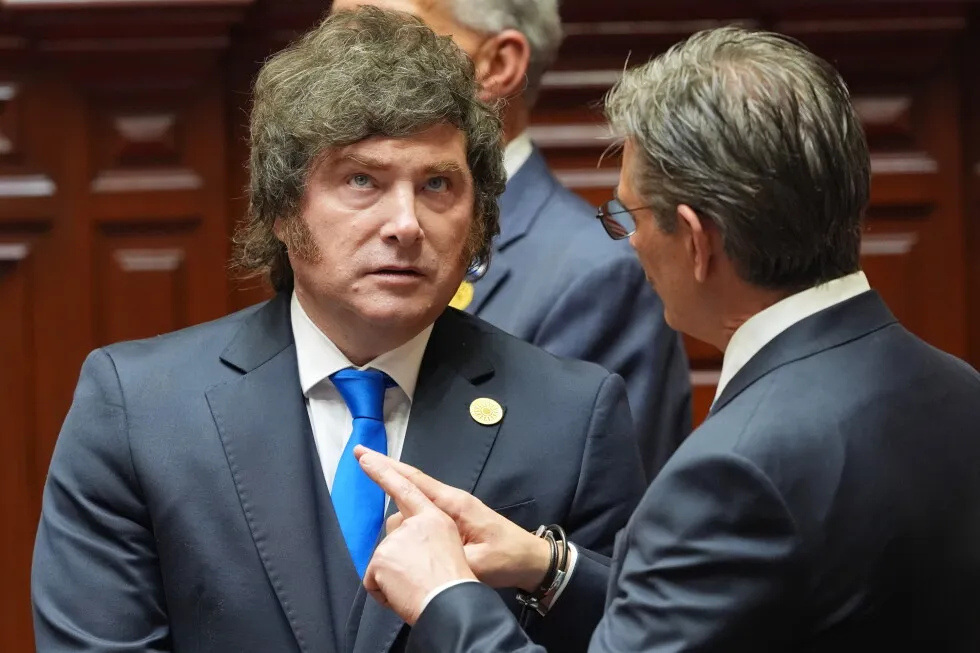
Milei empowers Argentina to bar or deport foreigners over hateful remarks about the country 1 of 4 | Argentina’s President Javier Milei, left, talks to Bolivia’s President Rodrigo Paz the inauguration of Peru’s new President Keiko Fujimori in Lima, Peru, Tuesday, July 28, 2026.(AP Photo/Guadalupe Pardo, Pool) 2 of 4 | Argentina’s President Javier Milei arrives at Congress for the inauguration of Peru’s new President Keiko Fujimori in Lima, Peru, Tuesday, July 28, 2026. (AP Photo/Miguel Paredes) 3 of 4 | Argentina fans hold a photo of Lionel Messi as they gather outside the Argentine Football Association headquarters and wait for the national team to arrive in Ezeiza, on the outskirts of Buenos Aires, Monday, July 20, 2026, following its World Cup final loss to Spain. (AP Photo/Gustavo Garello) 4 of 4 | An Argentina fan wearing a mask depicting Lionel Messi gathers outside the Argentine Football Association headquarters while waiting for the national team to arrive in Ezeiza, on the outskirts of Buenos Aires, Monday, July 20, 2026, following its World Cup final loss to Spain. (AP Photo/Rodrigo Abd) By ISABEL DEBRE Updated 8:35 PM MESZ, July 30, 2026 Add AP News on Google Add AP News as your preferred source to see more of our stories on Google. Share Share Facebook Copy Link copied Print Email X LinkedIn Bluesky Flipboard Pinterest Reddit Buenos Aires, Argentina (AP) — After a bruising World Cup defeat gave way to what many Argentines saw as a sweeping wave of hatred against their country, Argentine President Javier Milei on Thursday signed an emergency decree empowering the government to deny entry to or expel foreigners who incite discrimination or violence against Argentines because of their nationality. The measure adds new grounds to Argentina’s Immigration-law" class="entity-link entity-topic" data-entity-id="130065" data-entity-type="topic">Immigration Law, allowing authorities to bar, deport and revoke visas of people found to have promoted hatred against Argentines in spoken or written statements or who have desecrated national symbols. “In light of recent displays of hostility toward the Argentine Republic and Argentines, the national government reaffirms that the defense of the nation, its citizens and its symbols is non-negotiable,” the president’s office said. “Anyone who attacks the Argentine Republic is not welcome in our country.” The move marks a sharp shift for a country that has long prided itself on welcoming immigrants. Argentina’s Constitution explicitly encourages Immigration, and for decades the country has offered foreigners broad civil rights and relatively easy access to legal residency, public education and health care. Milei’s office cast the decree as a response to weeks of criticism from celebrities, opposing fans and social media users after controversial refereeing decisions fueled speculation that FIFA had tilted the tournament in favor of the reigning champions and superstar Lionel Messi. UK urges FIFA to investigate Argentina over Falklands banner at World Cup 2 MIN READ Spanish Prime Minister Pedro Sánchez to attend World Cup final against Argentina 1 MIN READ Tens of thousands of Argentine soccer fans celebrate their team’s World Cup semifinal victory 1 MIN READ Condemnations of occasionally aggressive Argentine fans and the team’s roughhousing on the pitch soon broadened into attacks on Argentine society as a whole, amplifying long-standing criticism that Argentines view themselves as culturally and economically superior to their Latin American neighbors. Online petitions to expel Argentina from the World Cup drew hundreds of thousands of signatures. The backlash intensified when Argentina players and staff became involved in a post-match brawl with Spanish opponents after the World Cup final. FIFA, global soccer’s governing body, on Wednesday opened disciplinary proceedings against the Argentine Football Association over the scuffle, as well as over alleged racist abuse and fan misconduct. Players also faced a FIFA investigation into their parading of a banner that asserted Argentina’s claim to the British-controlled Falkland Islands after the team’s semifinal victory over England. Milei, a close ally of U.S. President Donald Trump, has described the torrent of criticism as an “anti-Argentina campaign.” He alleged without evidence last week that the left-wing governments of Brazil and Mexico and the U.S. Democratic Party had financed the effort to stigmatize Argentina to discredit his libertarian government. His accusations and insults triggered a diplomatic crisis with neighbor Brazil, which recalled its ambassador to Argentina last weekend. Thursday’s decree says the punishments don’t apply to ideological disagreement or political, academic or civic criticism protected under Argentina’s Constitution. But it leaves unanswered how officials will distinguish protected speech from prohibited hate speech, whether Immigration authorities will review foreigners’ social media activity and how aggressively the new powers will be enforced against tourists and longtime residents. ISABEL DEBRE DeBre writes about Argentina, Bolivia, Chile, Paraguay and Uruguay for The Associated Press, based in Buenos Aires. Before moving to South America in 2024, she covered the Middle East reporting from Jerusalem, Cairo and Dubai. twitter mailto
SRCAssociated Press (AP)
LANGEN
LEANCenter
WORDS797
ENT12
THU · 2026-07-30 · 18:53 GMTBRIEF NSR-2026-0730-97616
NSR-2026-0730-97616News Report·EN·Political Strategy
Milei empowers Argentina to bar or deport foreigners over hateful remarks about the country
Argentine President Javier Milei has signed an emergency decree allowing the government to deny entry to or expel foreigners who incite discrimination or violence against Argentines. This new measure, enacted following widespread criticism of Argentina after its World Cup defeat, adds grounds to the immigration law for barring, deporting, or revoking visas of individuals found to have promoted hatred or desecrated national symbols.
Associated Press (AP)Filed 2026-07-30 · 18:53 GMTLean · CenterRead · 4 min
Associated Press (AP)FIG 01
Reading time
4min
Word count
797words
Sources cited
1cited
Entities identified
12entities
Quality score
100%
§ 01
Briefing Summary
AI-generatedNEWSAR · AI
Argentine President Javier Milei has signed an emergency decree allowing the government to deny entry to or expel foreigners who incite discrimination or violence against Argentines. This new measure, enacted following widespread criticism of Argentina after its World Cup defeat, adds grounds to the immigration law for barring, deporting, or revoking visas of individuals found to have promoted hatred or desecrated national symbols. The decree represents a significant shift for Argentina, a country that has historically welcomed immigrants. Milei's office stated the measure is a defense of the nation and its citizens, though it excludes protected forms of criticism. The move comes amidst international scrutiny of Argentine football association conduct and diplomatic tensions with Brazil.
Confidence 0.90Sources 1Claims 5Entities 12
§ 02
Article analysis
Model · rule-basedFraming
Political Strategy
Diplomatic
Tone
Measured
AI-assessed
CalmNeutralAlarmist
Factuality
0.80 / 1.00
Factual
LowHigh
Sources cited
1
Limited
FewMany
§ 03
Key claims
5 extracted01
“Anyone who attacks the Argentine Republic is not welcome in our country.”
quotePresident's office
Confidence
1.00
02
The measure adds new grounds to Argentina’s immigration law, allowing authorities to bar, deport and revoke visas of people found to have promoted hatred against Argentines.
factual
Confidence
1.00
03
Argentine President Javier Milei signed an emergency decree empowering the government to deny entry to or expel foreigners who incite discrimination or violence against Argentines.
factualArgentine President Javier Milei
Confidence
1.00
04
Argentina has long prided itself on welcoming immigrants and its Constitution explicitly encourages immigration.
factual
Confidence
0.90
05
The decree is a response to criticism from celebrities, opposing fans and social media users after controversial refereeing decisions fueled speculation about FIFA tilting the World Cup in favor of Argentina.
factualMilei's office
Confidence
0.90
§ 04
Full report
4 min read · 797 words§ 05
Entities
12 identifiedKey playerOppositionContextPositiveNeutralNegative
People4
Organizations1
Locations4
§ 06
Keywords & salience
9 termsimmigration law
1.00
deportation
1.00
hate speech
0.90
national symbols
0.80
argentina
0.70
javier milei
0.70
foreigners
0.60
discrimination
0.50
world cup defeat
0.40
§ 07
Topic connections
Interactive graph Network visualization showing 42 related topics
View Full Graph Person Organization Location Event|Click node to navigate|Edge numbers = shared articles