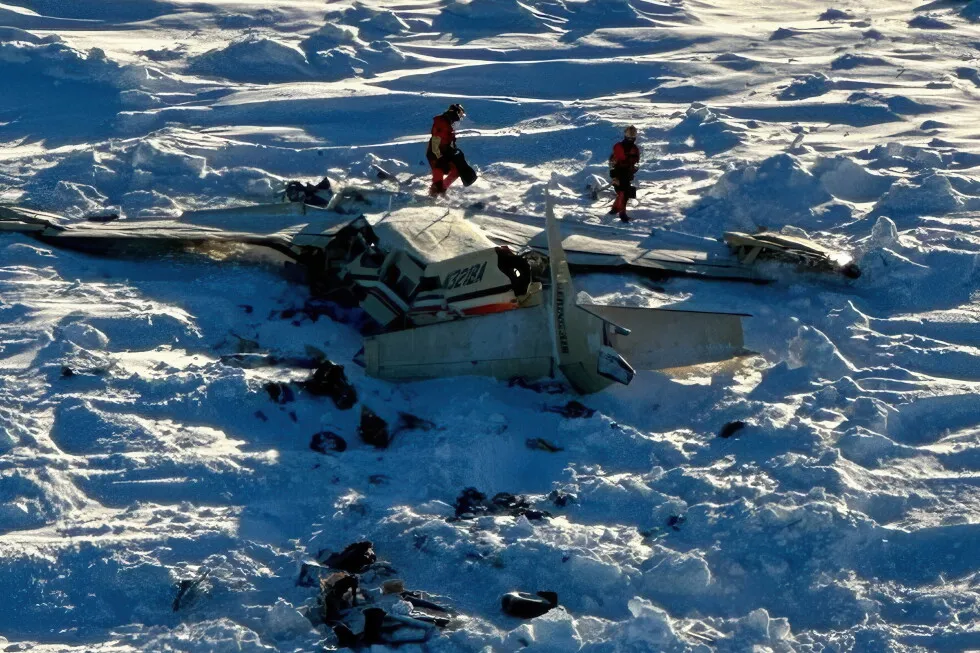
This photo provided by the U.S. Coast Guard on Feb. 7, 2025, shows a small commuter plane that crashed in western Alaska on a flight that was bound for the hub community of Nome. (U.S. Coast Guard via AP, File) Updated [hour]:[minute] [AMPM] [timezone], [monthFull] [day], [year] JUNEAU, Alaska (AP) — The operator of a commuter plane that crashed on sea ice off Alaska last year, killing all 10 people on board, had a history of overweight flights, according to federal investigators.The National Transportation Safety Board, in a report released Thursday, also found the Federal Aviation Administration’s oversight of the company, Bering Air, was inadequate.Both were contributing factors to the February 2025 crash, which was one of Alaska’s deadliest plane crashes this century. The NTSB also determined the pilot did not monitor and maintain adequate airspeed, likely because he was trying to manage the plane’s ice protection system while preparing to approach the airport in Nome. And it said the plane was overweight for a trip into icy conditions. The airport itself had temporarily closed its runways for de-icing, the agency said. The Associated Press sent a message seeking comment to Bering Air. The FAA released a statement in response to questions stating it “takes NTSB recommendations seriously and will carefully review them.”Recommendations made by the NTSB to the FAA include calling for pilot training on preventing and recovering from loss of control in flight for many charter and air taxi operators. The NTSB also raised prior recommendations, such as expanded use of flight data monitoring programs and broader load manifest requirements.The NTSB said it found a pattern of underreported weights on Bering Air flight manifests and flights operating above weight limits. 3 MIN READ 1 MIN READ 2 MIN READ The agency said the FAA failed to recognize the air carrier’s “increased operational complexity and rapid growth” after the pandemic and bankruptcy of its largest competitor as factors warranting increased oversight. The report said the FAA’s oversight “failed to identify and address the routine operation of overweight flights.” Jennifer Homendy, the NTSB chair, in a statement said the tragedy “was not the result of a single failure, but a series of preventable breakdowns that eroded critical safety margins.” The plane was flying as part of a regularly scheduled commuter flight from the community of Unalakleet to Nome, a 150-mile (240-kilometer) trip. Authorities have said that the aircraft went missing about 30 miles (50 kilometers) southeast of Nome. The wreckage was recovered from a drifting ice floe.
SRCAssociated Press (AP)
LANGEN
LEANCenter
WORDS417
ENT11
THU · 2026-07-30 · 22:23 GMTBRIEF NSR-2026-0731-97677
NSR-2026-0731-97677News Report·EN·Public Health
Probe cites history of overweight flights, inadequate oversight in crash that killed 10 off Alaska
A National Transportation Safety Board (NTSB) report released Thursday found that the operator of a commuter plane that crashed off Alaska in February 2025, killing all 10 people aboard, had a history of overweight flights. The NTSB also determined that the Federal Aviation Administration's (FAA) oversight of the company, Bering Air, was inadequate, and both factors contributed to the crash.
By
BECKY BOHRERAssociated Press (AP)Filed 2026-07-30 · 22:23 GMTLean · CenterRead · 2 min
Associated Press (AP)FIG 01
Reading time
2min
Word count
417words
Sources cited
3cited
Entities identified
11entities
Quality score
100%
§ 01
Briefing Summary
AI-generatedNEWSAR · AI
A National Transportation Safety Board (NTSB) report released Thursday found that the operator of a commuter plane that crashed off Alaska in February 2025, killing all 10 people aboard, had a history of overweight flights. The NTSB also determined that the Federal Aviation Administration's (FAA) oversight of the company, Bering Air, was inadequate, and both factors contributed to the crash. Investigators found a pattern of underreported weights and flights operating above limits, with the FAA failing to recognize Bering Air's increased operational complexity. The pilot also likely failed to maintain adequate airspeed while managing the plane's ice protection system during approach to Nome. The NTSB has made recommendations to the FAA, including enhanced pilot training and expanded use of flight data monitoring.
Confidence 0.90Sources 3Claims 5Entities 11
§ 02
Article analysis
Model · rule-basedFraming
Public Health
Legal & Judicial
Tone
Measured
AI-assessed
CalmNeutralAlarmist
Factuality
0.90 / 1.00
Factual
LowHigh
Sources cited
3
Well sourced
FewMany
§ 03
Key claims
5 extracted01
The tragedy was not the result of a single failure, but a series of preventable breakdowns.
quoteJennifer Homendy, NTSB chair
Confidence
1.00
02
The plane was overweight for a trip into icy conditions.
factualNational Transportation Safety Board
Confidence
1.00
03
The pilot did not monitor and maintain adequate airspeed, likely due to managing the plane's ice protection system.
factualNational Transportation Safety Board
Confidence
1.00
04
The Federal Aviation Administration’s oversight of Bering Air was inadequate.
factualNational Transportation Safety Board
Confidence
1.00
05
The operator of the commuter plane had a history of overweight flights.
factualNational Transportation Safety Board
Confidence
1.00
§ 04
Full report
2 min read · 417 words§ 05
Entities
11 identifiedKey playerOppositionContextPositiveNeutralNegative
Organizations4
§ 06
Keywords & salience
10 termsoverweight flights
1.00
inadequate oversight
1.00
plane crash
1.00
ntsb report
0.90
faa
0.80
bering air
0.70
alaska
0.60
pilot error
0.50
flight safety
0.50
loss of control
0.40
§ 07
Topic connections
Interactive graph Network visualization showing 36 related topics
View Full Graph Person Organization Location Event|Click node to navigate|Edge numbers = shared articles