0 seconds of 1 minute, 50 secondsVolume 0% Press shift question mark to access a list of keyboard shortcuts Keyboard ShortcutsEnabledDisabled Shortcuts Open/Close/ or ? Play/PauseSPACE Increase Volume↑ Decrease Volume↓ Seek Forward→ Seek Backward← Captions On/Offc Fullscreen/Exit Fullscreenf Mute/Unmutem Decrease Caption Size- Increase Caption Size+ or = Seek %0-9 Next Up EXCLUSIVE VIDEO: Scientists' mission to understand Greenland's melting glaciers 01:38 Subtitle Settings OffEnglish(US)_v Font Color White Font Opacity 100% Font Size 100% Font Family Arial Character Edge None Edge Color Black Background Color Black Background Opacity 50% Window Color Black Window Opacity 0% Reset WhiteBlackRedGreenBlueYellowMagentaCyan 100%75%50%25% 200%175%150%125%100%75%50% ArialCourierGeorgiaImpactLucida ConsoleTahomaTimes New RomanTrebuchet MSVerdana NoneRaisedDepressedUniformDrop Shadow WhiteBlackRedGreenBlueYellowMagentaCyan WhiteBlackRedGreenBlueYellowMagentaCyan 100%75%50%25%0% WhiteBlackRedGreenBlueYellowMagentaCyan 100%75%50%25%0% 00:00 01:50 01:50 More Videos 01:38 EXCLUSIVE VIDEO: Scientists' mission to understand Greenland's melting glaciers 00:30 Crowd breaks through border from Spanish territory of Ceuta from Morocco 01:00 Crowds of migrants swim around border from Morocco into Spanish territory of Ceuta 01:25 The Mediterranean's warming waters are drawing hundreds of invasive species 01:58 Los Angeles hospital transformed into immersive art experience 02:02 Fed leaves interest rate unchanged but with 3 dissents as Warsh praises 'good family fight' 01:52 Americans face biggest food-price spike in decades 00:35 Australian conservationists protest against spread of buffel grass Close Human-caused Climate Change made Spanish fires 20 times more likely, scientists calculate By Seth Borenstein Updated 12:05 AM MESZ, July 31, 2026 Add AP News on Google Add AP News as your preferred source to see more of our stories on Google. Share Share Facebook Copy Link copied Print Email X LinkedIn Bluesky Flipboard Pinterest Reddit Climate Change’s fingerprints are all over the extreme fire weather that sparked this week’s devastating wildfires in Spain and France and has spiked Southern Europe’s burning the past eight years, two new studies conclude. Human-caused Climate Change made the hot and dry conditions responsible for Spain’s record-sized inferno 20 times more likely to happen, and it doubled the chances of extreme fire conditions for the flames in France, scientists at World Weather Attribution calculated in a rapid analysis Thursday, conducted while fires were still burning. Warming in the past 26 years has tripled the odds of the severe fire risk conditions in Spain and increased the chances in France 40%, the same report found. At the same time, researchers published a separate study on Thursday — written and edited long before this week’s fires began — that found the number of days that Southern Europe’s weather reached extreme fire-prone levels has more than doubled compared to decades ago. Both studies examined changes in the weather that creates fire-prone conditions. The measurements factor in air temperature, drought conditions, humidity and wind. “The change in these fire weather conditions in Spain is really extremely strong and is, I think, one of the largest changes that I’ve seen,” said Friederike Otto, an Imperial College of London climate scientist who coordinates World Weather Attribution. Spain is having its hottest summer on record, after an incredibly wet January that allowed plants to grow before a severe drought hit, a combination that increased wildfire fuel, the report said. Wildfire forces Tour de France to ban fans from stage finale as parts of Europe sizzle again 2 MIN READ Hundreds of firefighters battle wildfire in southern Spain that killed at least 12 4 MIN READ Wildfire smoke kills tens of thousands of people a year. Here’s how it attacks the body 4 MIN READ Spain also had the added problem of land abandonment, which left unmanaged plants and trees to dry out, Otto said. France’s Bordeaux region, meanwhile, had thick groves of pines that also burn well when a fire starts, she said. World Weather Attribution — an international collaboration of scientists who examine extreme events to determine Climate Change’s role, if any — did that study so quickly, the report didn’t get peer reviewed, which is the scientific gold standard. But Otto and her colleagues used techniques that are scientifically accepted, and many of their reports are published in peer-reviewed journals later. Warming world means fires ignite ‘more explosively’ A plane releases fire retardant as it flies over a forest near Blagon, during wildfires in southwestern France, July 29, 2026. (AP Photo/Emma Da Silva, File) Otto’s team calculated how much Climate Change — from the burning of coal, oil and gas — increased the chances for fires of this intensity to happen. They did so by comparing fire weather severity levels to past measurements for the region and to what they would be if the world was 2.5 degrees (1.4 degrees Celsius) cooler. That is how much Earth has warmed since pre-industrial times. Thursday’s other study, in the journal Scientific Reports, finds that there were about 10 extreme fire weather days a year in Southern Europe in earlier decades, but it is now up to around 25 a year, said study author Raúl Cordero, a climate scientist at the University of Groningen in the Netherlands. And it is not just more frequent bad fire weather days. Those days are about 50% more intense than they were from 1981 to 2010, his study said. Fires were decreasing until Climate Change overwhelmed gains An area scorched by a wildfire surrounds structures in El Tiemblo, Avila province, Spain, Thursday, July 30, 2026. (AP Photo/Manu Fernandez, File) The number of Southern European fires and amount of land burned had decreased quite a bit from the 1980s to 2018, mostly because of better fire suppression and management techniques, Cordero said. But then things quickly got worse fast because Climate Change overwhelmed that improvement, he said. “It doesn’t matter how many resources or how much money you have, you just cannot stop the propagation of a fire when the weather is so extreme,” Cordero said. “The climate forcing is so extreme nowadays that it’s just amazing.” University of California Merced fire scientist John Abatzaglou, who also wasn’t part of either research, said, “these findings make clear that Climate Change is not just a future problem, it’s already here.” “We need to stop burning fossil fuels,” Otto said. “Because as long as we keep burning fossil fuels, temperatures will increase globally. And that will mean that these fire weather conditions will get worse and worse and worse. And there are hard limits to what we can adapt to.” The Associated Press’ climate and environmental coverage receives financial support from multiple private foundations. AP is solely responsible for all content. Find AP’s standards for working with philanthropies, a list of supporters and funded coverage areas at AP.org. Seth Borenstein Borenstein is an Associated Press science writer, covering Climate Change, disasters, physics and other science topics. He is based in Washington, D.C. twitter mailto
SRCAssociated Press (AP)
LANGEN
LEANCenter
WORDS1 110
ENT8
THU · 2026-07-30 · 22:23 GMTBRIEF NSR-2026-0731-97679
NSR-2026-0731-97679News Report·EN·Environmental
Human-caused climate change made Spanish, French fires much more likely, scientists calculate
Two new studies conclude that human-caused climate change significantly increased the likelihood of extreme fire weather in Spain and France. Scientists at World Weather Attribution calculated that climate change made the conditions for Spain's record inferno 20 times more probable and doubled the chances for fires in France.
Associated Press (AP)Filed 2026-07-30 · 22:23 GMTLean · CenterRead · 5 min
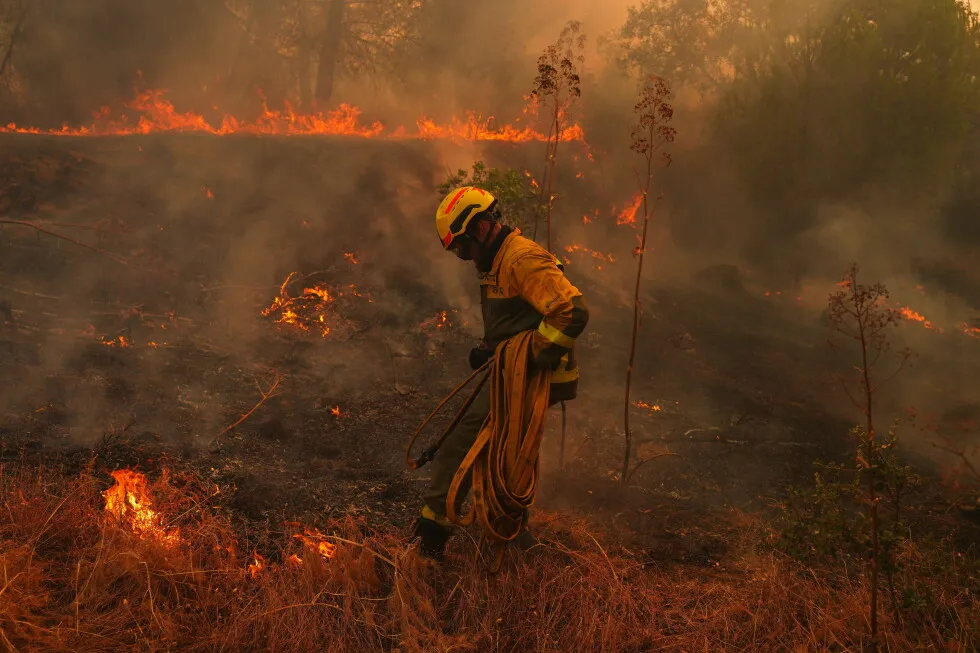
Associated Press (AP)FIG 01
Reading time
5min
Word count
1 110words
Sources cited
2cited
Entities identified
8entities
Quality score
100%
§ 01
Briefing Summary
AI-generatedNEWSAR · AI
Two new studies conclude that human-caused climate change significantly increased the likelihood of extreme fire weather in Spain and France. Scientists at World Weather Attribution calculated that climate change made the conditions for Spain's record inferno 20 times more probable and doubled the chances for fires in France. Over the past 26 years, warming has tripled the odds of severe fire risk in Spain and increased it by 40% in France. A separate study found that the number of extreme fire weather days in Southern Europe has more than doubled compared to previous decades, with these days now being about 50% more intense. These findings highlight that climate change is already contributing to more frequent and severe wildfires.
Confidence 0.90Sources 2Claims 5Entities 8
§ 02
Article analysis
Model · rule-basedFraming
Environmental
Human Interest
Tone
Mixed Tone
AI-assessed
CalmNeutralAlarmist
Factuality
0.90 / 1.00
Factual
LowHigh
Sources cited
2
Limited
FewMany
§ 03
Key claims
5 extracted01
Warming in the past 26 years increased fire risk chances in France by 40%.
statisticWorld Weather Attribution
Confidence
1.00
02
Warming in the past 26 years has tripled the odds of severe fire risk conditions in Spain.
statisticWorld Weather Attribution
Confidence
1.00
03
Human-caused climate change doubled the chances of extreme fire conditions for flames in France.
statisticWorld Weather Attribution
Confidence
1.00
04
Human-caused climate change made Spanish fires 20 times more likely.
statisticWorld Weather Attribution
Confidence
1.00
05
Climate change's fingerprints are all over extreme fire weather in Spain and France.
factual
Confidence
0.90
§ 04
Full report
5 min read · 1 110 words§ 05
Entities
8 identifiedKey playerOppositionContextPositiveNeutralNegative
Organizations1
Locations5
§ 06
Keywords & salience
9 termshuman-caused climate change
1.00
extreme fire weather
0.90
wildfires
0.80
spain fires
0.70
france fires
0.70
scientists
0.60
hot and dry conditions
0.50
southern europe
0.50
climate change studies
0.40
§ 07
Topic connections
Interactive graph Network visualization showing 51 related topics
View Full Graph Person Organization Location Event|Click node to navigate|Edge numbers = shared articles