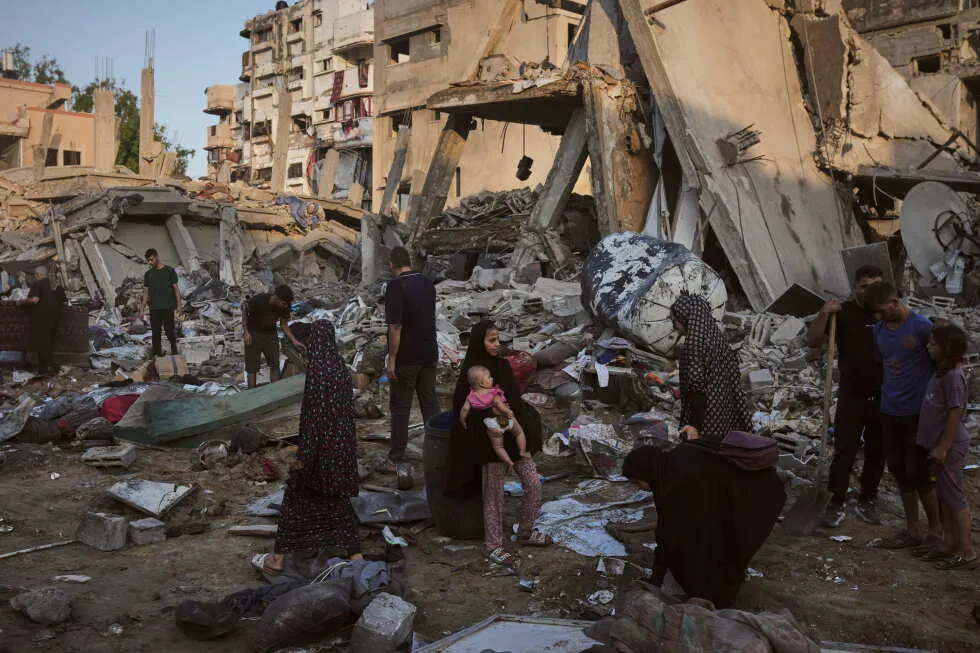
Trump announces a deal for Hamas to disarm in Gaza, but many hurdles and uncertainty remain 1 of 2 | Palestinians salvage their belongings from the rubble of a building and tents destroyed in an Israeli airstrike in Gaza City, Thursday, July 30, 2026. (AP Photo/Jehad Alshrafi) 2 of 2 | President Donald Trump arrives on Air Force One at Hagerstown Regional Airport, in Hagerstown, Md., en route to Camp David, Md., June 8, 2025. (AP Photo/Manuel Balce Ceneta, File) 1 of 2 | Palestinians salvage their belongings from the rubble of a building and tents destroyed in an Israeli airstrike in Gaza City, Thursday, July 30, 2026. (AP Photo/Jehad Alshrafi) 1 of 2 Palestinians salvage their belongings from the rubble of a building and tents destroyed in an Israeli airstrike in Gaza City, Thursday, July 30, 2026. (AP Photo/Jehad Alshrafi) Add AP News on Google Add AP News as your preferred source to see more of our stories on Google. Share 2 of 2 | President Donald Trump arrives on Air Force One at Hagerstown Regional Airport, in Hagerstown, Md., en route to Camp David, Md., June 8, 2025. (AP Photo/Manuel Balce Ceneta, File) 2 of 2 President Donald Trump arrives on Air Force One at Hagerstown Regional Airport, in Hagerstown, Md., en route to Camp David, Md., June 8, 2025. (AP Photo/Manuel Balce Ceneta, File) Add AP News on Google Add AP News as your preferred source to see more of our stories on Google. Share Updated [hour]:[minute] [AMPM] [timezone], [monthFull] [day], [year] WASHINGTON (AP) — President Donald Trump said Thursday that a deal has been reached for Hamas to disarm and Israel to withdraw its forces from Gaza, but many hurdles, conditions and long timelines remained to wind down the war in the Palestinian territory. Neither Hamas nor Israel gave immediate indication that they had agreed.The White House announcement comes nine months after a U.S.-brokered ceasefire was signed. Negotiations between Israel and Hamas had largely deadlocked over the implementation of its second phase, including the disarmament of Hamas and the reconstruction of Gaza.“The agreement will be carried out in carefully structured phases,” Trump said on social media. “As disarmament is completed, Israeli forces will withdraw, and the International Stabilization Force will work with a new Palestinian police force to take responsibility for Gaza being safe for its residents and its neighbors.”Trump’s 20-point ceasefire plan calls on the militant group to surrender its weapons and destroy its vast network of tunnels. It also envisions Israeli forces withdrawing from Gaza, the arrival of a new technocratic Palestinian government, deployment of an international security force and the rebuilding of the battered Palestinian enclave.Trump announced what he said was an agreement to realize one of the most difficult portions of the Gaza ceasefire while negotiations have stalled and military attacks have escalated in the war that the U.S. and Israel in February launched against Iran, a key sponsor of Hamas. Officials offer long or unspecific timelines for Hamas to disarmU.S. and Board of Peace officials, describing the deal to reporters on condition of anonymity under guidelines set by the White House, gave an extremely optimistic assessment of the agreement that laid out a scenario very similar to the one described by Trump and his top aides when the Board of Peace, an international body established by Trump to oversee the ceasefire in Gaza, was first formed. The officials were unable to offer specific timelines for the disarmament of Hamas or other groups that operate in Gaza, such as Palestinian Islamic Jihad, but said the Gaza police force would turn over weapons to the technocratic Board of Peace-backed Gaza administration in the next two weeks. The Gaza police force, however, does not include the vast majority of Hamas militants and heavy weaponry is not included in that part of the agreement, according to the officials.Instead, the surrender of heavy weapons and the decommissioning of Hamas tunnels and other infrastructure are to come later in a process that could take between 200 and 350 days, a Board of Peace official said. Israel has not responded but has been deeply skepticalA U.S. official said Israel, which has been deeply skeptical about Hamas’ willingness to give up its guns or relinquish at least behind-the-scenes control of Gaza, had been consulted at every step of the negotiation.However, the official said Israel was not being asked to do anything more than what it had initially committed to when it agreed to Trump’s 20-point plan, which essentially involves withdrawing its forces from Gaza and committing to ending airstrikes on the territory. The official said Trump would be “very, very disappointed” if Israel didn’t adhere to the agreement. Trump and Israeli Prime Minister Benjamin Netanyahu met at the White House on Tuesday, but neither said much about what was discussed in their first face-to-face meeting since launching the war against Iran.Israel’s U.N. Mission said it had no immediate comment.The official added that Iran remains a wildcard in the equation because although it counseled Hamas members not to accept a deal, it is also not in a position to offer the group much support because it is preoccupied with the conflict with the United States.Hamas previously had insisted on implementing the first phase of the ceasefire before moving to discuss its weapons. The group’s founding charter calls for armed resistance against Israel, and it has been reluctant to give up an arsenal, including rockets, anti-tank missiles and explosives, that lies at the heart of its identity.Hamas announced earlier this month, however, that it had dissolved its government in Gaza and was preparing to transfer power to a technical committee backed by the United Nations as part of the ceasefire deal. The war in Gaza began after the Hamas-led attack on southern Israel on Oct. 7, 2023, killed around 1,200 people and saw 251 taken hostage. Israel’s retaliatory offensive in Gaza has killed more than 73,000 Palestinians, including those killed since the ceasefire, Gaza’s Health Ministry said.Israel’s military now controls more than half of Gaza, leaving Palestinians confined to squalid tent camps and heavily damaged urban neighborhoods.___Cooper reported from Phoenix and Amiri from New York. Associated Press writer Edith M. Lederer contributed from the United Nations. Cooper is a national politics reporter based in Phoenix. He previously covered news and politics in Arizona, California and Oregon. Amiri covers foreign policy and the United Nations as a correspondent for The Associated Press, based in New York.
SRCAssociated Press (AP)
LANGEN
LEANCenter
WORDS1 074
ENT10
FRI · 2026-07-31 · 00:53 GMTBRIEF NSR-2026-0731-97701
NSR-2026-0731-97701News Report·EN·Conflict
Trump announces a deal for Hamas to disarm in Gaza, but many hurdles and uncertainty remain
President Donald Trump announced a deal for Hamas to disarm in Gaza and for Israeli forces to withdraw, though significant hurdles and long timelines remain. The White House statement comes nine months after a U.S.-brokered ceasefire, with negotiations previously stalled on Hamas's disarmament and Gaza's reconstruction.
By
JONATHAN J. COOPER, MATTHEW LEE and FARNOUSH AMIRIAssociated Press (AP)Filed 2026-07-31 · 00:53 GMTLean · CenterRead · 5 min
Associated Press (AP)FIG 01
Reading time
5min
Word count
1 074words
Sources cited
1cited
Entities identified
10entities
Quality score
100%
§ 01
Briefing Summary
AI-generatedNEWSAR · AI
President Donald Trump announced a deal for Hamas to disarm in Gaza and for Israeli forces to withdraw, though significant hurdles and long timelines remain. The White House statement comes nine months after a U.S.-brokered ceasefire, with negotiations previously stalled on Hamas's disarmament and Gaza's reconstruction. Trump's plan involves Hamas surrendering weapons and destroying tunnels, followed by Israeli withdrawal and the establishment of an international stabilization force with a new Palestinian police force. U.S. officials indicated that while the Gaza police force would transfer weapons within two weeks, the disarmament of Hamas militants and heavy weaponry would be a longer process, potentially taking 200-350 days. Israel has not yet commented, but has reportedly been consulted throughout the negotiations.
Confidence 0.90Sources 1Claims 5Entities 10
§ 02
Article analysis
Model · rule-basedFraming
Conflict
Diplomatic
Tone
Mixed Tone
AI-assessed
CalmNeutralAlarmist
Factuality
0.70 / 1.00
Factual
LowHigh
Sources cited
1
Limited
FewMany
§ 03
Key claims
5 extracted01
Trump's 20-point ceasefire plan includes Hamas surrendering weapons and destroying tunnels.
quoteDonald Trump
Confidence
1.00
02
The agreement will be carried out in carefully structured phases, with disarmament completed before Israeli forces withdraw.
quoteDonald Trump
Confidence
1.00
03
President Donald Trump announced a deal for Hamas to disarm and Israel to withdraw its forces from Gaza.
quoteDonald Trump
Confidence
1.00
04
Neither Hamas nor Israel gave immediate indication that they had agreed to the deal.
factual
Confidence
0.90
05
The war in Gaza was launched by the U.S. and Israel against Iran in February.
factual
Confidence
0.80
§ 04
Full report
5 min read · 1 074 words§ 05
Entities
10 identifiedKey playerOppositionContextPositiveNeutralNegative
Organizations3
Locations4
§ 06
Keywords & salience
10 termsgaza withdrawal
1.00
hamas disarmament
1.00
trump administration
0.90
israeli airstrike
0.80
palestinian territory
0.70
ceasefire plan
0.70
international stabilization force
0.60
new palestinian police force
0.50
war in gaza
0.50
negotiations
0.40
§ 07
Topic connections
Interactive graph Network visualization showing 51 related topics
View Full Graph Person Organization Location Event|Click node to navigate|Edge numbers = shared articles