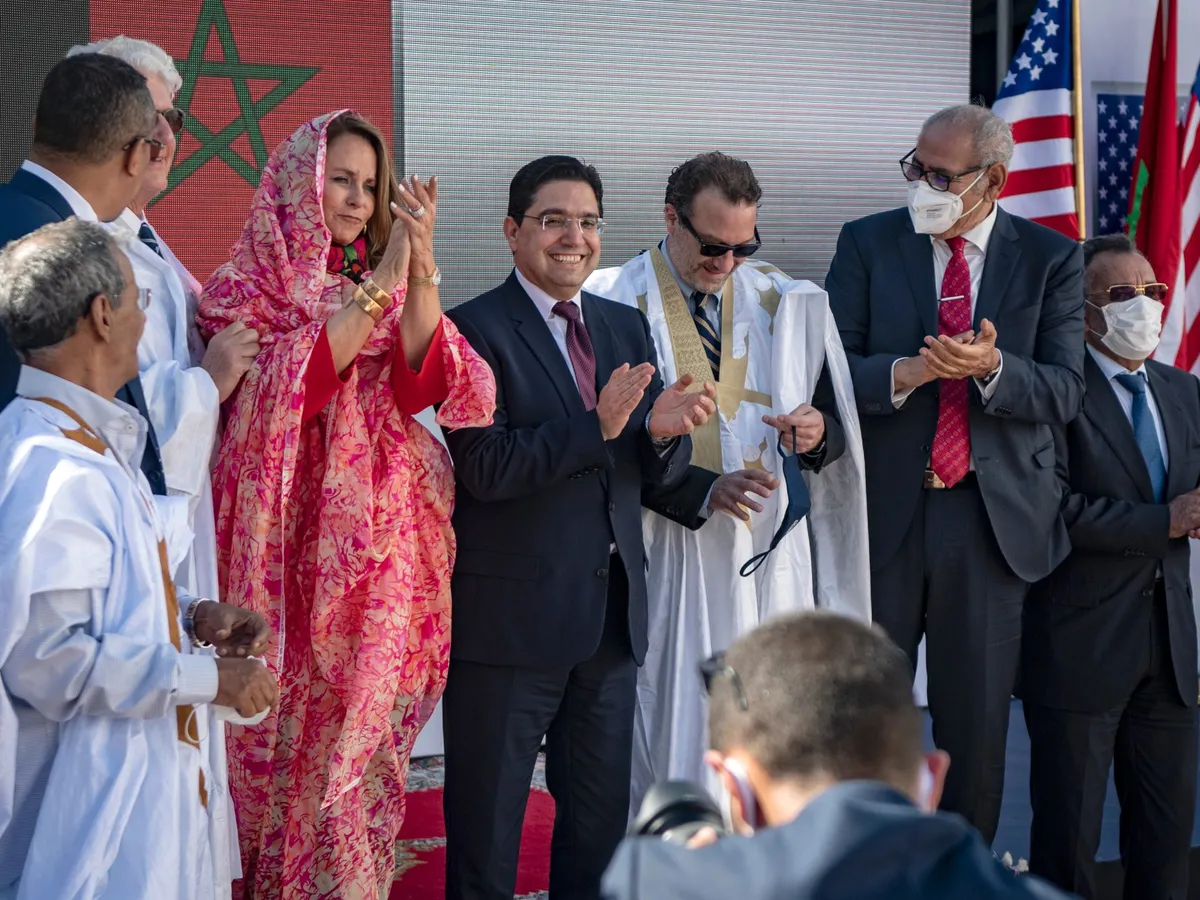
The claimed tribute to Trump forms part of Morocco’s larger ambitions in the disputed Western Sahara.The US officially recognised Morocco’s sovereignty over Western Sahara in December 2020 [File: AFP]Published On 31 Jul 2026The announcement by United States President Donald Trump that Morocco had named an important highway after him came as a surprise to many, not least because Rabat itself has remained silent.In a post on his Truth Social platform on Monday, Trump thanked Morocco’s monarch, King Mohammed VI, and said he looked forward to travelling on the “Great Highway one day”.Recommended Stories list of 4 itemslist 1 of 4Is Pakistan ‘using India’s playbook’ in Kashmir?list 2 of 4Why Mali’s northern conflict has entered a dangerous new phaselist 3 of 4Why Saudi Arabia holds the key to Palestinian statehoodlist 4 of 4Apartheid wealth cannot buy silence on Gazaend of listIf confirmed, however, experts say the gesture would be far from surprising. Morocco and the US have long enjoyed close ties, and both of Trump’s administrations were particularly beneficial for Rabat.Morocco was one of the signatories to the Trump-brokered Abraham Accords, which saw the country normalise relations with US ally Israel in 2020. In return, the Trump administration provided crucial support at the United Nations and through bilateral channels, bringing Rabat closer to securing greater control over the disputed territory of Western Sahara.“So absolutely, it makes perfect sense that Morocco would do something like this for Trump, who single-handedly moved that case forward – the only American administration to give Morocco what it always wanted, which is much clearer support on Western Sahara,” analyst Intissar Fakir of the Middle East Institute told Al Jazeera.What is more striking, she said, is the timing. The Trump administration sponsored a resolution endorsing Morocco’s position at the UN Security Council (UNSC) in October 2025. So why is the recognition coming now?“In my opinion, this is tied to Morocco’s ambitions to host the football final of the 2030 World Cup,” Fakir said, referring to the tournament that will be cohosted by Spain, Portugal and Morocco.Alternatively, she said, it may simply be that the section of the highway reportedly dedicated to Trump has only recently been completed.What is clear, however, is that the highway forms part of a broader network of infrastructure projects aimed at strengthening Morocco’s hold over the long-disputed territory, where an independence struggle has continued for five decades in what is widely regarded as a frozen conflict.A flag of the Sahrawi Arab Democratic Republic, proclaimed by the separatist Polisario Front, flies at a checkpoint manned by Sahrawi security forces outside a refugee camp, about 170km southeast of the Algerian city of Tindouf [File: Ryad Kramdi/AFP]A highway for Rabat’s ambitionsAfter a decade of construction, the Tiznit-Dakhla highway became fully operational in January.The 1,055km (655.5-mile) highway links southern Morocco with Mauritania and carries a price tag of about $1bn.It runs from Tiznit through Guelmim and Tan-Tan before reaching Laayoune, the main city in Morocco-controlled Western Sahara, and continues south to the Dakhla Peninsula, where Morocco is building the Dakhla Atlantic Port.Rabat has long sought to use its position between the Mediterranean and the Atlantic to establish itself as a regional trade gateway, connecting Europe with Africa and the Sahel through land and sea routes.Since 2023, Morocco has promoted what it calls the Atlantic Initiative, offering Atlantic port access to landlocked Sahel countries such as Mali, Burkina Faso and Niger.Between 2004 and 2024, African exports through Morocco rose from $300m to $3bn, according to the German think tank Konrad Adenauer Stiftung. Rabat was also among the first countries to sign the African Continental Free Trade Area agreement in 2018, giving it access to the continent’s tariff-free single market.The long-disputed territoryCrucially, the Trump Highway runs through Western Sahara, a UN-designated non-self-governing territory that Morocco calls its “southern provinces” and where it has invested heavily in roads, ports and other infrastructure over the past two decades.Analysts say those projects are part of a broader effort to strengthen Morocco’s hold over the disputed territory.Morocco claims the phosphate- and fisheries-rich former Spanish colony, while the Algeria-backed Polisario Front, which seeks independence for Western Sahara, declared the Sahrawi Arab Democratic Republic (SADR) after Spain withdrew in 1975.A 16-year war followed, forcing hundreds of thousands of Sahrawis to flee to refugee camps around Tindouf in western Algeria. UN humanitarian agencies estimate that about 173,600 Sahrawi refugees live in the camps, though Morocco disputes those figures and has long called on the UN to conduct a census there.In 1991, a UN-brokered ceasefire ended the fighting and was meant to pave the way for a referendum on self-determination. But disputes over voter eligibility and the terms of the vote left the process deadlocked.Some Sahrawi groups and Morocco’s critics have long accused Rabat of exploiting Western Sahara’s natural resources.“Over the years, we’ve documented growing investment, particularly in renewable energy, agriculture, fisheries and infrastructure,” Erik Hagen of Western Sahara Resource Watch (WSRW) told Al Jazeera.The territory’s phosphate reserves remain one of its most valuable assets. About 2 million tonnes of phosphate rock were mined in Western Sahara in 2025, according to WSRW.Al Jazeera requested comment from Moroccan authorities.Currently, the majority of the disputed territory is controlled by Morocco, while the Polisario Front controls a narrow strip along the borders with Algeria and Mauritania. Separating the two sides is a fortified sand barrier guarded by Moroccan soldiers.In November 2020, the Polisario Front, which continues to push for a referendum on self-determination, declared an end to the 1991 ceasefire and announced that it was resuming armed struggle against Morocco. A month later, on December 10, 2020, the Trump administration recognised Morocco’s sovereignty over Western Sahara, becoming the first Western government to do so.Washington reinforced that position in October 2025, when it sponsored a UNSC resolution calling for negotiations on Western Sahara to proceed on the basis of Morocco’s autonomy proposal.The proposal would grant the territory a degree of self-government while remaining under Moroccan sovereignty, an arrangement often compared with Spain’s autonomous regions such as the Canary Islands or Catalonia.A US-brokered path to peace?Algeria was among the most vocal critics of the UNSC resolution.Relations between Rabat and Algiers have long been tense. Algeria views support for the Sahrawi people in Western Sahara as a core principle of its foreign policy, shaped by its own bloody war of independence against French colonial rule.But Algiers is also competing with Morocco for influence in the Maghreb, and its backing of the Polisario Front gives it significant leverage over Morocco’s security calculations, analysts say.Morocco’s normalisation of relations with Israel in 2020 deepened tensions between the neighbours, and diplomatic relations remain severed.In 2024, France endorsed Morocco’s autonomy plan for Western Sahara and declared that the territory’s future should lie within the framework of Moroccan sovereignty, prompting Algeria to recall its ambassador from Paris.A possible indication of renewed diplomatic engagement came in February, when Washington said it had facilitated discussions in Madrid involving Morocco, the Polisario Front, Algeria and Mauritania over the implementation of a UN Security Council resolution on Western Sahara.US Africa envoy Massad Boulos reportedly led Washington-facilitated talks in Madrid and subsequent discussions in the US. He later told journalists that the conflict was “on the path to resolution”.
SRCAl Jazeera
LANGEN
LEANCenter
WORDS1 195
ENT12
FRI · 2026-07-31 · 02:31 GMTBRIEF NSR-2026-0731-97706
NSR-2026-0731-97706Analysis·EN·Political Strategy
Trump says Morocco named Tiznit-Dakhla highway after him: Why it matters
Former US President Donald Trump claimed Morocco named the Tiznit-Dakhla highway after him, a gesture experts suggest is linked to Morocco's ambitions in the disputed Western Sahara. The US officially recognized Morocco's sovereignty over Western Sahara in December 2020, a move that benefited Rabat's long-standing claims.
Shola LawalAl JazeeraFiled 2026-07-31 · 02:31 GMTLean · CenterRead · 5 min
Al JazeeraFIG 01
Reading time
5min
Word count
1 195words
Sources cited
1cited
Entities identified
12entities
Quality score
100%
§ 01
Briefing Summary
AI-generatedNEWSAR · AI
Former US President Donald Trump claimed Morocco named the Tiznit-Dakhla highway after him, a gesture experts suggest is linked to Morocco's ambitions in the disputed Western Sahara. The US officially recognized Morocco's sovereignty over Western Sahara in December 2020, a move that benefited Rabat's long-standing claims. The 1,055km highway, fully operational in January, runs through Western Sahara and is part of Morocco's broader infrastructure development aimed at strengthening its control over the territory. Analysts believe this naming, if confirmed, could also be tied to Morocco's bid to co-host the 2030 World Cup. The highway connects southern Morocco with Mauritania and is a key component of Rabat's strategy to become a regional trade gateway.
Confidence 0.90Sources 1Claims 5Entities 12
§ 02
Article analysis
Model · rule-basedFraming
Political Strategy
Diplomatic
Tone
Measured
AI-assessed
CalmNeutralAlarmist
Factuality
0.60 / 1.00
Mixed
LowHigh
Sources cited
1
Limited
FewMany
§ 03
Key claims
5 extracted01
Morocco officially recognized US sovereignty over Western Sahara in December 2020.
factualarticle
Confidence
1.00
02
Donald Trump claimed Morocco named the Tiznit-Dakhla highway after him.
factualDonald Trump
Confidence
1.00
03
Morocco normalized relations with Israel in 2020 as part of the Abraham Accords, with US support for Western Sahara in return.
factualarticle
Confidence
0.90
04
The Tiznit-Dakhla highway is part of Morocco's broader infrastructure projects to strengthen its hold over Western Sahara.
factualarticle
Confidence
0.90
05
The timing of the highway naming may be tied to Morocco's ambitions to host the 2030 World Cup.
predictionIntissar Fakir
Confidence
0.70
§ 04
Full report
5 min read · 1 195 words§ 05
Entities
12 identifiedKey playerOppositionContextPositiveNeutralNegative
People3
Locations5
§ 06
Keywords & salience
8 termsmorocco
1.00
western sahara
1.00
donald trump
0.90
abraham accords
0.80
us-morocco relations
0.70
2030 world cup
0.60
highway naming
0.50
united nations
0.40
§ 07
Topic connections
Interactive graph Network visualization showing 51 related topics
View Full Graph Person Organization Location Event|Click node to navigate|Edge numbers = shared articles